
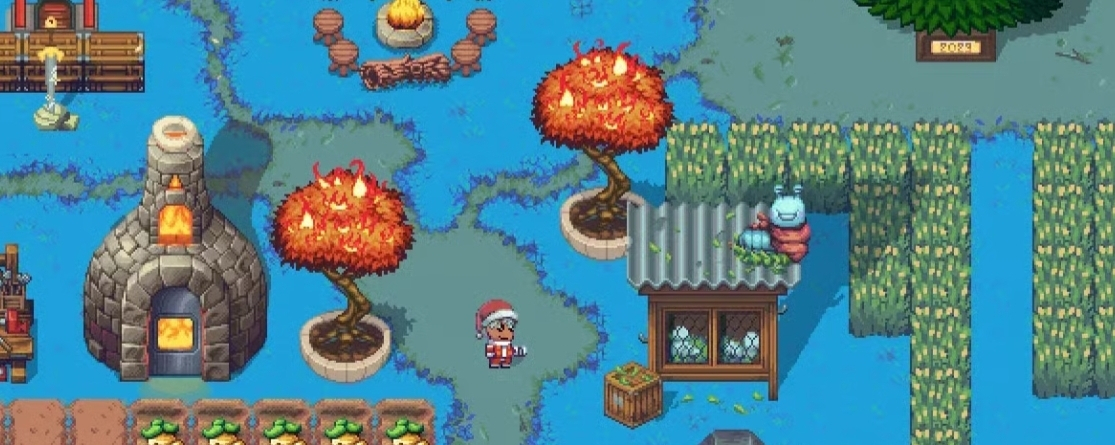

Let me start with something that feels obvious but still needs to be said… the more you follow official updates around Pixels, the clearer it becomes that this isn’t just a game anymore. It’s slowly turning into a collection of interconnected systems living inside a game shell. As we move toward 2026, Pixels feels less like a single experience and more like a layered ecosystem.
But here’s where it gets interesting from the outside, everything looks polished and well-structured. Inside, though, it’s not that clean. And that contrast is where most of the real story sits.
Now, if you look at the core, Chapter 3 is still the heart of everything. Farming, crafting, social loops all of it tries to simulate a living, breathing world. On the surface, it comes across like a soft casual game. Underneath, though, there’s a functioning economic loop. Players farm resources, convert them into items, and circulate them back through trading. That loop isn’t just gameplay it’s designed to sustain the token economy itself.
Step back a bit, and the scope widens. Pixels is no longer confined to one game. It’s becoming a broader gaming hub, with mini-games and partner integrations feeding into the same system. If you isolate it purely as a game, then a few core experiences still act as the lifeblood. But in reality, it’s already moving beyond that definition.
And that brings up the obvious question how stable is this structure?
There’s no clean answer. Systems like this only hold up when utility consistently outweighs speculation. Pixels is clearly moving in that direction, but it hasn’t fully reached that balance yet. Being ranked among the top Web3 games helps perception, but rankings in this space shift quickly. They don’t guarantee durability.
The real shift starts when you look at the ecosystem layer. This is where Pixels stops being self-contained. The token is no longer restricted to one environment it’s beginning to flow across different games. And that changes everything. The focus moves from improving a single gameplay loop to strengthening a broader game cycle.
Projects like Pixel Dungeons and Forgotten Runiverse highlight this shift. Different genres, different mechanics but tied together through a shared token flow. That idea of a cross-game currency is powerful, but also difficult to execute. Each game creates its own economic behavior. Demand in one place can easily translate into imbalance somewhere else. It turns the whole system into a continuous balancing act.
And complexity often leads to friction.
Then come the mini-games small on the surface, but more important than they look. Squish-a-Fish, Candy Chaos… they sound almost trivial at first 😂. But spend some time there, and you realize what they’re actually doing. These are retention engines. Short loops, quick engagement, easy re-entry. You start with one round, and suddenly you’ve been there for 40 minutes. In a system like this, retention isn’t optional it’s what keeps the entire economy alive.
Zoom out again, and you see where this might be heading. With things like the Realms scripting engine and NFT integrations, Pixels is clearly aiming beyond just content creation. It’s trying to become a platform. Supporting dozens of NFT collections isn’t just cosmetic it’s about building identity across the ecosystem and letting others plug into it.
Now you’re dealing with governance, developer incentives, economic coordination multiple layers that all need to align. This is where many projects slow down or break.
Then there’s the token itself.
The intention is clear shift PIXEL from an earning token into a utility-driven one. But in reality, a large part of the user base still operates with an “earn and exit” mindset. That gap between design and behavior is one of the biggest challenges. Because long-term economies don’t just depend on systems they depend on how people choose to use them. And that kind of behavior shift can’t be forced.
So where does that leave everything?
Right now, Pixels feels like it’s in transition. On one side, you have a growing ecosystem multiple games, integrations, NFTs, expanding layers. On the other, the economy itself is still stabilizing, still being tested in real time.
Both of these realities exist together.
At times, it genuinely feels like this could evolve into a new kind of gaming economy. At other moments, it raises a different question is this becoming too complex for its own good?
In the end, Pixels doesn’t feel like a finished product anymore. It feels like an ongoing system. And systems like this don’t resolve instantly they evolve over time.
If utility, design, and user behavior eventually align, this could turn into something meaningful.
If not, it may just remain what it already is today a very interesting experiment.