
I’ll be honest. When I first got into @Pixels I thought I had it figured out within a few sessions.
Log in
Farm fast
Craft
Claim rewards
Sell $PIXEL
Repeat
It felt efficient. It felt productive. Numbers were moving, progress looked visible, and like most Web3 games, it gave that early sense of “I’m doing this right.”
But after spending more time in the game, watching other players, and actually slowing down to understand what’s happening beneath the surface… that whole idea started to break.
Because @Pixels isn’t really rewarding speed anymore.
It’s rewarding structure.
THE PART MOST PLAYERS MISS
At a surface level, Pixels still looks like a farming and crafting game. You plant, harvest, build, upgrade. Nothing unusual.
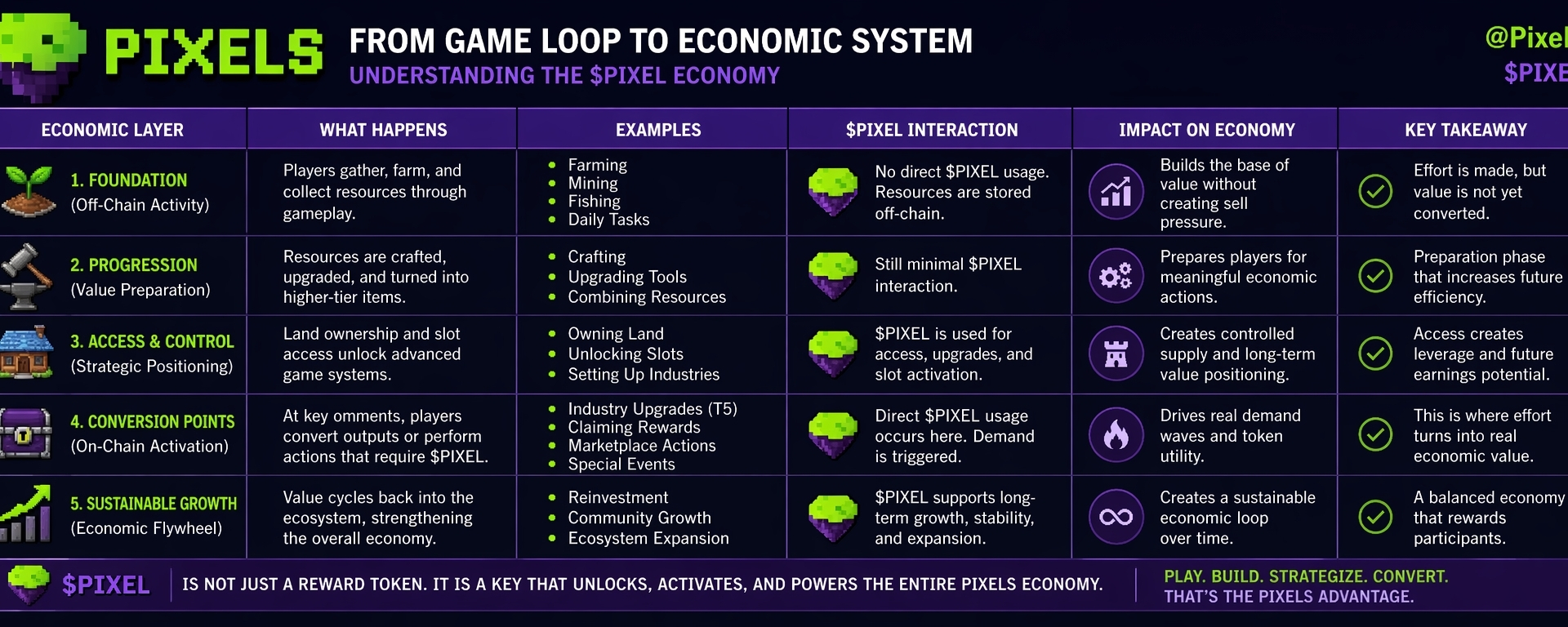
But the real system is happening in layers.
Most of what you do inside the game doesn’t immediately touch $PIXEL. That’s the key detail many people overlook. Farming, resource gathering, crafting basic items… all of this builds off-chain value first. It stacks quietly in the background.
There’s no instant token output for every action.
Instead, the game waits.
And only at certain points does that effort convert into something on-chain, something that directly interacts with $PIXEL.
That delay is not accidental. It’s design.
OFF-CHAIN FIRST, TOKEN LATER
This shift changes everything about how the economy behaves.
In older play-to-earn models, activity equals token output. The more you play, the more you earn, and the faster tokens enter the market. That’s why most GameFi economies collapse under sell pressure.
But @Pixels separates effort from reward timing.
You can play for hours, stack resources, and still not generate direct $PIXEL demand or supply until you hit a conversion point.
Those conversion points are where things matter:
• Upgrading industries
• Unlocking Tier 5 slots
• Using crafting systems that require $PIXEL
• Participating in certain economic actions
• Accessing advanced gameplay layers
This means $PIXEL demand doesn’t stay constant. It comes in waves.
And that’s a very different structure compared to traditional GameFi.
WHY TIER 5 CHANGES THE GAME
The introduction of Tier 5 industries is where this system becomes much more obvious.
Not everyone can just jump into T5. You need NFT land. You need slot access. You need preparation. And even then, your slots expire, which forces ongoing participation rather than one-time setup.
That alone changes behavior.
Players now have to think in terms of:
• Capacity management
• Resource planning
• Long-term positioning
• Timing upgrades vs selling
T5 isn’t just “higher rewards.” It’s controlled production.
And since these industries don’t compete with lower tiers for space, they create a separate layer of advantage. Landowners and strategic players can position themselves in a way that compounds over time.
It’s no longer about grinding harder.
It’s about playing smarter.
LAND IS NOT JUST OWNERSHIP, IT’S CONTROL
A lot of people still underestimate land in @Pixels.
They see it as passive income or just another NFT asset.
But in reality, land is becoming infrastructure.
When you own land, especially with higher-tier capabilities, you’re not just earning from your own activity. You’re enabling others to produce, craft, and interact within your ecosystem.
That creates a flow:
Players → Use land → Generate output → Owner earns a share
This is where the economy starts to resemble real systems instead of simple game loops.
Ownership becomes leverage.
And over time, that leverage compounds.
THE ROLE OF STACKED AND LIVE ECONOMIC CONTROL
Another layer that’s easy to miss is how the system behind the game is evolving.
Stacked, the live ops and reward engine, plays a major role here. It doesn’t just distribute rewards randomly or mechanically. It adjusts how and when value flows based on player behavior, engagement, and economic conditions.
That means the economy isn’t static.
It’s actively managed.
Rewards are not just given. They are timed, shaped, and influenced to maintain balance.
This reduces the classic problem of inflation where tokens flood the system without control.
Instead, Pixels leans toward controlled conversion.
WHY $PIXEL DOESN’T MOVE LIKE YOU EXPECT
A lot of traders come into Pixels expecting a direct relationship between player activity and token price.
More players = more demand
More farming = more usage
But that’s not exactly how it works here.
Because most activity is off-chain, increased gameplay doesn’t automatically create immediate demand for $PIXEL.
Demand only shows up when players hit those conversion layers.
So what you get is:
• Periods of low demand despite high activity
• Sudden spikes when players upgrade or convert
• Cooling phases when players return to accumulation
This creates a cyclical demand pattern instead of a linear one.
If you don’t understand this, the price action can feel disconnected from the game itself.
But once you see it, it makes sense.
FROM PLAYERS TO ECONOMIC PARTICIPANTS
What’s happening inside Pixels right now is a slow transition.
Players are turning into participants in an economy.
Your role is no longer just to play.
Your role is to decide:
• When to hold resources
• When to convert
• When to invest in upgrades
• When to expand capacity
• When to interact with $PIXEL
Those decisions define your outcome more than raw activity.
And that’s a big shift from where Web3 gaming started.
THE REAL DIFFERENCE
Most GameFi projects failed because they pushed tokens first and gameplay second.
Pixels is moving in the opposite direction.
Gameplay builds first
Value forms second
Token interaction comes later
That sequence matters.
Because it reduces unnecessary sell pressure and gives the token a more meaningful role.
Pixel is not just a reward.
It’s a key used at specific points in the system.
WHAT THIS MEANS GOING FORWARD
If you’re approaching pixels the same way you approached older play-to-earn games, you’re probably missing the real opportunity.
This isn’t about maximizing daily output anymore.
It’s about:
• Understanding conversion timing
• Positioning yourself within the system
• Leveraging land and industries
• Managing resources strategically
• Thinking long-term instead of session-based
The players who adapt to this will move ahead consistently.
Not because they play more, but because they understand the system better.
FINAL THOUGHT
Pixels is no longer just a farming game with a token attached.
It’s evolving into a controlled, layered economy where effort, timing, and structure define value.
Pixel sits at the center of that system, but it only activates when it matters.
And that’s exactly what makes this model different.
We’re not looking at another play-to-earn cycle here.
We’re watching the early stages of something closer to a real in-game economy being built step by step.
And honestly, that’s where things start getting interesting. #pixel