
I didn’t fully understand this idea until one random afternoon when I logged into Pixels with a very simple goal: just farm, sell, and log out. No curiosity, no excitement, no “let’s explore.” Just math.
I remember noticing that a specific crop had a decent margin. Nothing crazy, just consistent. So I did what anyone rational would do—I repeated the same loop over and over. Plant, wait, harvest, sell. At some point, a friend messaged me asking if I was enjoying the game. I paused for a second because I didn’t have a clean answer. I wasn’t bored, but I also wasn’t having fun in the way I would describe playing something like a traditional game. I was engaged, but not entertained.
And that moment stuck with me.
Because it revealed something uncomfortable: Pixels doesn’t actually need to be fun to work.
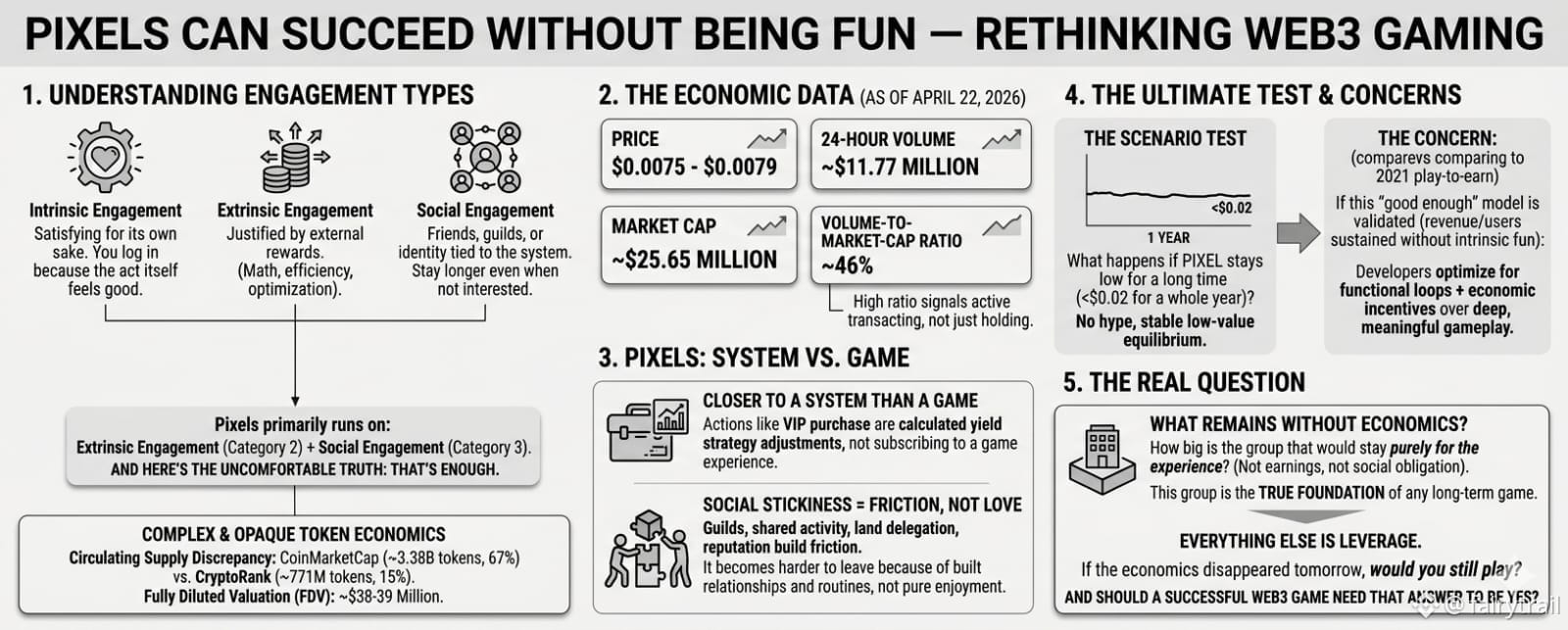
To understand why, I started thinking in terms of engagement types. Not all “playing” is the same. Some games survive because they are intrinsically satisfying. You log in because the act itself feels good. That’s category one. Then there’s extrinsic engagement, where the activity is justified by external rewards. That’s category two. And finally, social engagement, where you stay because your friends, guild, or identity are tied to the system. That’s category three.
Pixels, at least from what I’ve experienced and observed, runs primarily on category two and category three.
And here’s the uncomfortable truth: that’s enough.
If you look at the current state of the PIXEL token as of April 22, 2026, the numbers tell a story that aligns with this. The price sits around $0.0075 to $0.0079, with a 24-hour volume of roughly $11.77 million. That’s a massive volume relative to its market cap of about $25.65 million, creating a volume-to-market-cap ratio near 46%. That kind of ratio usually signals one thing: people are actively transacting, not just holding.
The fully diluted valuation hovers around $38 to $39 million, and depending on which data source you trust, circulating supply varies significantly. CoinMarketCap places it at about 3.38 billion tokens, roughly 67% of total supply, while CryptoRank suggests a much lower circulating figure of 771 million, or about 15%. That discrepancy alone tells you how complex and somewhat opaque token economics can be.
But the more important part isn’t the exact number. It’s the behavior.
People are still playing. Still trading. Still optimizing.
Not because the farming loop suddenly became revolutionary, but because the transaction still makes sense.
And I’ve felt this personally. I bought VIP once, not because I cared about any “premium experience,” but because I calculated that the increased coin generation would likely offset the cost. It felt less like subscribing to a game and more like adjusting a yield strategy.
That’s when it hit me: this is closer to a system than a game.
Now, to be fair, Pixels has done something smarter than earlier play-to-earn models like Axie Infinity. It has added layers of social stickiness. Guilds, shared activity, land delegation, reputation. These things matter. I’ve stayed in sessions longer simply because my friends were online, even when I wasn’t particularly interested in what I was doing.
But that creates a different kind of retention. Not love, but friction.
It becomes harder to leave, not because you’re deeply enjoying yourself, but because you’ve built something. Relationships, routines, maybe even identity.
And friction can sustain a system for a long time.
But not forever.
What really concerns me isn’t Pixels itself. It’s what happens if this model is validated as “good enough.”
Because if a game can generate revenue, maintain users, and sustain its ecosystem without needing strong intrinsic engagement, then developers are naturally going to optimize for that. Why spend years crafting deep, meaningful gameplay when you can design a functional loop, attach economic incentives, and achieve similar financial outcomes?
We’ve seen this before. In 2021, many play-to-earn projects thrived without being good games. They were economic engines wrapped in game-like interfaces. When rewards were high, users flooded in. When rewards dropped, they left just as quickly.
Pixels is more resilient, but it hasn’t faced the ultimate test yet.
That test is simple in theory but brutal in practice: what happens when PIXEL stays low for a long time?
We’ve already seen the token fall from an all-time high of $1.02 in March 2024 to current levels, representing a drop of over 99%. It even hit a low of $0.0045 earlier this year before recovering slightly. But despite this, activity hasn’t completely disappeared.
That’s interesting.
But it’s not conclusive.
Because the system is still influenced by expectations. People are still thinking about potential upside, future updates, possible recoveries. Speculation hasn’t fully died; it’s just quieter.
I keep thinking about a scenario where PIXEL stays below $0.02 for an entire year. No hype, no narrative shifts, no external catalysts. Just stable, low-value equilibrium.
Would I still log in every day?
Honestly, I’m not sure.
I might log in occasionally to check things, maybe chat with friends, maybe run a quick loop if it feels efficient. But the urgency, the consistency, the “I need to optimize this” mindset—that would likely fade.
And I suspect I’m not alone.
That’s the real question hanging over Pixels: how big is the group that would stay purely for the experience?
Not the earnings. Not the social obligation. Just the game itself.
Because that group is the true foundation of any long-term game.
Everything else is leverage.
So I’m curious how others see this.
If the economics disappeared tomorrow, would you still play?
And more importantly, should a successful web3 game need that answer to be yes?