I have started paying more attention to what a system removes than what it adds.
New features are easy to celebrate.
New rewards are easy to notice.
New loops are easy to explain.
What interests me more now is the moment a project looks at an old part of its economy and decides it no longer wants that part carrying the same weight. That is usually where the real priorities become visible.
That shift changed the way I look at Pixels.
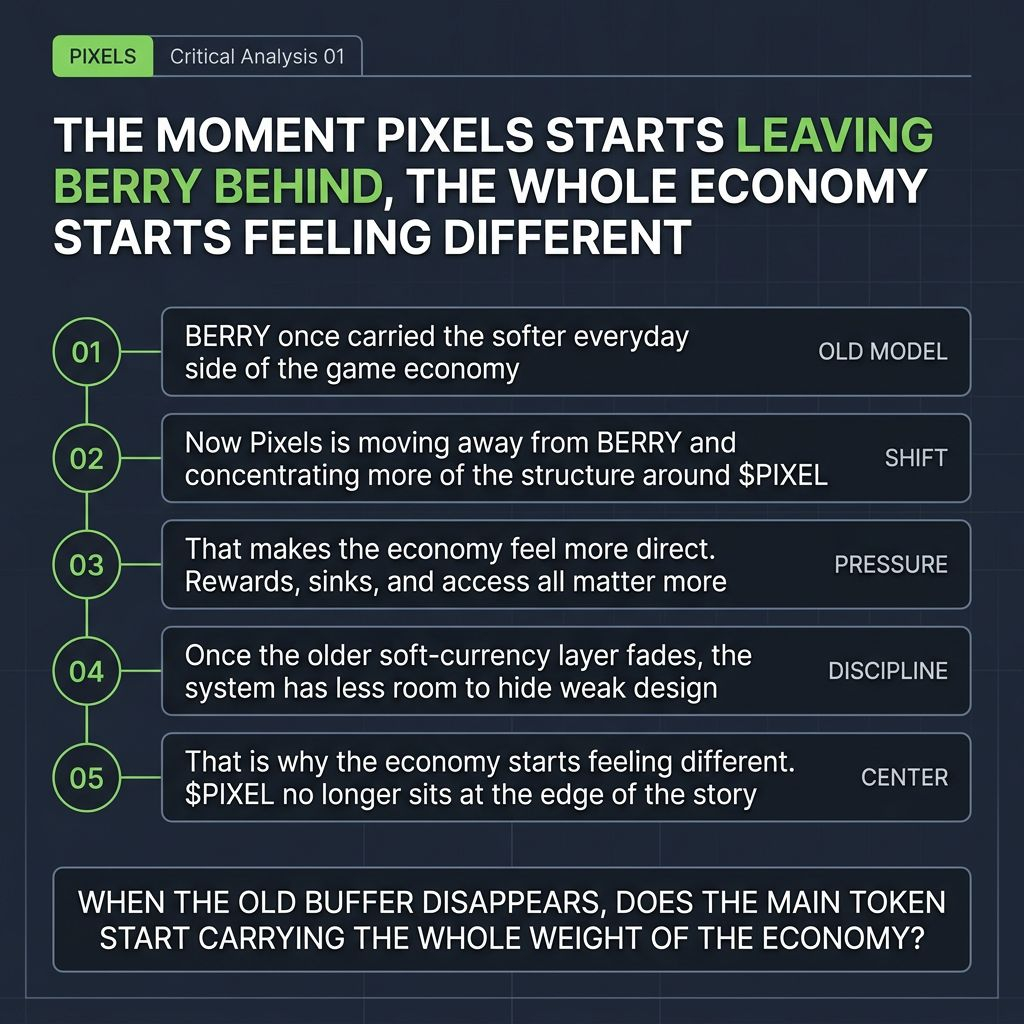
For a long time, the easiest way to understand Pixels was through its older two-token logic. In the older official whitepaper, $BERRY was framed as the primary in-game soft currency used for progression and core gameplay, while $PIXEL was framed as the premium currency used for things outside the core loop, such as speeding up builds, boosting energy, unlocking skins, minting land, and buying special items. In that earlier structure, BERRY carried the everyday economy, and PIXEL sat closer to premium access and controlled demand.
That older split matters because it makes the newer shift much more meaningful.
Pixels’ official FAQ now says the team has evolved how it thinks about tokens in-game, made the strategic decision to focus on $PIXEL, and to phase out $BERRY. The same FAQ says all BERRY holders will be rewarded with PIXEL in proportion to their BERRY holdings, and explains the transition by pointing to BERRY’s roughly 2% daily inflation and the desire to build a more sustainable ecosystem without the complications of managing an on-chain soft currency.
That is not a small adjustment to me.
Because once a project starts leaving the old soft currency behind, the economy stops feeling padded. It stops feeling like one token can absorb the mess while the other carries the brand, the scarcity, or the premium layer. The whole structure starts feeling more exposed. More direct. More accountable. That is my reading of the shift, but it is grounded in the fact that Pixels is explicitly moving away from the inflationary BERRY model and concentrating its design around PIXEL.
And that is where the project started feeling heavier to me.
The reason is simple. When a game keeps a soft currency in front doing the everyday work, it can delay harder questions. It can spread pressure across multiple layers. It can let the core experience run on one asset while another captures the more premium or strategic side. But once that structure starts collapsing into a stronger PIXEL focus, the economy has less room to hide its weaknesses. Reward design matters more. Sinks matter more. Access matters more. Retention matters more. Because the token at the center is no longer protected by a second layer doing the dull work underneath.
That difference matters to me.
And it matters even more when I look at where PIXEL already sits inside the game. The official Task Board page says the Task Board is the primary method used to earn $PIXEL and Coins within the game, and also says it is the only way to earn $PIXEL within the game. It refreshes every 24 hours, new tasks appear after completion, and getting PIXEL tasks is not guaranteed on a given day. The same page says VIP and land ownership can increase the chance of getting PIXEL tasks.
That changes the way I read the transition.
Because if BERRY fades and PIXEL becomes more central, then the path into value starts looking more structured than before, not less. PIXEL is not just “the token” in an abstract way. It is already tied to selective opportunity. Not every player gets the same reward path in the same rhythm. Not every session carries the same economic weight. The system is already deciding how PIXEL appears, how often it appears, and under what conditions it becomes accessible.
That is where the whole economy starts feeling different to me.
Then the VIP layer makes that picture even clearer. Pixels’ official VIP page says VIP costs about $10 per month in PIXEL and includes benefits such as 1,500 reputation points, 3 extra Task Board tasks, VIP-only tasks, 5 extra marketplace listing slots, and other convenience benefits. Once I place that next to the Task Board structure, PIXEL no longer looks like a premium extra sitting politely at the edge of the experience. It starts looking like a token that is increasingly shaping how smoothly a player moves through the economy.
That is a very different kind of story.
A lot of people still talk about game tokens as if the main question is whether they exist, whether they are tradable, or whether they have enough utility bullets attached to them. I think that reading is too shallow here. The more interesting question is what happens when the old soft-currency cushion starts disappearing and the main token has to carry more of the system’s seriousness on its own.
That is the real test.
Because once PIXEL becomes more central, the design standard gets stricter. Rewards cannot just be noisy. They have to be justified. Access cannot just be flat. It has to be structured. Spending cannot just look useful. It has to support the loop without distorting it. And if the project gets this wrong, the weakness becomes harder to hide because the economy is no longer spread across a softer inflationary layer in the same way.
That is why the shift away from BERRY feels important to me.
It forces a clearer reading of what Pixels is trying to become.
Even the historical contrast makes that obvious. Older archived updates show BERRY once had visible centrality inside the game, including BERRY booths, deposit and withdrawal functions, and even a “BERRY Millionaire” leaderboard. That older world made BERRY feel culturally and economically embedded in the visible life of the game. The current official direction moves away from that model entirely. That is not just a token change. It is a statement about what kind of economy the team wants to defend going forward.
And to me, that is where Pixels starts looking more serious.
Not because it added another feature.
Not because it found another reward mechanic.
Not because it can still tell a familiar farming story.
Because the moment it starts leaving BERRY behind, the whole economy is forced to show what it really believes about sustainability, access, and value.
That is the part I keep coming back to.
A soft currency can keep an economy moving.
A more central token has to justify why the economy deserves to move that way at all.
That difference matters.
Because once the old buffer starts disappearing, PIXEL is no longer just part of the story.
It starts carrying the weight of the story itself.