
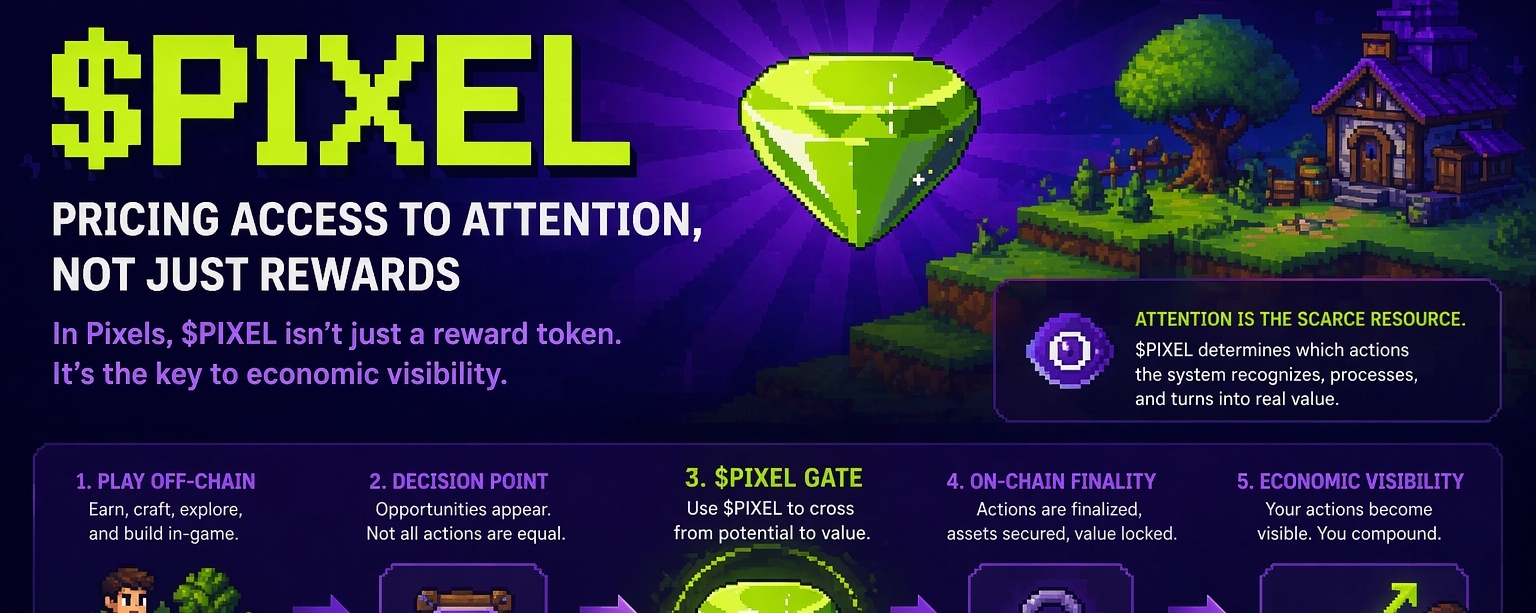

I didn’t really notice it at first. Pixels just felt… busy. Farms moving, trades happening, people grinding like they always do in these systems. You look at it quickly and it reads like any other game economy trying to keep players engaged long enough to matter.
But after a while, something starts to feel off. Not broken. Just slightly uneven.
You can spend hours doing the same loops as everyone else, yet the outcomes don’t line up. Some players seem to consistently land in better positions. Not necessarily more skilled, not even more active. Just… better placed when it counts. I kept thinking it was randomness. Or maybe timing. But it doesn’t fully explain it.
That’s where I started rethinking what $PIXEL is actually doing.
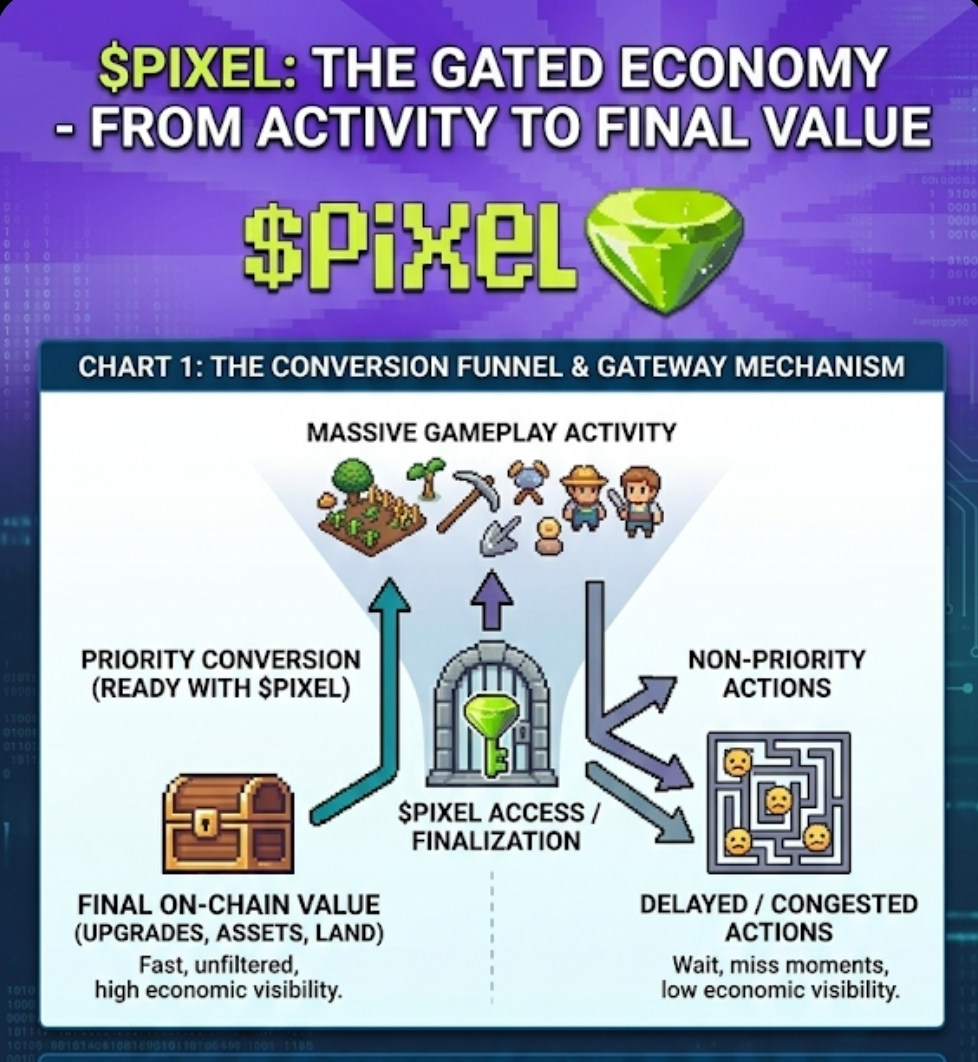
On paper, it’s simple. You play off-chain, earn, then use $PIXEL when you want to finalize something that matters. Upgrade assets, secure land, interact with the deeper economic layer. Standard design. Plenty of projects separate cheap activity from expensive finality.
Still, the gap between those two layers feels wider than it should.
Most of the time, players are operating in a kind of background mode. Farming, crafting, moving resources around. It’s fluid, almost frictionless. Nothing really forces a decision. But the moment something meaningful shows up, limited supply, a valuable upgrade, a time-sensitive opportunity, the system tightens. Suddenly it’s not about activity anymore. It’s about who can act without hesitation.
And that’s where Pixel quietly steps in.
Not as a reward. More like a pass.
If you have it ready, you move. If you don’t, you wait, or worse, you miss the moment entirely. It’s subtle, but over time it stacks. The same players keep showing up at the exact points where value locks in. Not because they worked harder in that moment, but because they were already positioned to convert.
I’ve seen this before, just not framed like this inside a game.
In markets, access usually matters more than effort. Traders with better liquidity don’t just make more trades, they take the trades that matter. They’re present when spreads tighten, when opportunities appear for a few seconds. Everyone else is technically participating, but not really competing.
Pixels is starting to feel similar.
The strange part is that the system doesn’t advertise it this way. It still looks open. Anyone can play, anyone can earn, anyone can participate. And that’s true, at least on the surface. But once you watch closely, you notice that not all actions carry the same weight. Some just circulate inside the system. Others get pulled upward and turned into something final.
Pixel seems to sit right at that boundary.
It doesn’t decide what you do. It decides whether what you did actually counts.
That distinction is uncomfortable, because it shifts how you think about “fairness” in the economy. If rewards were purely tied to effort, the system would eventually flatten out. Everyone optimizing the same loops, returns compressing, nothing really standing out. But if the system is filtering which actions become visible or finalized, then scarcity moves somewhere else.
Not into resources. Into attention.
And not the social kind. System attention. Which actions the economy recognizes, processes, and locks into value.
I’m not even sure this was fully intentional. It might just be what happens when you mix off-chain scale with on-chain constraints. You need some way to decide what crosses over. You can’t finalize everything. It would be too expensive, too noisy, too chaotic.
So a gate forms. And once there’s a gate, something has to price access to it.
That’s where Pixel starts behaving differently from typical game tokens.
It’s less about how much you earn, more about when you’re allowed to matter.
There’s a practical side to this. It keeps the economy from collapsing under its own activity. Not every action needs to hit the blockchain. Not every player needs to convert at the same time. It introduces pacing, structure, a kind of economic rhythm that wouldn’t exist otherwise.
But it also creates drift.
Players figure things out. They always do. Once it becomes clear that conversion points are where real value happens, behavior shifts. Less wandering, more targeting. Less experimentation, more optimization. People stop playing the system casually and start approaching it like a series of checkpoints.
That’s where things can get fragile.
If too many players converge on the same moments, the advantage of being early or prepared becomes even more important. Those who already hold $PIXEL, or understand when to deploy it, start compounding their position. Not aggressively, just quietly. Over time.
New players still enter, still play, still generate activity. But their actions don’t always translate into the same level of economic visibility. They’re present in the system, but not always present where it matters.
And that gap is hard to see if you’re only looking at surface metrics.
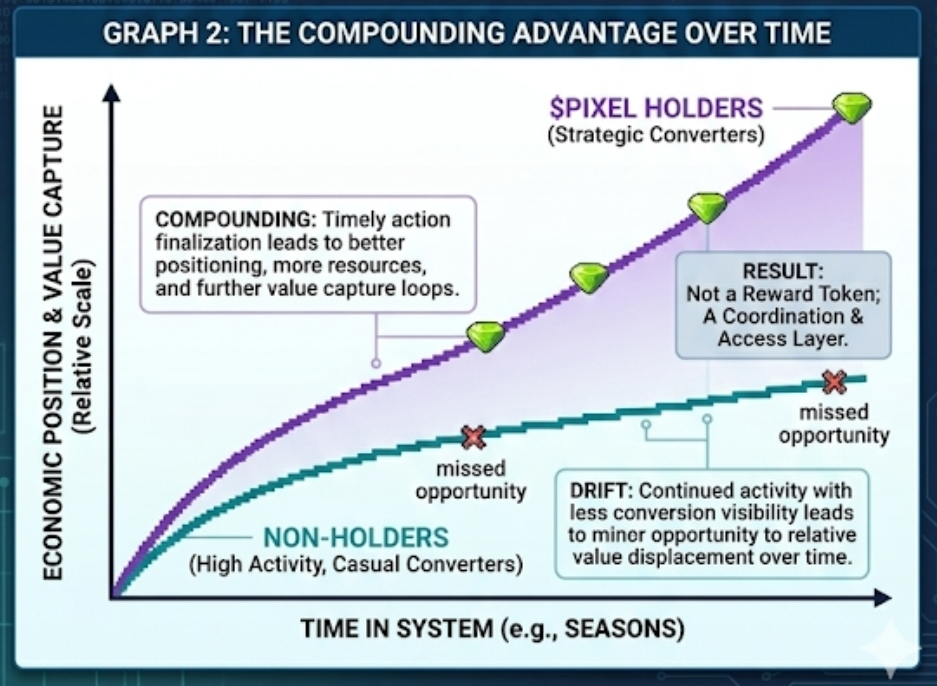
Player count can grow. Activity can increase. The world can feel alive. Meanwhile, the actual points where value crystallizes remain selective, maybe even more selective over time.
That’s why I hesitate to call Pixel just a reward token now. It feels closer to a coordination layer. Something that sits between effort and outcome, deciding which actions pass through cleanly and which ones stay in the background.
I don’t think the market is fully pricing that yet. Most narratives still revolve around growth, engagement, user numbers. The usual playbook. But if this system continues to evolve in this direction, those metrics might not tell the full story.
The real signal might be something harder to measure.
Who consistently shows up at the exact moment when the system turns activity into value… and who doesn’t.