
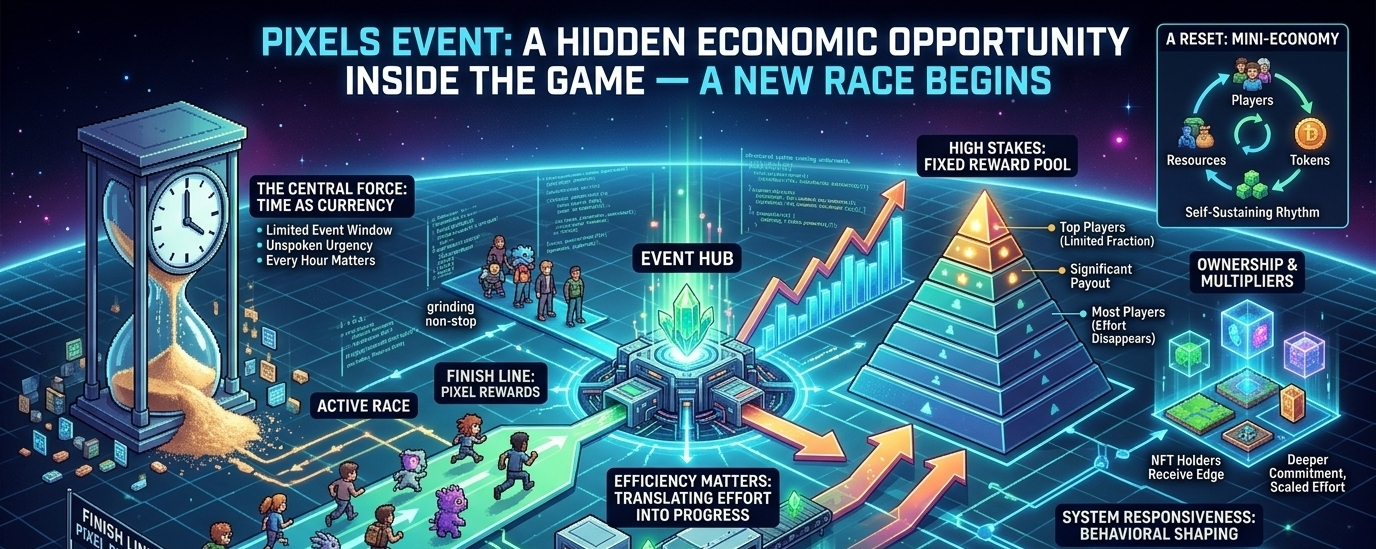
@Pixels I didn’t think much of it at first when the new Pixels event went live today, but the longer I stayed in it, the more it started to feel like something beyond just another in-game activity. On the surface, it’s simple and familiar—complete tasks, collect items, move up the leaderboard, and aim for a share of the PIXEL rewards at the end. But once you settle into it, there’s this subtle shift that happens in your mindset. It stops feeling like casual gameplay and slowly turns into something that demands attention, timing, and awareness. You’re not just playing anymore—you’re participating in something that feels structured, almost like a system quietly running underneath everything.
What really changes the experience is how time suddenly becomes the central force. From the very beginning, there’s this unspoken urgency. The event has a clear window, and every hour feels like it matters. If you delay, even slightly, it feels like the gap between you and others starts widening. And if you jump in early, you don’t just play—you commit. It creates this strange pressure where you’re constantly aware of the clock, not because the game tells you to rush, but because you can feel the consequences of slowing down. That’s when it stops being passive entertainment and starts feeling like an active race you didn’t fully realize you signed up for.
The way effort is translated into progress is where things get even more interesting. Items like Green Stones or gacha cards aren’t just rewards anymore—they feel like reflections of your activity, almost like physical evidence of the time you’ve invested. That time turns into points, and those points define where you stand. It creates a direct connection between how much you put in and what you get out of it, but it’s not always straightforward. You start thinking about efficiency, about routes, about whether you’re using your time in the best possible way. Every small action begins to carry weight.
Then there’s the reward system, which quietly raises the stakes. A fixed pool of tokens spread across a limited number of top players changes the entire dynamic. It’s no longer about simply participating—it’s about positioning yourself high enough to matter. Only a small fraction will actually walk away with something meaningful, and that reality sits in the back of your mind the entire time. The difference between ranks isn’t just numbers on a board—it feels like the difference between effort paying off or disappearing unnoticed.
Ownership adds another layer that you can’t ignore. Players with NFTs receive multipliers, meaning their effort scales differently compared to others. At first, it might seem uneven, but it also introduces a deeper sense of commitment into the system. It rewards those who are more embedded in the ecosystem, not just those who show up temporarily. That small shift changes how you view participation—it’s no longer just about what you do, but also about what you hold and how connected you are to the environment itself.
But what really stays with me is how all of this starts shaping behavior. It’s not just about completing tasks anymore—the system seems to respond to how you approach them. Your consistency, your timing, your decision-making patterns—they all start to matter. And at some point, you realize that the game isn’t just tracking your actions, it’s reflecting your efficiency. That’s when the line between game and system begins to blur. It stops being just about fun and starts becoming something that feels calculated, even if you didn’t intend it to.
Still, despite all of this, there’s something genuinely engaging about the experience. It’s not perfectly balanced, it’s not entirely predictable, and maybe that’s exactly why it works. Everyone is approaching the same structure differently—some are grinding non-stop, some are trying to outthink the system, and others are just going with instinct. Not everyone will succeed, and a lot of effort might not lead to rewards, but that uncertainty is what keeps everything moving.
It doesn’t feel like the core gameplay has changed dramatically, but the way it’s experienced definitely has. The loop feels tighter, more intense, and more meaningful. It’s no longer just about logging in and playing—it’s about navigating something that quietly pushes you to be better, faster, and more aware.
And maybe that’s what makes this event stand out. It doesn’t feel like just another feature—it feels like a reset, like a small economy coming back to life and running on its own rhythm. Winning or losing almost feels secondary compared to watching how everything unfolds. Seeing how players adapt, compete, and evolve inside the same space becomes part of the experience itself.
It’s a little chaotic, a bit overwhelming at times, but there’s something real about it. From the outside, it still looks like a simple play-to-earn event. But once you’re inside, it feels like a constant interaction between time, effort, and strategy—and that balance is what makes it hard to step away from.