
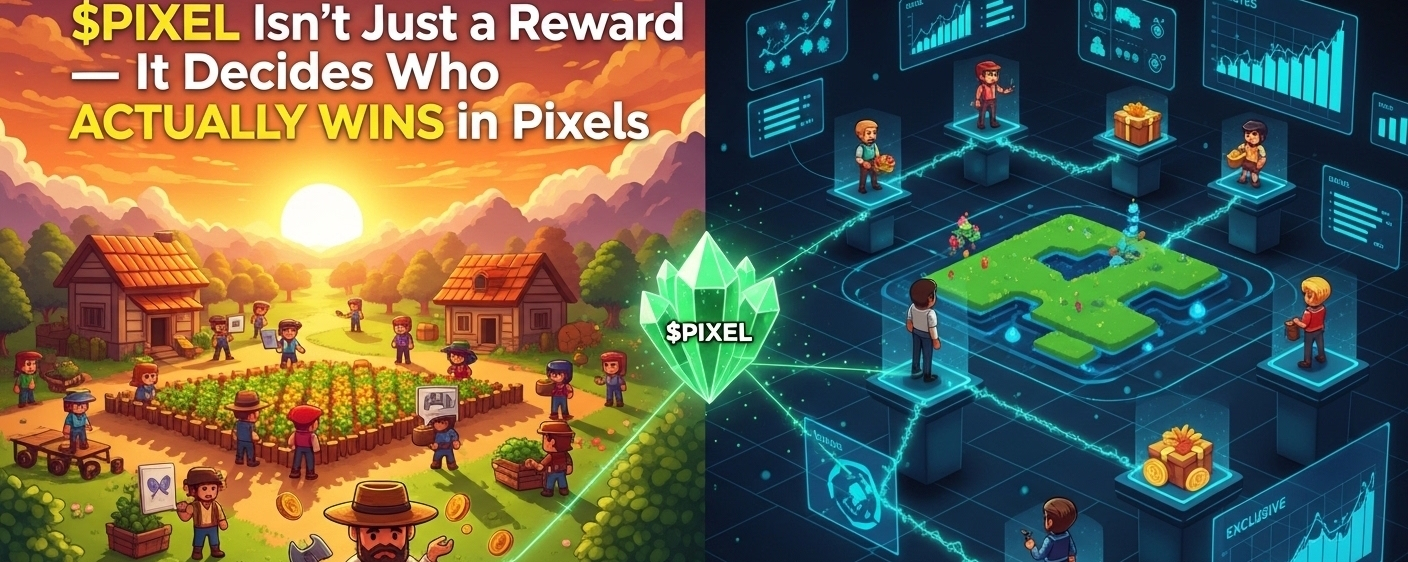
At first glance, Pixels looks like any other busy game economy. Farms are running, trades are happening, and players are grinding through familiar loops. It feels active, even fair. Everyone seems to be participating in the same system, putting in time and effort to move forward. But the longer you watch, the more you start to notice something subtle the outcomes don’t always match the effort.
Some players consistently end up in better positions. It’s not always about skill or even activity. They just seem to be present at the exact moments that matter. At first, it’s easy to blame randomness or timing, but that explanation doesn’t fully hold up. There’s something deeper shaping these results.
That’s where PIXEL begins to reveal its real role.
On the surface, the design is simple. Most gameplay happens off-chain players farm, craft, and trade without much friction. Then, when something important comes up, like upgrading assets, securing land, or locking in value, Pixel is required. This separation between low-cost activity and high-value final actions isn’t new. Many systems use it to stay efficient.
But in Pixels, the gap between these two layers feels more significant than expected.
For most of the time, players operate in a smooth, almost effortless environment. They can keep playing without making major decisions. But the moment a high-value opportunity appears something limited, time-sensitive, or competitive everything changes. The system suddenly favors those who can act instantly.
And that’s where PIXEL quietly becomes powerful.
It doesn’t function just as a reward. It works more like access. If you already have $PIXEL ready, you can move immediately. If you don’t, you hesitate or worse, you miss the opportunity completely. Over time, this creates a pattern where the same players keep capturing the most important moments, not because they worked harder at that exact point, but because they were already prepared.
This dynamic isn’t new it closely resembles how financial markets behave. In trading, access often matters more than effort. Those with better liquidity don’t just participate more; they capture the opportunities that actually matter. Others are present, but they’re not truly competing at the same level.
Pixels is starting to reflect that structure.
What makes it interesting is that the system doesn’t openly present itself this way. It still appears open and inclusive. Anyone can join, play, and earn. And technically, that’s true. But when you look closely, not all actions carry equal weight. Some actions remain within the system, while others get elevated into real, finalized value.
$PIXEL sits exactly at that boundary.
It doesn’t control what you do it determines whether what you did actually counts.
This changes how fairness in the game is perceived. If rewards were purely based on effort, outcomes would eventually balance out. But when a system filters which actions become meaningful, scarcity shifts. It’s no longer just about resources it’s about access to recognition within the system itself.
In a way, PIXEL becomes a form of “system attention.” Not social attention, but economic attention deciding which actions are processed, prioritized, and locked into value.
This might not even be fully intentional. It could simply be the result of combining off-chain scalability with on-chain limitations. Not every action can be finalized on-chain it would be too costly and chaotic. So naturally, a filter emerges. And once there’s a filter, something has to control access to it.
That’s where PIXEL evolves beyond a typical game token.
It’s no longer just about how much you earn it’s about when you’re allowed to matter.
There are benefits to this structure. It prevents the system from collapsing under too much activity and introduces a natural rhythm to the economy. Not everything needs to be finalized at once, and not every player needs to act at the same time.
But it also introduces imbalance.
Players quickly adapt. They begin to focus less on casual exploration and more on targeting key moments. The system shifts from open-ended gameplay to strategic checkpoints. And when too many players aim for the same opportunities, preparation becomes everything.
Those who already hold PIXEL or understand when to use it slowly build an advantage. Not aggressively, but consistently. Meanwhile, new players may still participate and stay active, but their actions don’t always translate into meaningful outcomes.
From the outside, everything still looks healthy. Player numbers grow, activity increases, and the world feels alive. But the real value the moments where effort turns into something lasting becomes more selective over time.
That’s why it’s becoming harder to describe PIXEL as just a reward token.
It feels more like a coordination layer something that sits between effort and outcome, quietly deciding which actions move forward and which stay in the background.
And this is where the real question begins.
If the system continues evolving in this direction, traditional metrics like user growth and engagement might not tell the full story. The more important signal may be harder to measure who consistently shows up at the exact moment when the system converts activity into value… and who gets left behind.
