
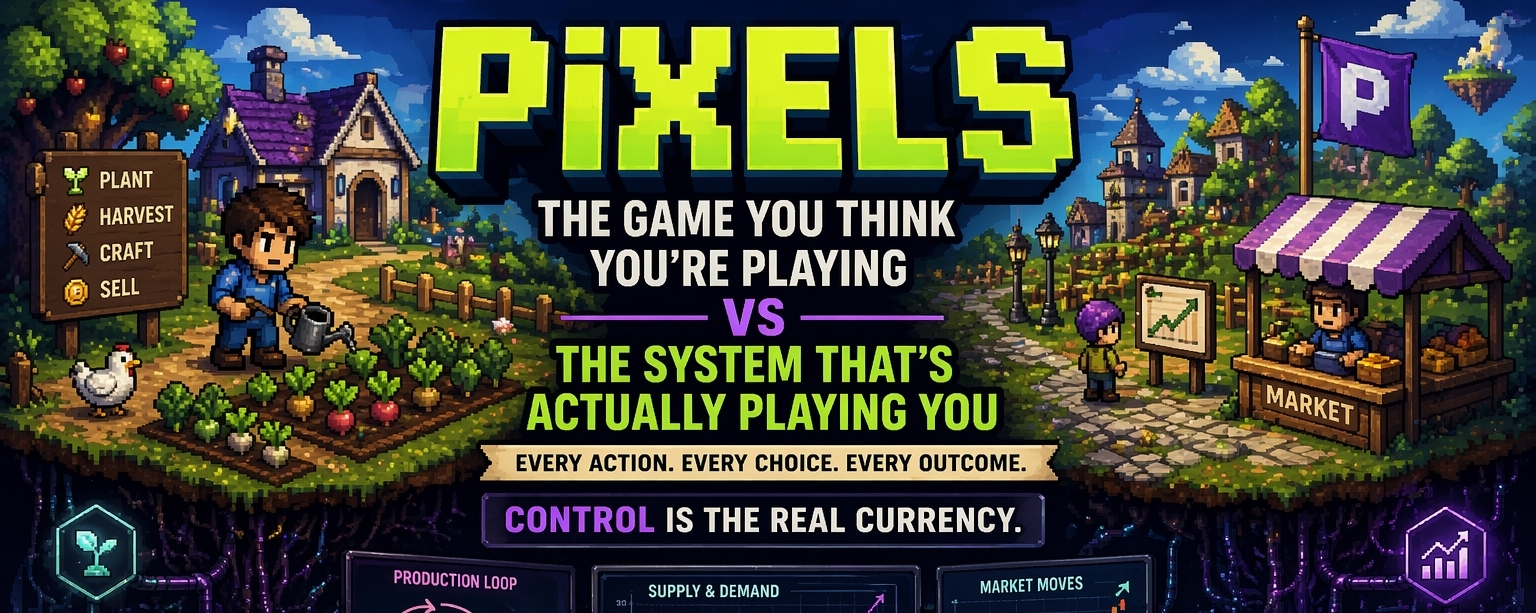
Look, people walk into Pixels (PIXEL) thinking it’s just a chill farming game.
Plant some crops.
Harvest.
Wander around a bit.
Relax, right?
Yeah… not really.
That’s just the skin.
Underneath, something else is running. And once you notice it, it’s hard to ignore.
Here’s the thing.
This isn’t really a “game loop.”
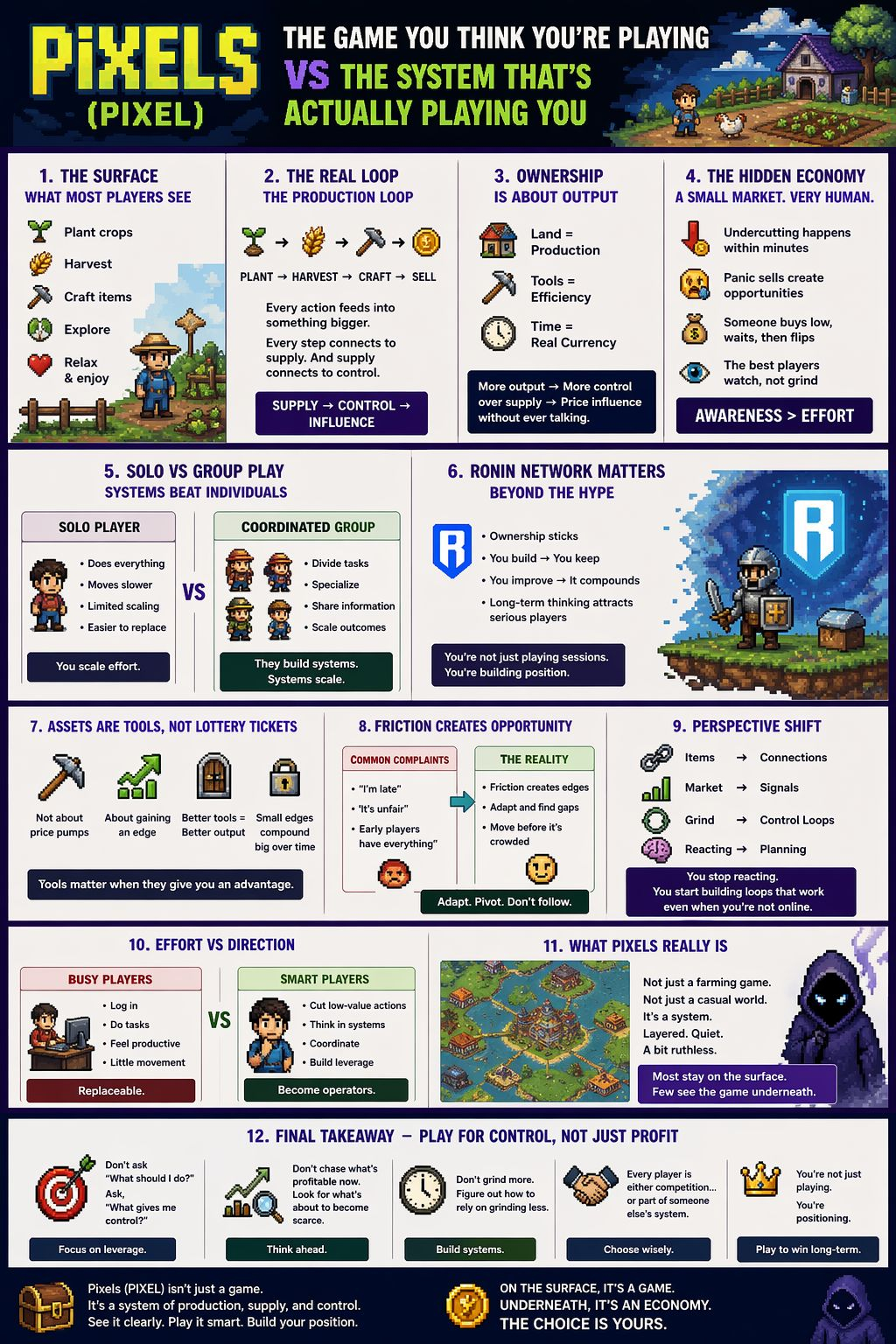
It’s a production loop.
Every action feeds into something bigger.
You plant → you harvest → you craft → you sell.
Simple.
But not innocent.
Because every step connects to supply. And supply connects to control.
And control? That’s where people quietly pull ahead.
Most players just see tasks.
A smaller group sees movement.
Where stuff comes from.
Where it gets stuck.
Where it suddenly becomes valuable.
That’s the real map.
And honestly, most people never even realize they’re standing on it.
Let’s talk about ownership for a second, because people get this completely wrong.
I’ve seen this before in other Web3 games too.
People treat assets like trophies.
“Look at my land.”
“Look at my tool.”
Cool. But that’s not the point.
Ownership here is about output.
If you own land, you’re not decorating anything.
You’re running production.
If you’ve got better tools, you’re not upgrading for fun.
You’re saving time.
And time… yeah, that’s the real currency.
The faster you produce, the more control you gain over supply.
And once you start influencing supply, you start nudging prices.
And once you nudge prices…
You’re affecting other players without ever talking to them.
That’s where it gets interesting.
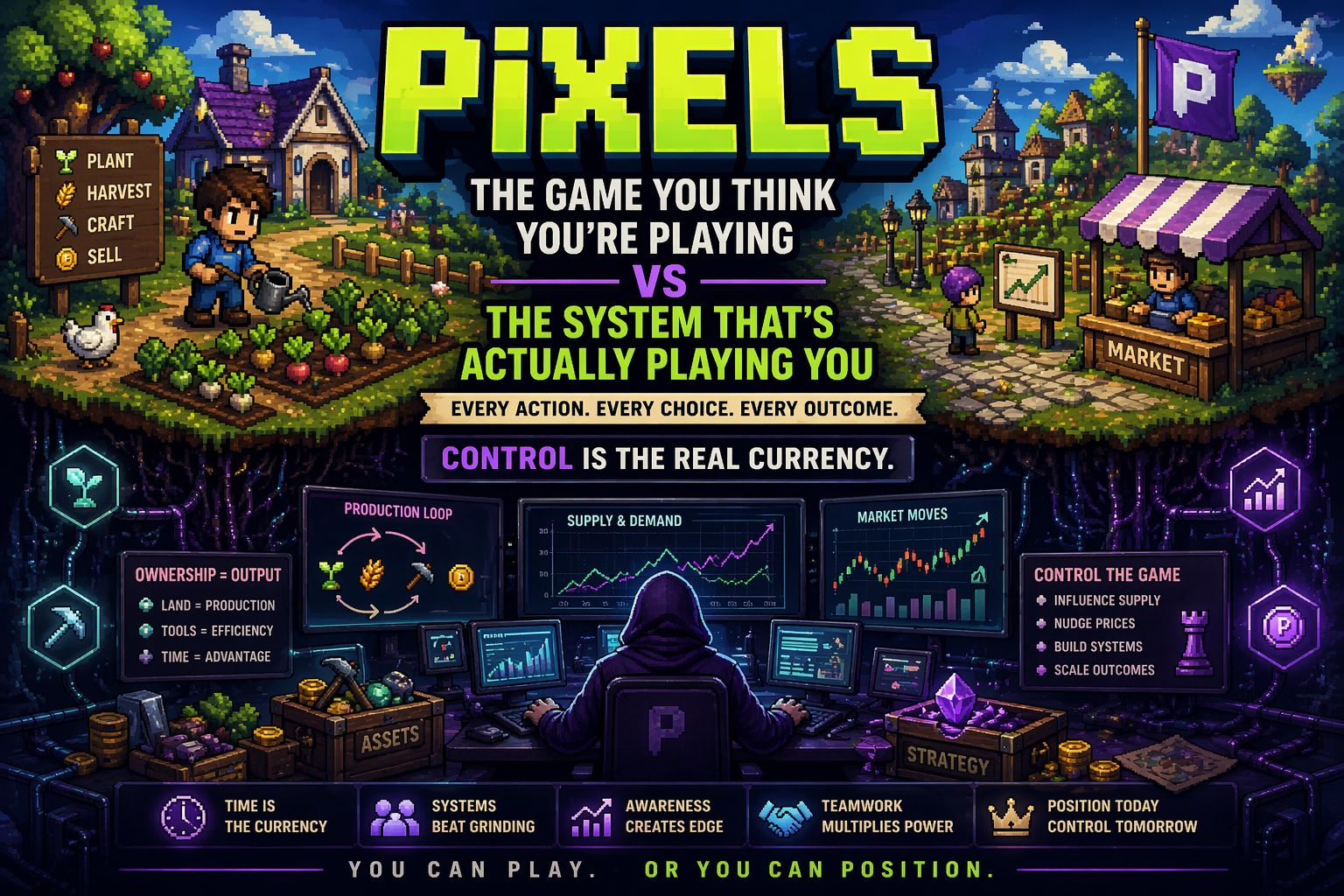
Now let’s zoom in on the economy.
Because this part? People don’t talk about it enough.
It looks cute on the surface. Bright colors, simple loops.
But the behavior underneath?
Messy.
Very human.
This isn’t some clean “game economy.”
It’s a small market.
And small markets get weird.
People undercut each other fast. Like, minutes fast.
Someone panics, dumps inventory.
Someone else quietly buys everything.
Then waits.
Then flips it later.
No drama. No announcement. Just timing.
I’ll be honest the best players here aren’t grinding harder.
They’re watching.
They’re paying attention.
They’re asking: where’s the next shortage coming from?
While everyone else is busy farming wheat or whatever…
They’re already positioned for what’s about to spike.
Effort matters. Sure.
But awareness? That wins.
Now here’s where things get tricky.
Solo players.
Look, I get it. Playing alone feels clean. Feels fair.
You do the work. You earn the reward.
Simple.
But this system doesn’t reward that long-term.
It just doesn’t.
Because everything you’re doing alone can be split up and optimized by a group.
And once a group does that…
You’re not competing anymore.
You’re feeding them.
Yeah, harsh. But true.
Groups don’t just move faster.
They move smarter.
One person handles raw materials.
Another focuses on crafting.
Another watches prices.
Another decides when to sell.
No one’s doing everything.
And that’s exactly why they win.
They build systems.
And systems scale.
A solo player? You scale effort.
A coordinated group? They scale outcomes.
Big difference.
Quick side note this is where Ronin Network actually matters.
Not in the hype way people talk about.
Forget “blockchain gaming” buzz.
What matters is this:
Ownership sticks.
You build something, you keep it.
You improve something, it compounds.
That changes how people behave.
You’re not just playing sessions anymore.
You’re building position.
And yeah, that attracts a very different kind of player.
The kind that thinks long-term.
Now let’s kill the “token dream” real quick.
You know the mindset.
“Buy early, wait, sell big.”
That whole thing.
Honestly? That’s lazy thinking.
And it’s usually late.
By the time you’re chasing price…
Someone else already built the system producing that asset.
They don’t need the pump.
They benefit from it.
Big difference.
Assets in Pixels aren’t lottery tickets.
They’re tools.
And tools only matter if they give you an edge.
A slightly faster harvest.
A bit more output.
Access others don’t have.
Small stuff.
But stacked over time?
It snowballs.
And yeah, people underestimate that. Every time.
Now, friction.
This is where people start complaining.
“I’m late.”
“It’s unfair.”
“Early players have everything.”
Look… some of that is true.
Early players do have advantages.
Some markets do get crowded fast.
Margins do shrink.
No argument there.
But here’s the part people miss.
Friction is what creates opportunity.
If everything worked smoothly…
There’d be no edge.
Everyone would earn the same.
And that’s boring. And pointless.
The players who adapt?
They move before things get crowded.
They switch when margins drop.
They don’t follow the obvious path.
The others?
They do what everyone else does.
And then they wonder why it stops working.
I’ve seen that pattern so many times it’s almost predictable.
Something else happens if you stick around long enough.
Your perspective shifts.
You stop seeing items as… items.
You start seeing connections.
A crop isn’t just food.
It’s an input for something else.
A crafted item isn’t the goal.
It’s a step in a bigger chain.
Even the market stops feeling like a “place.”
It becomes a signal.
Prices move → that tells you something.
Supply drops → that tells you something else.
Everything starts connecting.
And once you see those connections…
You stop reacting.
You start planning.
You build loops.
Not grind loops.
Control loops.
Ones that don’t rely on you constantly being active.
That’s when things really change.
Let’s be real for a second.
A lot of players are busy…
But they’re not actually moving forward.
They log in.
They do tasks.
They feel productive.
But their position?
Same as before.
Replaceable.
Because effort alone doesn’t move you up here.
Direction does.
The players who break out?
They don’t just work harder.
They work differently.
They cut low-value actions.
They think in systems.
They coordinate.
And slowly…
They stop being “players.”
They become operators.
So what is Pixels, really?
Not just a farming game.
Not just a casual world.
It’s a system.
Layered. Quiet. A bit ruthless if you look closely.
Most people never see that side.
They stay on the surface.
And that’s fine… if you’re here to pass time.
But if you’re not?
Then you’ve got to look deeper.
Next time you log in, try this.
Don’t ask, “What should I do?”
Ask, “What gives me control?”
Don’t chase what’s profitable now.
Look for what’s about to become scarce.
Don’t grind more.
Figure out how to rely on grinding less.
Yeah, that shift feels small.
But it changes everything.
Because once you see Pixels like this…
You can’t go back.
Every action starts to mean something.
Every trade feels like a signal.
Every player looks like either competition…
Or part of someone else’s system.
And that’s the moment it clicks.
You’re not just playing anymore.
You’re positioning.
And trust me…
That changes how you play forever.
