
Global markets just got another jolt—and this time, it’s not coming from charts… it’s coming straight out of Washington.
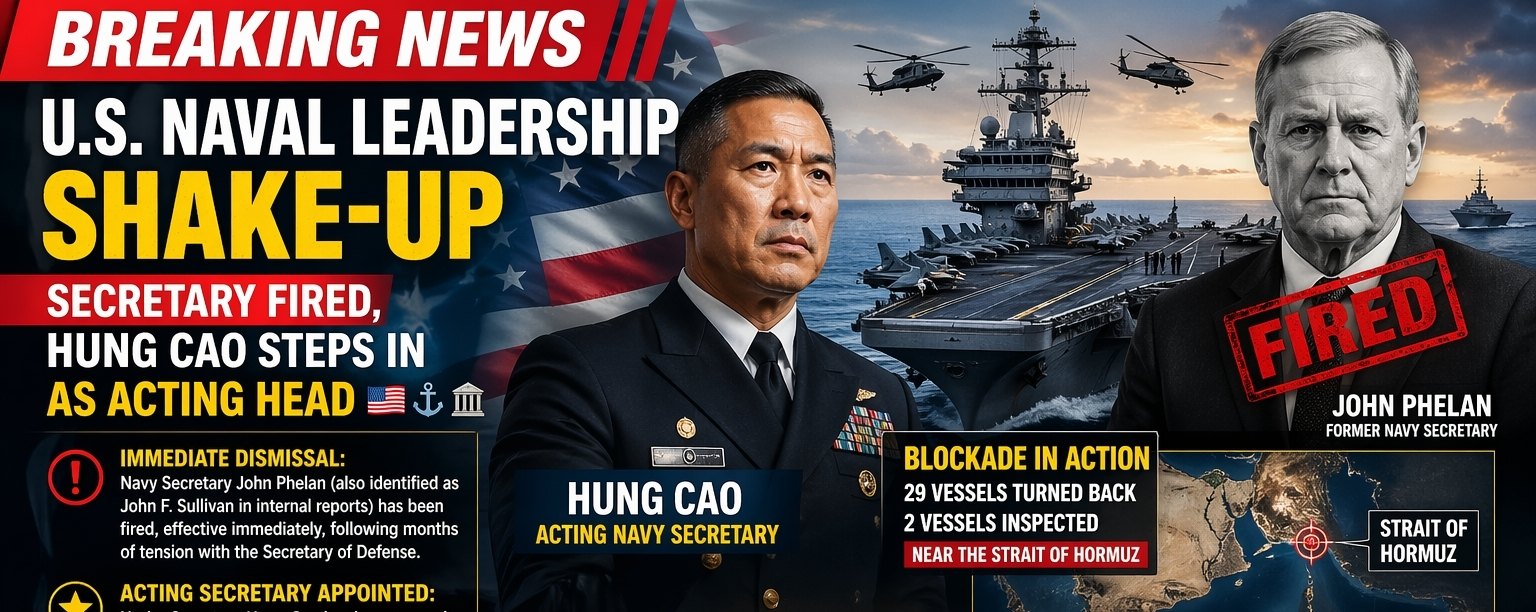
In a sudden and high-stakes move, the Pentagon has removed the sitting Navy Secretary in what insiders are calling a “pressure-driven decision” tied to escalating geopolitical risks. The dismissal lands at a critical moment, as U.S. naval forces intensify operations around the strategically vital Strait of Hormuz—a corridor that controls a massive portion of the world’s oil flow.
⚠️ Power Shift in the Middle of a Crisis
Leadership transitions in peacetime are routine. But doing it during an active maritime blockade? That’s a different story.
The outgoing secretary—closely aligned with Donald Trump—reportedly clashed with defense leadership over operational decisions and strategic direction. His removal signals more than just a personnel change; it reflects deeper fractures within the U.S. defense structure at a moment when unity is critical.
Stepping in is Hung Cao, a seasoned naval officer with decades of combat experience across multiple conflict zones. This isn’t a symbolic appointment—this is a battlefield-tested leader being dropped into a live geopolitical flashpoint.
🌍 Why This Matters Globally
Let’s be clear: this isn’t just about internal U.S. politics.
The U.S. Navy is currently enforcing aggressive maritime controls targeting Iranian-linked shipping routes. Reports indicate dozens of vessels have already been intercepted or redirected. Any miscalculation here doesn’t just affect diplomacy—it risks triggering a broader energy and security crisis.
And markets? They’re watching every move.
Crude oil volatility is already reacting. Supply chain fears are creeping back in. Traders are positioning defensively.
But beneath all of this… something else is quietly aligning.
💰 The Hidden Opportunity: Crypto in the Crossfire
Whenever global tension spikes, capital looks for escape routes. And increasingly, that escape route is crypto.
Not the hype-driven pumps. Not the meme noise.
Smart money is rotating into assets that benefit from instability.
🔹 $CL — The Liquidity Shadow Play
While traditional oil markets react instantly to Middle East tension, CL is positioning itself as a parallel liquidity magnet. It doesn’t need headlines—it feeds off them.
As energy narratives dominate, assets tied to macro sentiment often see delayed but powerful inflows. CL sits right in that pocket. If volatility sustains, this becomes less of a trade… and more of a rotation target.
🔹 $BZ — Silent Accumulation Phase
BZ isn’t making noise—and that’s exactly why it matters.
In times like these, the biggest gains don’t come from crowded trades. They come from assets that are still under accumulation while attention is elsewhere.
Geopolitical instability tends to accelerate capital movement into overlooked sectors. BZ is showing early signs of that quiet buildup. If momentum shifts, it won’t stay quiet for long.
🔹 $NATGAS — Narrative Alignment with Real-World Tension
Here’s where things get interesting.
Natural gas markets are directly tied to geopolitical stability, especially when maritime routes are under pressure. NATGAS as a crypto narrative aligns almost perfectly with this real-world tension.
That kind of narrative sync is rare—and when it happens, it attracts serious speculative capital.
🧠 Final Take
This isn’t just another headline.
A sudden leadership shake-up inside the U.S. Navy, right in the middle of a live geopolitical operation, signals instability at the highest level. And history shows—markets don’t ignore instability.
They react. Then they reposition.
While traditional traders focus on النفط (oil), shipping lanes, and defense strategy… crypto is quietly becoming the secondary battlefield for capital flow.
And if you’re paying attention, you’ll realize:
The real moves don’t happen when everything is calm.
They happen right now—when the world feels uncertain.
Stay sharp.