
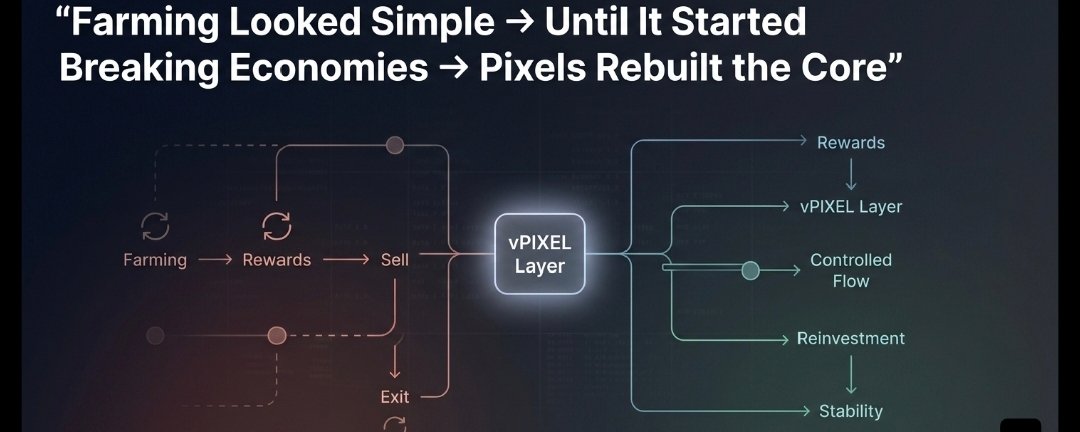

At first, Pixels just looks like a typical farming game. You log in, plant some crops, do a few simple tasks, and earn rewards. It feels easy and kind of cozy, like you’ve seen it a hundred times before. Honestly, nothing about it hints at any deep, complicated system. You get it in minutes and probably forget it just as fast.
But there’s more going on underneath.
The more you play, the less Pixels feels like a game and the more it acts like a living ecosystem. Every little action harvesting, upgrading, trading feeds into a bigger reward engine. And when real value gets mixed into that loop, even the simple stuff suddenly starts behaving like economic levers.
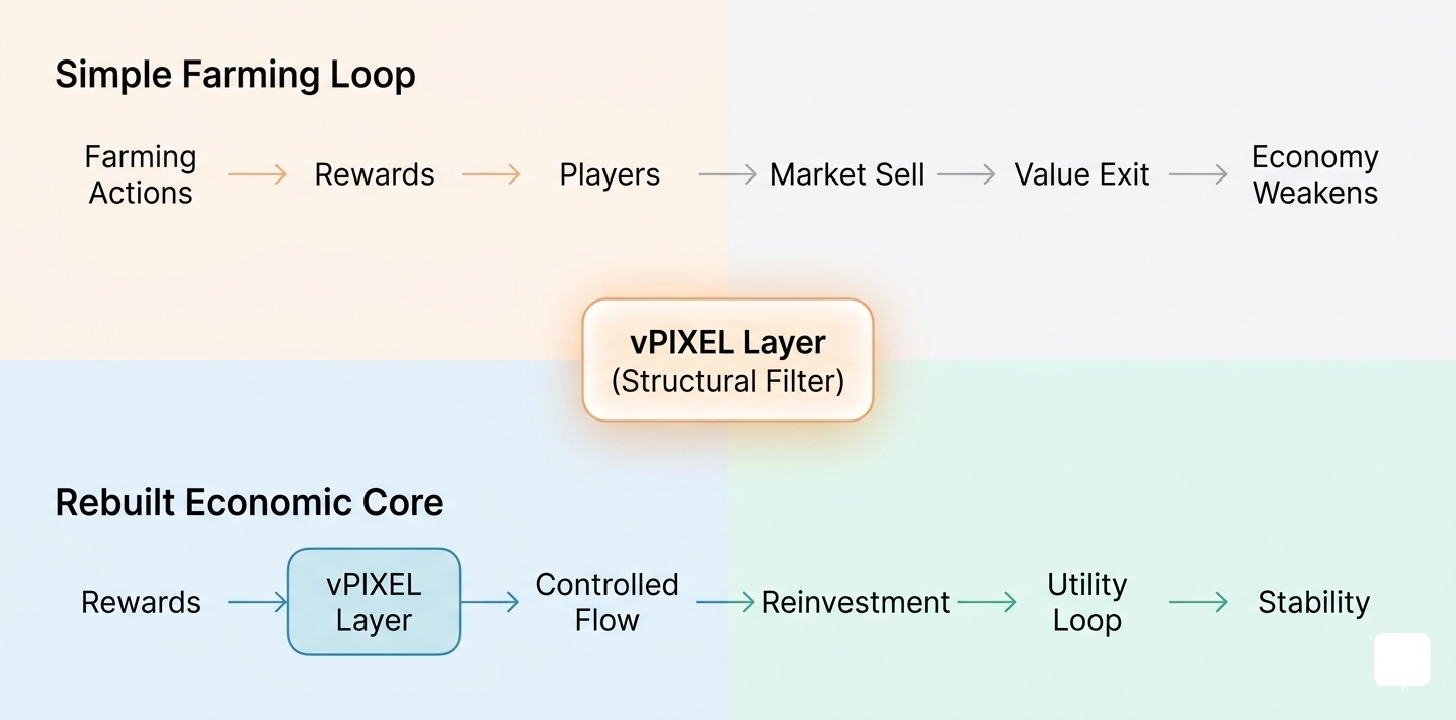
The trouble pops up when this simplicity scales up. That small reward cycle plant, harvest, collect works great on a tiny scale. But as more players join in and start chasing efficiency, the whole system tilts. People optimize, run the most productive routines, and rewards keep climbing. Suddenly, it’s not even a farming game anymore. It's about extraction. Value rushes out faster than it cycles back in.
That’s where most systems mess up. Developers think that more engagement equals more stability. But honestly, if there’s no friction, engagement just creates acceleration and acceleration without a way to slow down leads to inflation. The economy doesn’t blow up overnight; instead, it slowly loses depth.
Pixels hits right on this tension point. The more the reward loop succeeds, the more danger it faces. Players are no longer just casual farmers. They’re economic operators, squeezing every bit out for maximum return. And as everyone fine-tunes their strategy, the whole system starts coming apart at the seams.
The real issue isn’t gameplay. It's how value is built. Traditional rewards assume more play means a healthier economy. But in reality, more activity often drains value faster unless there’s something to control it.
And here’s where things shift.
Instead of just tossing roadblocks at players, Pixels changes how value flows. The arrival of vPIXEL isn’t just a tweak it’s a total redesign. Now there’s a filter between earning rewards and cashing them out.
So, value doesn’t jump straight from action to liquidity. It passes through this layer first. That short delay changes everything. People start reinvesting rather than just extracting and dumping. There’s time for value to circle around before it leaves.
That’s real infrastructure thinking. vPIXEL isn’t just another token gimmick. It’s a behavioral buffer. It shapes how players deal with their rewards without shutting them down. It doesn’t push people out it just quietly changes the way liquidity works.
In this setup, farming suddenly isn’t just farming. It’s part of a managed loop where timing, reinvestment, and utility matter just as much as the total harvest. The system holds off on restricting rewards; instead, it shapes how those rewards actually enter the market.
And that shift is bigger than it looks. Most digital economies don’t collapse because nobody’s playing they collapse because everyone’s draining value out too fast.
By adding friction and filters, Pixels isn’t making things tougher. It’s making everything more stable.
So here’s the real question:
If gameplay can turn into infrastructure, and reward loops morph into economic engines, where’s the line between “game” and “economy” anymore?
Honestly, are we still playing games, or have we wandered into the first wave of digital economies that just happen to wear the mask of games?
