At first, @Pixels feels familiar.
You log in, clear your energy, plant crops, craft items, maybe run around exploring or collecting materials. On the surface, it looks like every other farming-based Web3 game. Activity equals progress. Time spent equals rewards.
That’s what I thought too.
But after spending real time inside the system, something started to feel… off. Not broken, just different. I remember one session clearly. I had everything lined up perfectly. Crops planted, materials ready, crafting queued. Then I hit a wall because I was short on just a few specific resources. Not a lot. Just enough to stop everything.
That small moment says a lot about how pixels actually works.
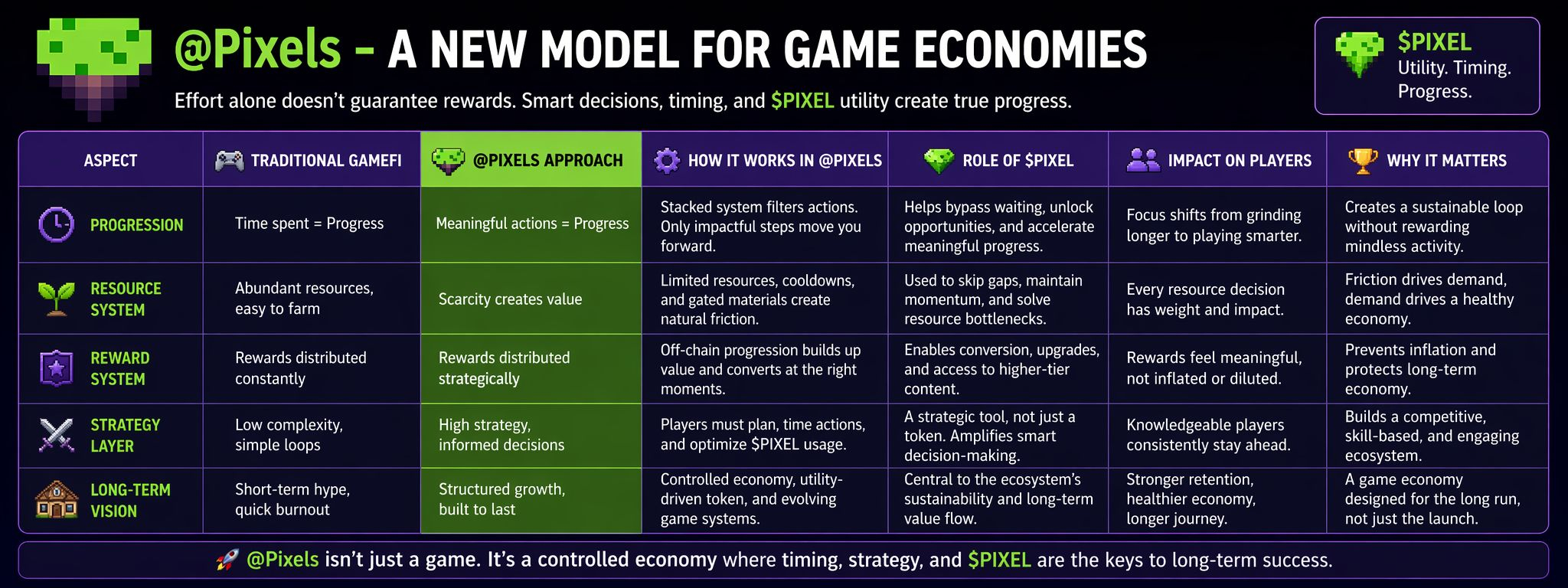
Because this isn’t a system built to reward constant action. It’s a system built to control when progress happens.
The Hidden Layer Most Players Miss
Most GameFi projects follow a predictable loop. You play, you earn, you claim tokens. Simple. The more active you are, the more you get. That’s why a lot of those ecosystems eventually collapse. Too much emission, not enough control.
Pixels doesn’t do that.
A big part of your progression doesn’t even exist on-chain. You’re constantly farming, crafting, gathering, but the real value isn’t immediately paid out in $PIXEL. It builds up quietly in the background.
That changes player behavior completely.
Instead of chasing constant rewards, you’re building toward specific moments. Moments where your effort actually converts into something meaningful.
And that’s where things get interesting.
$PIXEL Isn’t Just a Reward… It’s a Shortcut
At a surface level, pixel looks like any other in-game token.
But once you spend enough time in the system, you realize it plays a very different role.
It’s not just something you earn. It’s something you use to remove friction.
Waiting for cooldowns
Missing one key material
Being stuck between crafting tiers
Needing to unlock something at the right moment
All of these are natural barriers in the game. And pixel sits right at the center of them.
You don’t need it to play. But if you understand when to use it, everything moves differently.
I’ve seen situations where players spend hours grinding just to reach a point that others skip in seconds. Not because they’re richer. Because they understand timing better.
That’s a major shift from traditional play-to-earn.
The Stacked System Changes Everything
Now let’s talk about the part that really defines @Pixels… the Stacked system.
Most people still think of it as a reward engine. It’s not.
It’s closer to a filter.
Not every action you take gets rewarded. Only the ones that matter. Only the ones that move you forward in a meaningful way.
That’s why sometimes you can play for hours and feel like nothing changed… and other times a few smart decisions push you ahead quickly.
Stacked is constantly evaluating behavior.
Are you just repeating loops?
Are you actually progressing?
Are you optimizing your resources?
This is where the game starts to feel less like farming and more like strategy.
And honestly, this is also where a lot of players get frustrated. Because effort alone isn’t enough anymore.
Why Some Players Move Ahead Without Grinding
If you’ve spent time in @Pixels, you’ve probably noticed this.
Some players just move faster.
They’re not always online. They’re not always grinding harder. But somehow they’re always in a better position.
At first, it feels random. Maybe luck. Maybe better land. Maybe more time invested earlier.
But over time, you realize it’s none of that.
It’s understanding the system.
They know when to act and when to wait.
They know when to convert progress and when to hold.
They know where to spend pixel and where not to.
That’s the difference.
And once you see it, you can’t unsee it.
Tier 5 (T5) and the Shift Toward Structured Progression
The recent updates around T5 content push this idea even further.
We’re not just talking about more items or more crafting options. We’re talking about controlled capacity.
T5 industries only exist on NFT land. They don’t compete with lower tiers. You need slot access. You need planning.
Each slot unlock requires a T5 Slot Deed, and even then, it’s not permanent. There’s a time component. You need to maintain it, manage it, and decide how to use it effectively.
This introduces a completely new layer of decision-making.
It’s no longer about “what can I craft?”
It becomes “what should I prioritize with limited access?”
And that’s where the economy starts to feel real.
Why This Design Feels More Sustainable
Most GameFi projects fail for the same reason. They reward everything equally.
More clicks = more tokens
More time = more profit
That model works… until it doesn’t.
Pixels is moving in the opposite direction.
Less reward noise
More controlled output
Higher value for meaningful actions
By limiting when and how value is distributed, the system avoids inflation pressure that usually kills game economies.
It also shifts the mindset of players.
You’re not just farming anymore. You’re planning.
The Psychology Shift: From Grinding to Positioning
This might be the most underrated part of the entire system.
In most games, you feel productive when you’re busy.
In @Pixels, you can be busy and still fall behind.
That forces a mental shift.
Instead of asking: “What should I do next?”
You start asking: “What actually matters right now?”
That’s a completely different way of playing.
And it’s why some players start enjoying the game more over time, while others lose interest. It depends on whether you adapt to the system or fight it.
The Role of Friction in Value Creation
Here’s something most people overlook.
Friction is what creates demand.
Waiting, resource gaps, cooldowns… these are not problems. They’re part of the design.
If everything was instant and smooth, there would be no reason to use $PIXEL.
But because friction exists, the token has real utility.
You’re not just buying items. You’re buying time, access, and efficiency.
And that’s what keeps the economy alive.
Where Pixels Is Actually Heading
If you zoom out, the direction becomes clear.
Pixels is not trying to be another play-to-earn game.
It’s building a structured economy where:
Access matters more than activity
Timing matters more than speed
Strategy matters more than repetition
The combination of off-chain progression, controlled reward distribution, and utility-driven token design is what sets it apart.
And we’re still early in that transition.
Final Thought
At first, pixels feels slow.
Then it feels confusing.
Then it starts to make sense.
And once it does, you realize you’re not just playing a game anymore. You’re navigating a system where every decision has weight.
That’s what makes it different.
That’s what makes it interesting.
And that’s why I’m paying attention to where this goes next.