
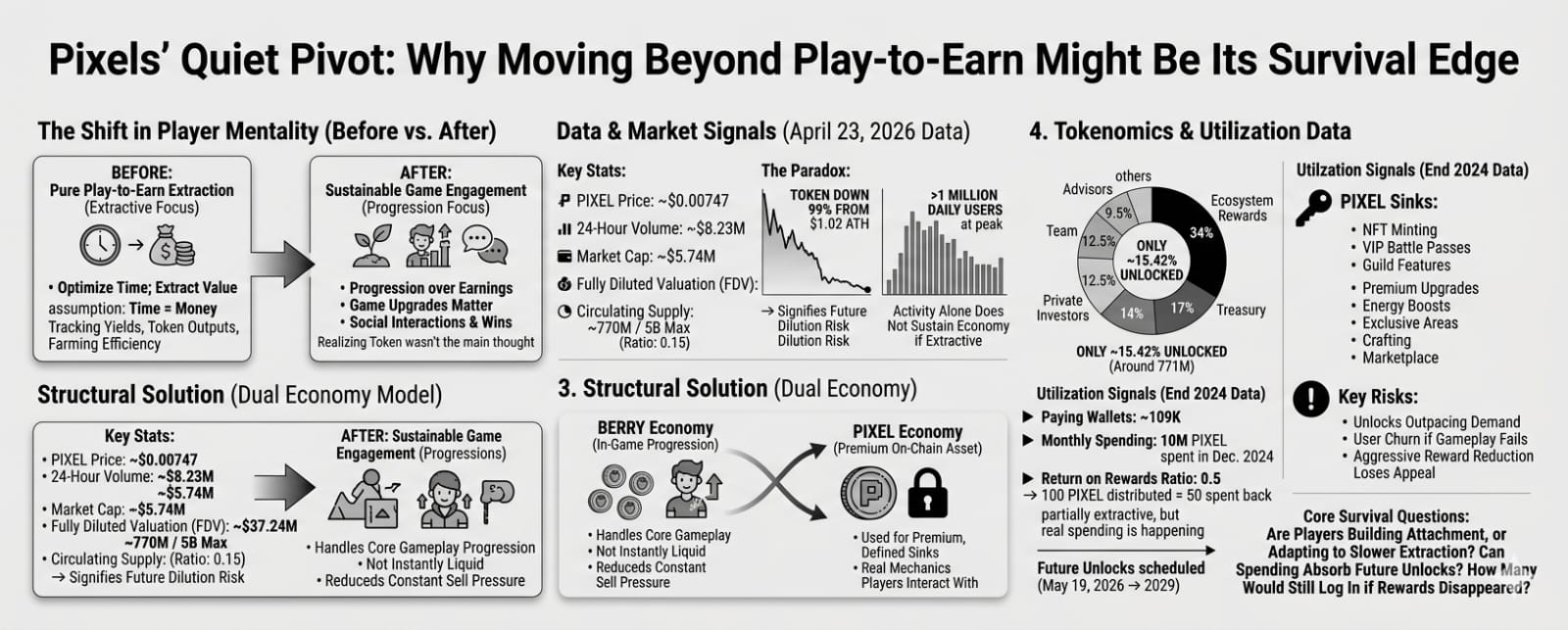
I remember the exact moment something clicked for me with Pixels. It wasn’t during a big announcement or some flashy roadmap reveal. It was actually after a long grind session where I realized I wasn’t even thinking about the token anymore. I was just… playing. That surprised me, because when I first approached Pixels, I treated it like every other Web3 game I’ve seen—optimize time, extract value, repeat.
Early on, I did what most people did. I tracked yields, calculated token outputs, compared efficiency between farming loops. I noticed that everything revolved around one assumption: time equals money. But then something odd happened. My earnings started to matter less than my progression. I found myself caring more about upgrades, social interactions, and small in-game wins. That shift felt subtle, but looking back, it was fundamental.
And I think that’s the contrarian core here—Pixels didn’t survive by fixing play-to-earn. It survived by quietly stepping away from it.
Let’s be honest about what the numbers say. As of April 23, 2026, PIXEL is trading around $0.00747, with roughly $8.23M in 24-hour volume, a market cap of about $5.74M, and a fully diluted valuation near $37.24M. The circulating supply sits around 770 million out of a 5 billion max supply, putting the market cap to FDV ratio at 0.15. That’s not just a statistic—it’s a signal. The market is pricing in a massive amount of future dilution and uncertainty.
I remember checking the chart after hearing how big Pixels had gotten—over a million daily users at one point—and thinking, “This doesn’t match.” A game with that level of activity shouldn’t have a token down over 99% from its all-time high of $1.02. But that’s exactly the point. Activity alone doesn’t sustain an economy if most of it is extractive.
I’ve seen this pattern before. A friend of mine once got into a different GameFi project early. He was earning well, pulling out consistent profits. Then rewards got diluted, new players slowed down, and suddenly the same grind produced less and less value. Eventually, he stopped logging in—not because he didn’t like the game, but because the math stopped working. That’s the trap Pixels seemed headed toward.
But instead of doubling down on rewards, it adjusted the structure.
The introduction of a dual economy—where BERRY handles core gameplay progression and PIXEL acts as a premium, on-chain asset—changed the flow. Not everything you do translates into something instantly liquid. That reduces the constant sell pressure that kills most GameFi tokens. I noticed this firsthand when I stopped thinking, “How fast can I sell this?” and started thinking, “Is this worth using in-game?”
That psychological shift matters more than people think.
If you look deeper into the tokenomics, only about 15.42% of the total supply is currently unlocked—around 771 million tokens. The rest is still vesting, with the next unlock scheduled for May 19, 2026, and a full schedule extending into 2029. The allocations are spread across ecosystem rewards (34%), treasury (17%), private investors (14%), team (12.5%), advisors (9.5%), and others.
Now, here’s where I get cautious. A large portion of supply is still coming. That means future sell pressure is not hypothetical—it’s scheduled. I’ve learned the hard way that ignoring unlocks is a mistake. But at the same time, if the in-game economy absorbs that supply through real usage, the impact changes.
And this is where Pixels gets interesting again.
The token actually has defined sinks. It’s used for NFT minting, VIP battle passes, guild features, and premium upgrades. In practice, I’ve seen it used for things like buying energy boosts, accessing exclusive areas, crafting items, and participating in the marketplace. These aren’t abstract promises—they’re real mechanics players interact with.
But the quality of demand still matters. Pixels reported around 109K paying wallets by the end of 2024, with in-game spending hitting 10 million PIXEL in December alone. The Return on Rewards ratio was 0.5, meaning for every 100 PIXEL distributed, only 50 were spent back into the system.
When I first read that, I paused. That ratio tells you everything. The system is still partially extractive. But it’s also not completely broken—because spending is happening.
I’ve started to think of it like a local economy. Imagine a small town where everyone works but no one spends—money flows out, and the town slowly dies. Pixels is trying to become the opposite: a place where some players grind, others spend, and some just participate socially. That balance is fragile, but it’s real.
What also stands out is how the game shifted its focus. Guilds, land ownership, and events now matter more than pure farming efficiency. I noticed that players who engage socially tend to stay longer, even if their earnings drop. That’s something most play-to-earn models never figured out.
Still, I wouldn’t call this “solved.”
There are real risks here. If unlocks outpace demand, the price will feel it. If gameplay doesn’t hold attention, users will churn. And if rewards are reduced too aggressively, the system could lose its remaining economic appeal.
But here’s the part that keeps me watching Pixels: it’s no longer pretending everyone can win financially.
That’s uncomfortable, especially in a space built on that promise. But it’s also more honest.
The biggest mistake I made early on was judging the entire project through the token chart. Now I think that’s only one piece of the puzzle. The more important question is whether players are staying when the rewards aren’t the main reason.
Because if they are, then something deeper is working.
So here’s what I’m still trying to figure out—and maybe you are too:
Are players in Pixels actually building attachment, or just adapting to a slower extraction cycle?
Can in-game spending realistically absorb future token unlocks?
And most importantly—if rewards disappeared tomorrow, how many people would still log in?
$PIXEL @Pixels #pixel $MOVR $KAT #BinanceLaunchesGoldvs.BTCTradingCompetition #CHIPPricePump #JustinSunSuesWorldLibertyFinancial #KelpDAOExploitFreeze
