
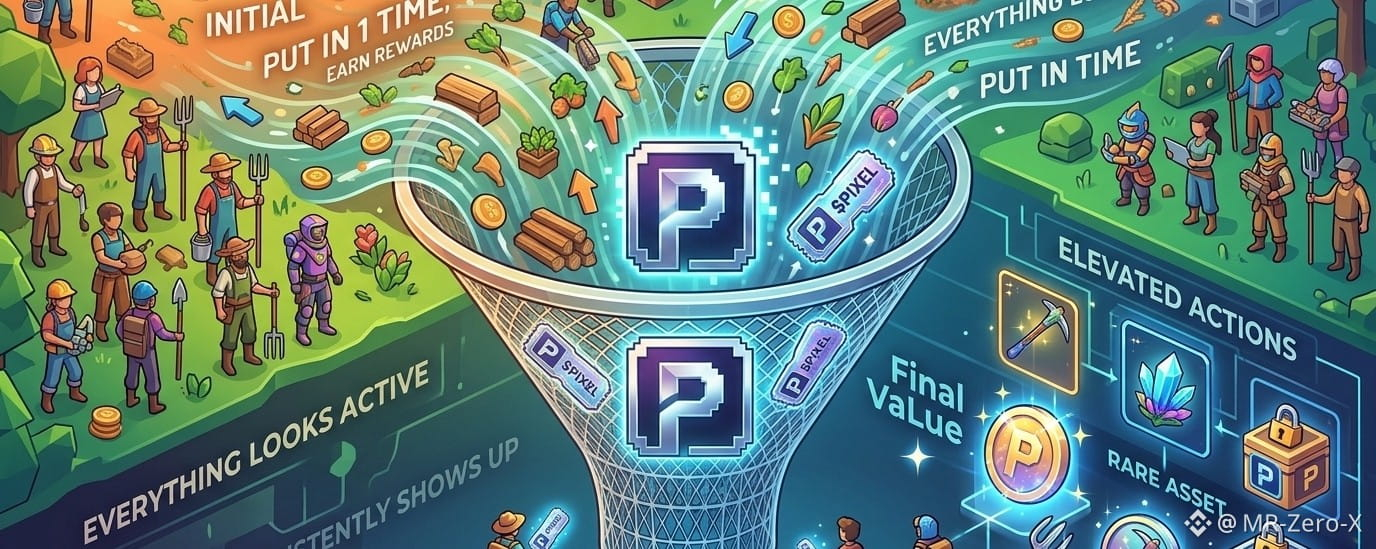
At first, $PIXEL doesn’t feel unusual.
Everything looks active—farms running, trades happening, players grinding like they do in any game economy. It gives the impression of a familiar loop: put in time, earn rewards, keep progressing.
Nothing seems out of place.
But the longer you stay, the more a subtle imbalance starts to appear. Not something obvious or broken—just a quiet inconsistency.
You can follow the same routines as others, invest the same effort, yet the outcomes don’t always match. Some players consistently end up in stronger positions. Not necessarily because they’re more skilled or more active, but because they seem to arrive at the right moments prepared.
 At first, it feels like coincidence. Maybe timing. Maybe luck.
But over time, that explanation starts to fall apart.
That’s where the role of PIXEL becomes clearer.
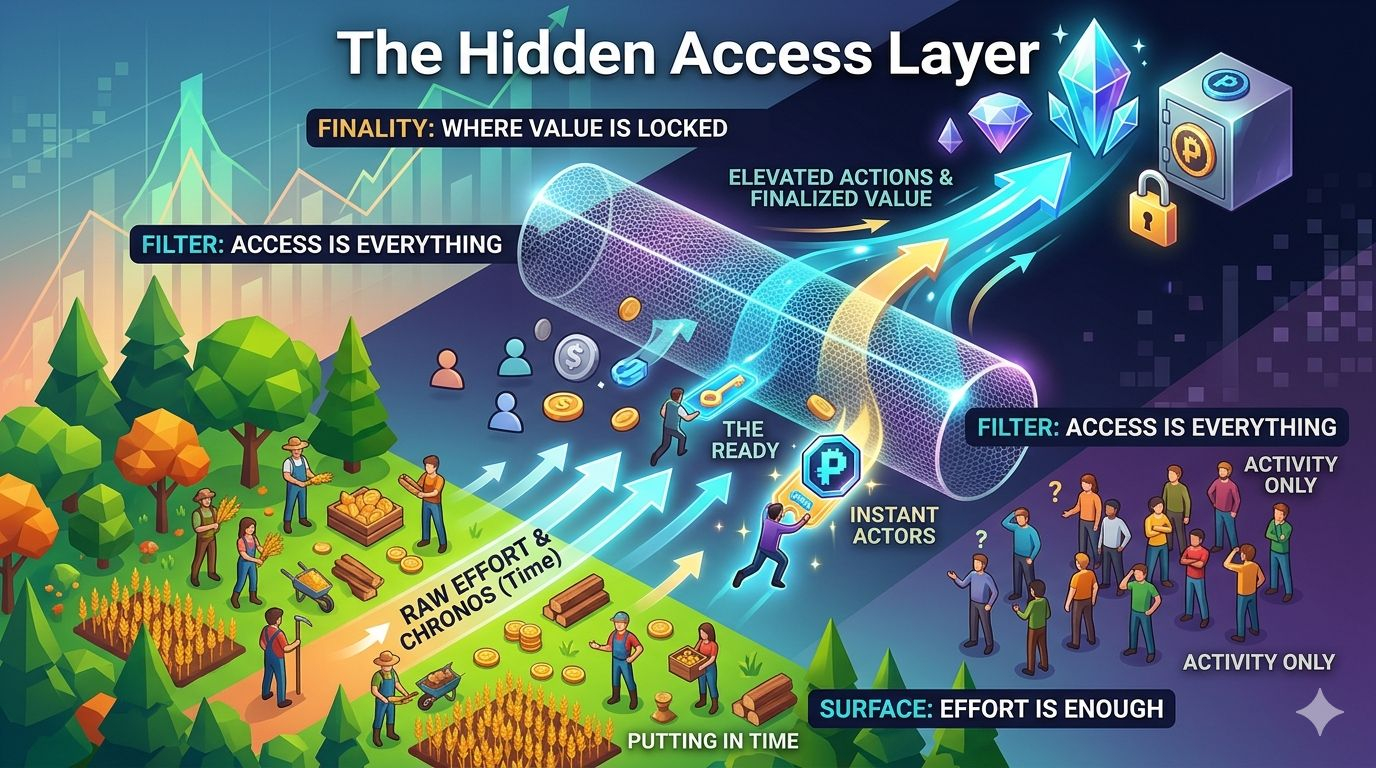
On the surface, the system is straightforward. Most activity happens off-chain—fast, smooth, and almost frictionless. Players farm, craft, and move resources freely without much pressure. It feels open, like anyone can participate without barriers.
But when something valuable appears—limited upgrades, rare assets, or time-sensitive opportunities—the system shifts.
Suddenly, it’s no longer about how much you’ve done.
It’s about whether you can act instantly.
And that’s where $PIXEL quietly changes everything.
It doesn’t behave like a typical reward. Instead, it works more like access.
If you already hold it, you can move without hesitation. If you don’t, you pause—and sometimes that pause is enough to miss the opportunity completely.
This difference may seem small in the moment, but over time, it compounds.
The same players keep appearing at key points where value is locked in. Not because they worked harder at that exact time, but because they were already positioned to act.
This pattern isn’t new. It’s something we’ve seen in financial markets for years.
In trading, effort alone isn’t enough. Access to liquidity matters more. Those who are ready when opportunities appear take the most meaningful positions, while others remain on the sidelines, even if they’re active.
 Pixels is starting to reflect a similar structure.
What makes it interesting is that the system doesn’t openly present itself this way. It still feels fair and accessible. Anyone can join, play, and earn.
And that’s true—on the surface.
But not every action carries equal weight.
Some actions simply circulate within the system, while others are elevated and converted into something final—something that actually holds value.
PIXEL sits at that boundary.
It doesn’t control your activity. It determines whether your activity truly counts.
That changes how the economy behaves.
Because now, success isn’t just tied to effort—it’s tied to timing, readiness, and positioning.
There’s a reason behind this structure. Not everything can be finalized on-chain. Doing so would be inefficient and chaotic. So naturally, a filter exists.
And once a filter exists, access to it becomes valuable.
That’s exactly what pixel represents.
Over time, players adapt. They shift from casual play to calculated decisions. Instead of doing everything, they focus on moments that actually matter.
But this also creates a gap.
As more players target the same opportunities, the advantage shifts toward those who are already prepared. They don’t dominate aggressively—they simply stay ahead, consistently.
New players still enter the system, and activity continues to grow. But not everyone participates equally where value is actually created.
And that difference isn’t always visible in basic metrics like player count or activity levels.
That’s why calling $PIXEL just a reward token feels incomplete.
It’s closer to a coordination layer—something that connects effort to outcome and decides which actions move forward.
If this dynamic continues, then the real signal won’t be how many people are playing…
It will be who consistently shows up at the exact moment when it actually matters.