
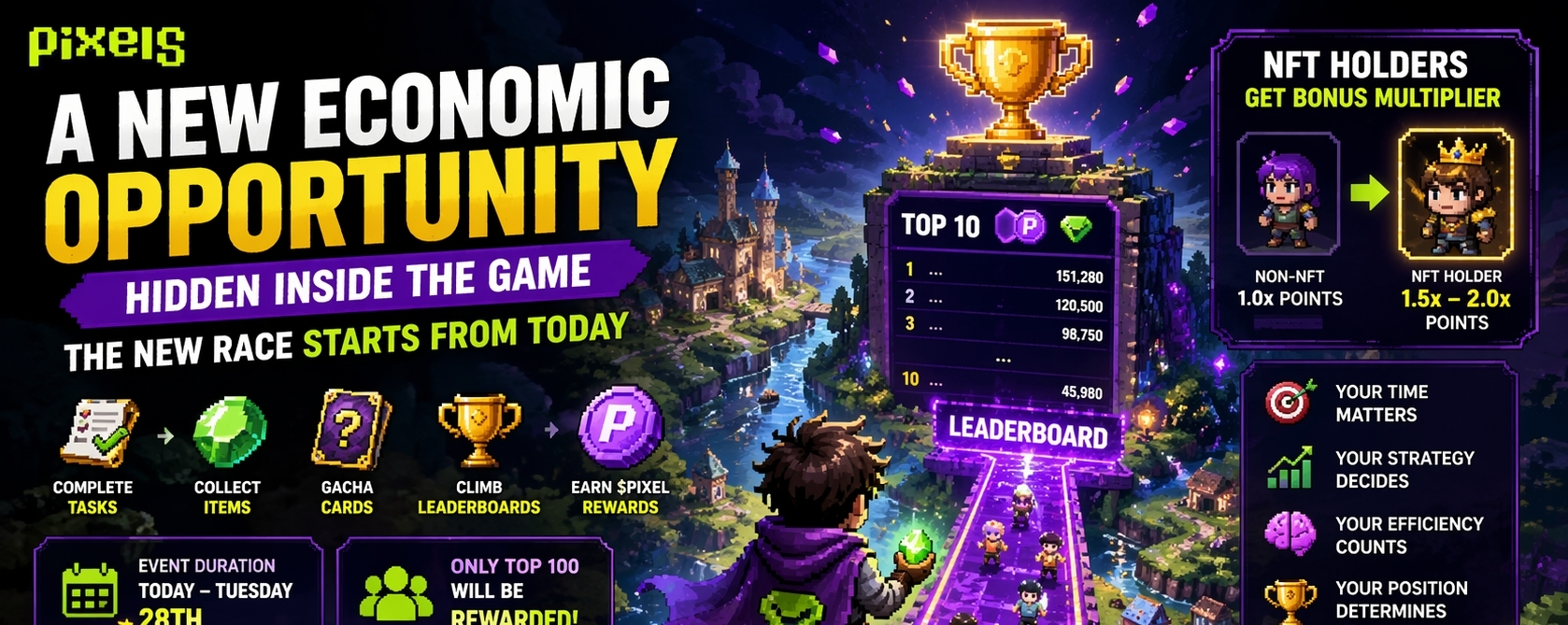
Ididn’t think it would feel any different this time, but something about today’s @Pixels event immediately pulled me in. On the surface, it’s exactly what you’d expect—complete tasks, collect items, climb the leaderboard, and hope to secure a share of the $PIXEL rewards by the end. It’s a loop we’ve all seen before, simple and familiar enough that you don’t question it too much at first. But the longer I stayed inside it, the harder it became to ignore a thought that kept circling back in my mind. Is this really just another event… or is it quietly turning into something closer to a small economic system running in real time?
Because when you slow down and actually look at what’s happening, it doesn’t feel like you’re just playing anymore. Items like Green Stones and gacha cards don’t feel like random collectibles—they start to look more like reflections of your activity. Every action you take is being translated into something measurable, something that builds your position. It’s almost like your time is being converted into a score, and that score is what defines your place in the entire system. Without even realizing it, your mindset begins to shift. You stop thinking casually and start thinking in terms of efficiency, asking yourself what the best move is instead of what the most enjoyable one might be.
The timing of the event adds a quiet pressure that’s hard to ignore. Knowing that everything runs only until the 28th creates this subtle urgency in the background. If you start late, you’re already behind. If you start early, you feel like you’ve stepped into a race that doesn’t really pause. It’s not overwhelming, but it’s always there, pushing you just enough to keep going. That’s where the experience starts to change. What begins as simple participation slowly turns into something more competitive, where every decision feels slightly more important than it should.
Then there’s the reward structure, which at first seems straightforward but carries more weight the deeper you think about it. Around 200,000 PIXEL tokens are distributed, but only a limited number of players will actually benefit in a meaningful way. The top 100 get rewarded, and within that group, the top 10 stand in a completely different position. It creates a clear hierarchy where performance directly shapes outcome. The better you play, the bigger your share—it’s simple, but it changes how you approach everything. It’s no longer just about being part of the event, it’s about finding your place within it.
The NFT multiplier adds another layer that quietly shifts the balance. Players who hold Pixels NFTs earn more for doing the same actions, which at first might feel a bit uneven. But when you think about it, it introduces a form of loyalty into the system. It connects ownership with efficiency, making the experience not just about how you play, but also about what you bring into the game with you. That small detail changes the way the entire ecosystem feels, because now participation and investment are tied together in a subtle but noticeable way.
What stands out the most, though, isn’t just the mechanics or the rewards—it’s how everything begins to influence behavior. From the outside, it looks like a simple leaderboard race. But inside, it feels like a loop that’s constantly observing and responding to how you play. How much time you spend, how you adapt, how you optimize—it all feeds back into your progress. And that’s where it starts to feel different. When a game begins to reflect not just what you do, but how efficiently you do it, it slowly moves beyond being just a game and starts to feel like a system you’re operating within.
And yet, despite all of that, it’s still engaging in a way that’s hard to explain. Maybe it’s the structure, or maybe it’s the unpredictability, but it keeps you involved. You’re not just completing tasks—you’re adjusting your approach, testing small strategies, and even trying to anticipate where you might end up by the time it’s over. Some players will make it to the top, some will grind without much reward, and most will fall somewhere in between. But everyone is navigating the same environment in their own way, and that shared competition gives it a certain kind of energy.
In a way, it feels like the gameplay itself hasn’t changed much, but the cycle around it has become stronger and more defined. It’s no longer just about doing things—it’s about doing them better, faster, and more strategically. And that’s why today doesn’t feel like just another event starting. It feels like a small system resetting, ready to run again, with every player stepping into it at a different pace but under the same rules.
It’s a little messy, a little intense, and not always fair—but that’s also what makes it feel alive. From the outside, it still looks like a simple “play and earn” setup. But once you’re inside, it becomes something more—a quiet competition shaped by time, effort, and decision-making. And honestly, that’s probably why I was looking forward to it more than I expected. Not just to see whether I win or lose, but to watch how this entire system unfolds, and how a game slowly continues to redefine itself through the way people play it.