
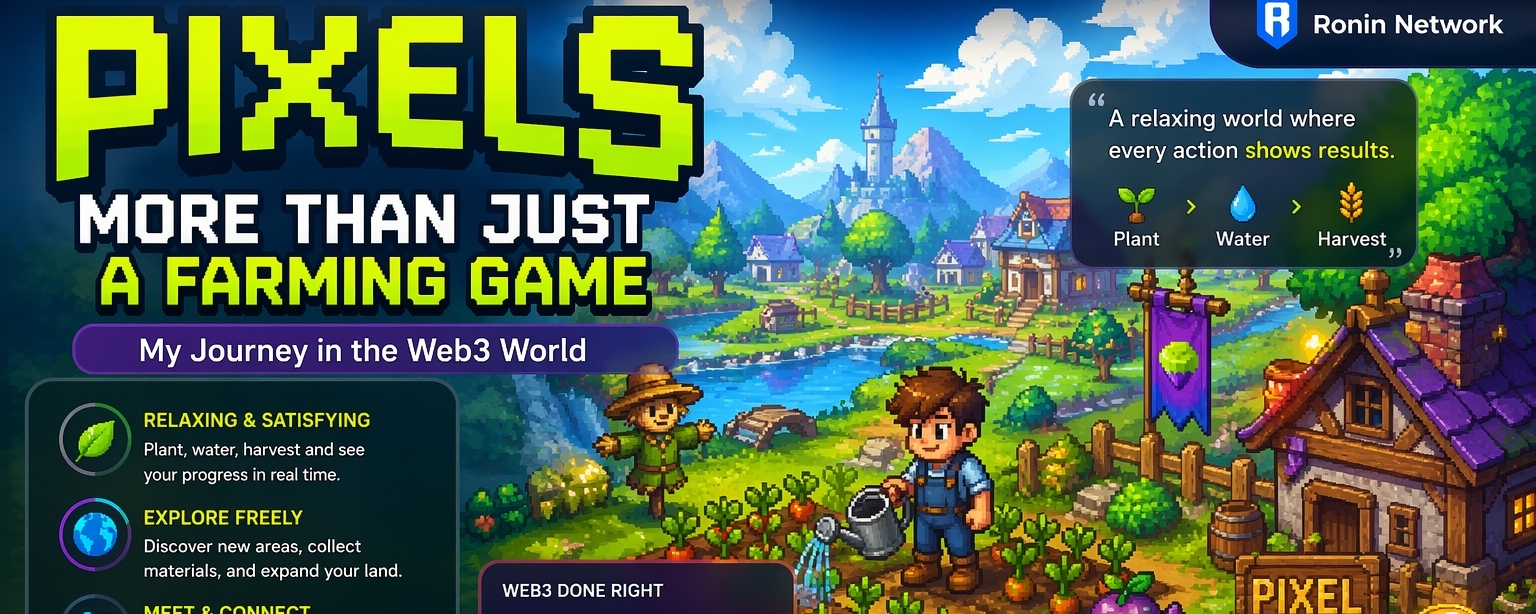
When I first discovered Pixels, I honestly didn’t think it would hold my attention for long.
The pixel-style graphics made it look almost too simple. In 2026, when most games are trying to impress people with high-end visuals, fast action, and huge promises, Pixels looked like the opposite of all that. My first reaction was simple: Can a game that looks this basic really become popular?
It felt hard to believe.
Still, I kept seeing people talk about it, so I decided to try it for myself. I thought maybe I’d spend a few hours in it and move on like I had with many other Web3 games.
At the start, it seemed exactly how I expected. You plant seeds, water crops, wait, and harvest. Very simple. No crazy mechanics, no instant excitement, no flashy rewards trying to hook you in.
But after a few days, something changed.
I started enjoying the routine.
There’s something peaceful about planting crops and watching your progress happen right in front of you. You put in a little effort, and later you see the results clearly. Your farm grows because of what you did. That feeling is small, but it’s satisfying in a way that many modern games forget.
It doesn’t feel stressful. It feels calm.
Instead of rushing for rewards, I found myself enjoying the process itself. Logging in became part of my day, not because I had to, but because I wanted to.
What surprised me most was realizing Pixels is much more than just farming.
As I spent more time playing, I started exploring the world beyond my land. There were new areas to visit, materials to collect, people to meet, and little discoveries everywhere. It gave the game a much bigger feeling than I expected from a simple farming setup.
Meeting other players made it feel alive. People were trading, helping each other, sharing ideas, and building their own progress at the same time. It didn’t feel like an empty blockchain game where everyone only shows up for rewards—it felt like an actual community.
Expanding my land became one of my favorite parts. Building and upgrading my own space made everything feel personal. Slowly, it stopped feeling like I was playing inside someone else’s game and started feeling like I was building my own small world.
That part kept me coming back.
The Web3 side was where I expected problems, because most blockchain games I’ve tried focus too much on tokens and not enough on gameplay.
Usually, the story is the same—people join for fast rewards, bots flood the system, and the whole project starts feeling more like work than fun.
Pixels feels different.
Yes, PIXEL is important, and yes, rewards are part of the experience, but it doesn’t feel like the game exists only to push token farming. It feels like it was built for real players first.
I noticed there’s a stronger focus on fairness and long-term participation. The anti-bot design makes a big difference. Instead of rewarding repetitive fake activity, the system seems to care more about genuine behavior—actual players spending real time in the game.
That creates trust.
It feels less like “how fast can I earn” and more like “is this a world I actually want to stay in?”
That mindset is rare in Web3 gaming.
Of course, Pixels isn’t perfect. Sometimes progress can feel slow, and if someone is looking for nonstop action or instant profits, they might lose interest quickly. The simple graphics will also not appeal to everyone.
But honestly, that simplicity became part of why I liked it.
Pixels takes complicated Web3 ideas like ownership, digital economy, and participation, and makes them feel natural through everyday gameplay. You’re not constantly thinking about blockchain—you’re just farming, exploring, building, and enjoying the world.
That’s what surprised me the most.
I started with doubt, expecting very little.
Now, it’s one of the few Web3 games I actually return to without forcing myself.
And for me, that says everything.
Disclaimer: This is only my personal experience and not financial or investment advice. Always do your own research before joining any blockchain game or investing in any token ecosystem.