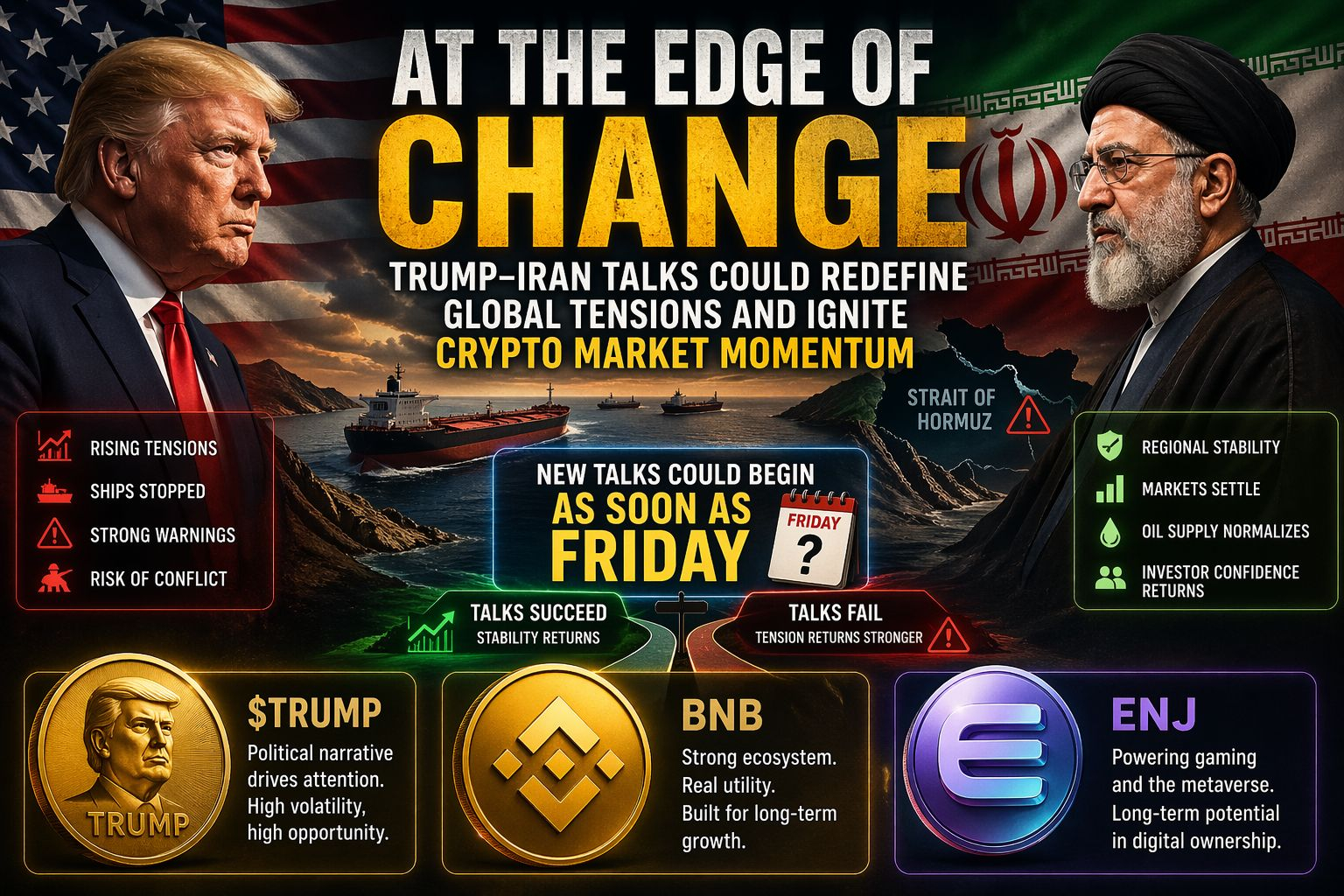
Something important might be about to unfold — and the tone in global politics is shifting faster than most expected.
Donald Trump has signaled that fresh talks with Iran could begin as soon as Friday. There’s no official confirmation yet, but even the possibility has started to ease what was, until very recently, a rapidly escalating situation.
Just days ago, the trajectory felt unmistakably dangerous.
Tensions across the Middle East were rising. Military posturing increased. The Strait of Hormuz — a narrow passage responsible for a significant share of the world’s oil flow — became the center of renewed friction. Reports of intercepted vessels, sharp warnings, and strategic signaling created an atmosphere where miscalculation felt dangerously close.
For a moment, it didn’t seem unthinkable that the situation could tip into direct confrontation.
And now, unexpectedly, a narrow diplomatic window appears.
Trump’s language suggests not just a return to negotiations, but an attempt to secure something more durable — a structured, enforceable agreement rather than a temporary easing of tensions. On the other side, Iran’s internal posture remains complex. There is no single unified voice, and that fragmentation adds another layer of unpredictability.
This is what makes the current moment so delicate.
It’s not resolution — it’s possibility.
A crossroads.
If talks do materialize, even the act of engagement could begin to stabilize the region. Risk premiums in global markets may soften. Energy flows could normalize. The psychological weight that has been pressing on investors might begin to lift.
But the inverse is just as powerful.
If negotiations stall before they begin — or collapse under pressure — the current tension may not simply return, but intensify. Markets tend to react faster to failure than to hope. And in geopolitics, failed diplomacy often carries a heavier cost than no diplomacy at all.
Right now, uncertainty is the only constant.
And that uncertainty is exactly where opportunity begins to form — particularly in the digital asset space, where narrative, sentiment, and timing intersect.
Market Undercurrent: Where Geopolitics Meets Crypto
Periods like this don’t just move oil and equities — they reshape capital flows. When global stability is questioned, investors quietly reposition. Some move toward traditional safe havens. Others look toward decentralized alternatives that operate outside political frameworks.
This is where selective positioning starts to matter.
One emerging narrative is the rise of politically-themed digital assets. The token often associated with Trump has been gaining attention not purely on fundamentals, but on narrative momentum. In moments where political figures dominate headlines, assets tied to their identity tend to experience speculative inflows. It’s not about intrinsic value alone — it’s about attention liquidity. If negotiations advance and media focus intensifies, this type of asset could see sharp, sentiment-driven volatility.
At the same time, infrastructure remains the backbone of sustained growth.
A major exchange-linked ecosystem like BNB continues to sit at the center of real usage — trading, fees, smart contracts, and liquidity. Unlike purely narrative-driven assets, its strength comes from consistent demand. In uncertain geopolitical conditions, platforms that facilitate movement of capital often become more relevant, not less. If global tension leads to increased hedging or repositioning, utility-driven ecosystems tend to benefit from the volume.
Then there’s the gaming and metaverse segment — often underestimated during macro-heavy cycles.
Enjin represents a different angle: digital ownership, NFTs, and gaming infrastructure. While it may not react instantly to geopolitical headlines, it operates on a longer adoption curve. Interestingly, when broader markets stabilize after tension events, capital frequently rotates into higher-risk, growth-oriented sectors. That’s where assets tied to digital economies can quietly outperform. If diplomatic progress restores confidence, this segment could re-enter focus faster than expected.
The Real Signal
This isn’t just about one meeting or one headline.
It’s about direction.
Geopolitical tension creates pressure. Pressure creates uncertainty. And uncertainty creates movement — across every market.
Friday now carries symbolic weight.
If talks begin, it signals de-escalation. If they don’t, it signals something else entirely.
Either way, the reaction will matter more than the event itself.
Because in today’s environment, markets don’t wait for clarity — they move on expectation.
And right now, expectation is shifting.