
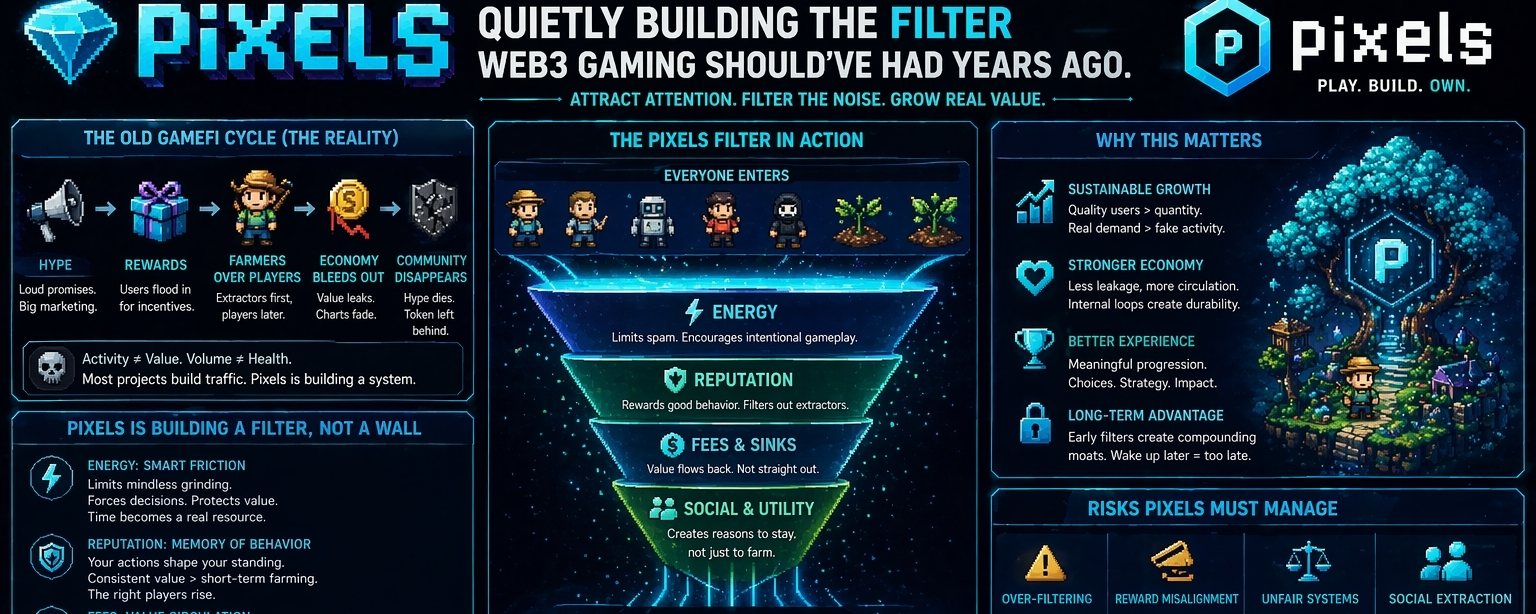
You can spot the weak game economies fast.
Rewards flood in. Farmers arrive before real players do. Bots sniff out every loophole. Tokens get treated like ATMs. Social feeds call it “adoption” while the chart slowly bleeds out in the background.
I’ve watched that circus too many times.
That’s why Pixels keeps pulling me back. Not because it’s loud. Not because it promises some shiny revolution. Because it looks like a project trying to solve the boring problem most Web3 games ignored for years:
How do you attract attention... without letting attention destroy the economy?
That question matters more than art style, lore, or whatever influencer is screaming this week.
Most crypto games rewarded movement itself. Click button. Complete task. Claim reward. Repeat until exhausted. They confused activity with value and volume with health. I remember watching dashboards full of “active users” while everyone inside was simply racing to extract faster than the next person.
That isn’t growth.
That’s leakage with branding.
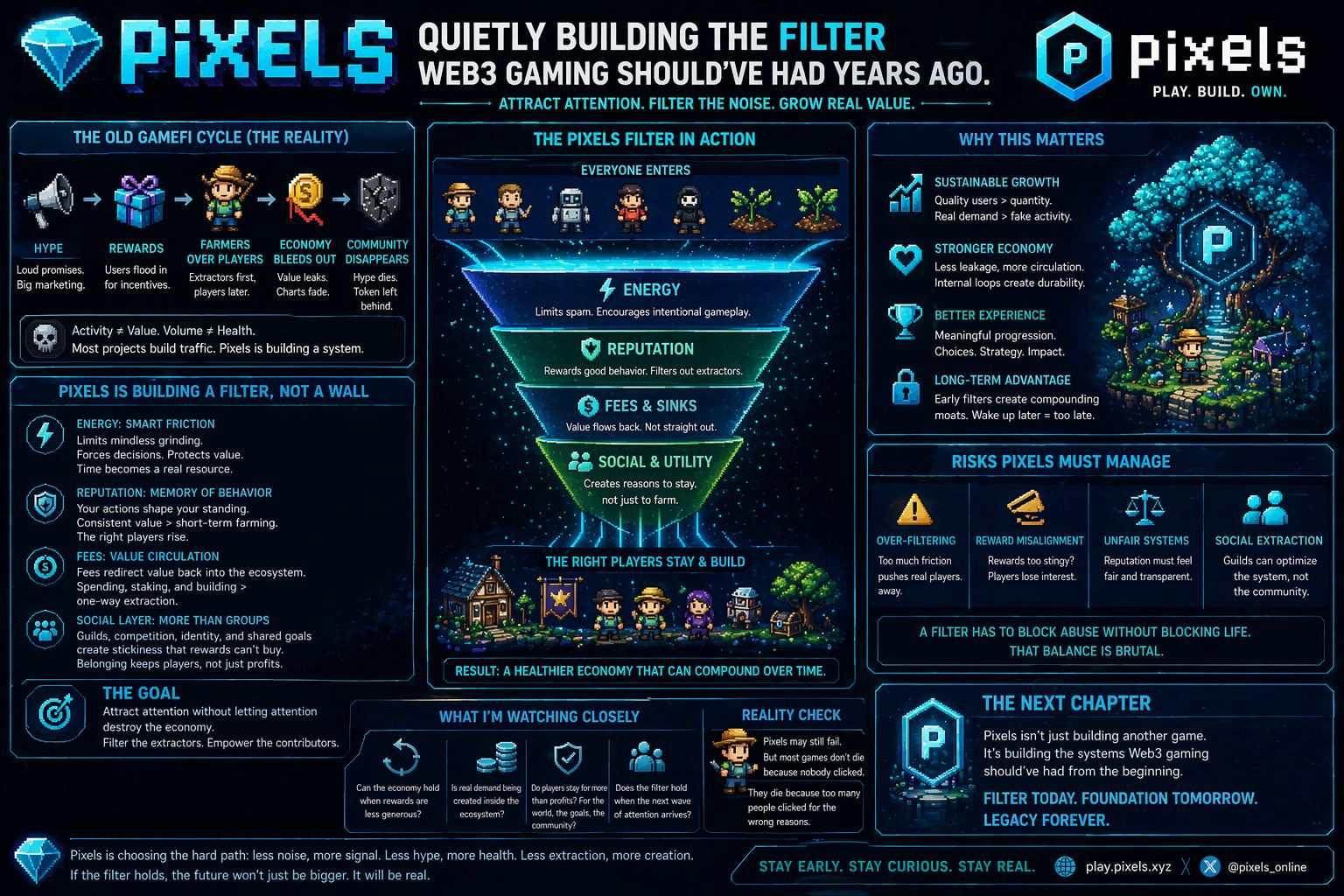
Pixels seems more skeptical than that. It appears to understand that an open economy needs filters. Not walls. Filters.
There’s a difference.
Walls kill participation. Filters shape it.
That’s where mechanics like energy become interesting. Some players hate limits. Fair complaint. Nobody enjoys being slowed down when they want to grind. But unlimited grinding is how economies become hollow recycling machines.
Click. Earn. Sell. Leave.
Looks lively from the outside. Dead on the inside.
Energy introduces friction. Useful friction. It forces choices. Where do you spend time? Which actions matter most? You can’t spam the same behavior endlessly and expect value to remain valuable.
Simple idea.
Rarely respected.
I’ve seen too many teams chase vanity metrics instead. More transactions. More claims. More screenshots for the timeline ego trip. Then months later they’re suddenly talking about sustainability like it was always the plan.
Pixels seems to be thinking about it earlier.
That doesn’t guarantee success. Nothing in crypto gets guarantees. But I’d rather watch a team trying to manage leaks than one celebrating leaks as growth.
Then there’s reputation.
This is where things get more serious.
A wallet can be active and still be useless. A player can grind daily and add nothing but sell pressure. A user can show up every week only because rewards are easy. Metrics often hide that reality.
Reputation creates memory.
Your behavior starts to matter over time. The system begins asking not just “Are you here?” but “How are you here?”
That distinction is gold.
I’ve had moments in online games where the people adding the most value weren’t the loudest or richest—they were the consistent ones. The builders. The organizers. The players who stayed when rewards got boring. If Pixels can recognize those users better than extractors, that’s meaningful.
It also makes pure farmers uncomfortable.
Good.
Not because farmers are villains. Because incentives matter, and healthy systems shouldn’t treat every behavior equally.
Fees are trickier.
People hate fees. I get it. Fees feel like drag. They feel like someone’s hand in your pocket. And badly designed fees absolutely can become dead weight.
So I’m cautious here.
But fees can also redirect behavior. If leaving the ecosystem is always the easiest and most rewarded move, users will leave. Every time. If participation, spending, staking, or building inside the world has more relative value, the loop changes.
That’s what I’m watching with Pixels.
Not whether fees exist.
Whether they do anything useful.
Because one-way value movement kills game economies. Rewards flow out, nothing meaningful flows back, and eventually the token becomes a drainpipe wearing cute graphics.
Pixels appears to be trying the opposite route: keep some value circulating internally through spending loops, progression systems, staking, and social engagement.
Not glamorous.
Useful.
The social layer matters too, maybe more than many admit.
Players don’t stay only because numbers go up. They stay because they have status, routine, competition, friends, habits... reasons that don’t fit neatly into token spreadsheets. Shared goals create stickiness. Recognition creates attachment. Leaving starts to feel heavier.
That’s powerful.
But here’s the downside.
Social systems can become extraction networks too. Guilds farming harder. Groups optimizing rewards faster. Coordinated pressure instead of genuine community. I’ve seen that movie as well.
So Pixels still has to prove the social layer creates belonging, not just better farming squads.
That’s the real exam.
And then there’s the biggest risk of all: over-filtering.
If friction gets too heavy, real users feel punished. If rewards feel stingy, attention fades. If reputation systems feel unfair, trust cracks. If progression feels like admin work, casuals disappear.
A filter has to block abuse without blocking life.
That balance is brutal to maintain.
Still, Pixels at least seems aware of the challenge. That alone separates it from many projects that repeated old reward models, changed the art, and acted shocked when users behaved exactly how incentives told them to behave.
Mechanics decide more than community slogans ever will.
That’s why I’m less interested in the visible farming loop and more interested in the invisible sorting underneath it. Users being nudged toward stronger behavior. Extraction getting slower. Participation carrying more weight. Value circulating instead of instantly escaping.
That’s serious design work.
And serious is rare in Web3 gaming.
Pixels may still fail. Entirely possible. Markets punish clean theories all the time.
But most games don’t die because nobody clicked.
They die because too many people clicked for the wrong reasons.
Pixels seems to understand that.
The question now is simple... when the next wave of attention arrives, will the filter hold?