
Introduction
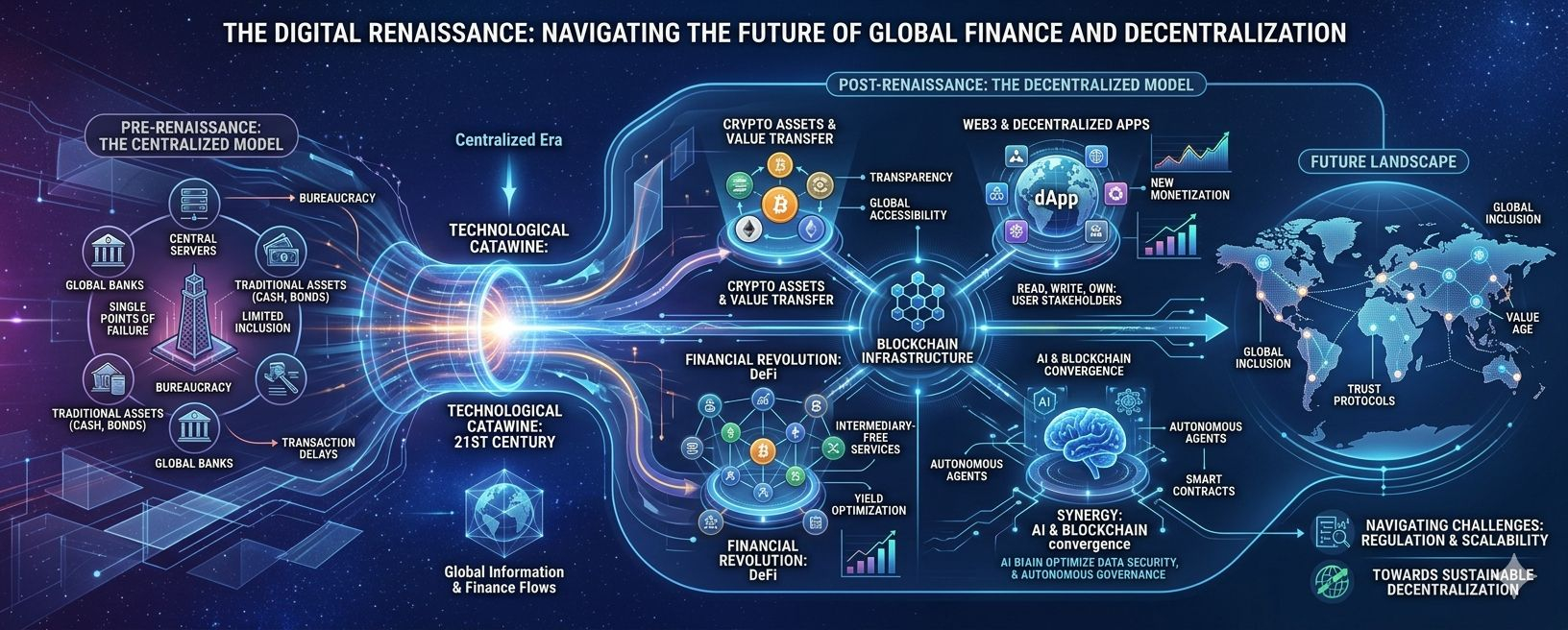
The dawn of the 21st century brought with it the "Information Age," but we have quickly transitioned into something far more profound: the Value Age. For decades, the internet functioned primarily as a medium for communication and data exchange. Today, it has evolved into a sophisticated layer of global infrastructure that facilitates the real-time transfer of value, ownership, and trust without the need for traditional intermediaries.
The Shift from Centralization to Decentralization
Historically, our financial and social systems have been built on a foundation of centralization. Whether it is a central bank managing a nation’s currency or a social media giant controlling user data, the power has resided at the "center."
However, the rise of Blockchain Technology has introduced a paradigm shift. Decentralization is not just a buzzword; it is a structural redesign of how systems function. By distributing data across a global network of computers, we eliminate "single points of failure." This shift offers three primary advantages:
Transparency: Every transaction is recorded on a public ledger, visible to all but alterable by none.
Security: Cryptographic protocols ensure that assets cannot be duplicated or stolen through traditional hacking methods.
Inclusion: Anyone with an internet connection—regardless of their geographic location or socioeconomic status—can participate in the global economy.
The Rise of Digital Assets and Web3
The most visible manifestation of this evolution is the cryptocurrency market. What started as an experiment with Bitcoin has blossomed into a multi-trillion-dollar ecosystem including Ethereum, DeFi (Decentralized Finance), and NFTs.
Web3 represents the next iteration of the internet. In Web1, we "read." In Web2, we "read and wrote" (social media). In Web3, we "read, write, and own." In this new era, users are no longer the product; they are stakeholders. Content creators can now monetize their work directly through tokenization, bypassing the hefty fees charged by traditional platforms.
The Convergence of AI and Blockchain
As we look toward 2026 and beyond, the intersection of Artificial Intelligence (AI) and Blockchain will be the ultimate game-changer. AI requires massive amounts of data and computing power, while Blockchain provides a way to verify the authenticity of that data. Together, they can create autonomous systems that manage wealth, optimize supply chains, and even govern digital communities (DAOs) with unprecedented efficiency.
Challenges on the Horizon
Despite the optimism, the path forward is not without hurdles. Regulatory frameworks are still catching up to the pace of innovation. Governments worldwide are struggling to balance the need for consumer protection with the desire to foster technological growth. Furthermore, the issues of scalability (how many transactions a network can handle) and user experience remain significant barriers to mass adoption.
Conclusion: The Road Ahead
The transition to a decentralized digital economy is inevitable, but it will be a marathon, not a sprint. We are moving toward a world where "Trust" is programmed into the code rather than granted by institutions. For investors, creators, and daily users, the secret to success in this new era lies in continuous learning and adaptability. The digital frontier is vast, and we are only just beginning to map its potential. As the lines between the physical and digital worlds continue to blur, those who understand the underlying mechanics of this shift will be the ones who lead the next generation of global progress.
Key Takeaways for the Reader:
Ownership is Key: Moving from being a consumer to an owner is the core philosophy of the new internet.
Security First: As the value of digital assets grows, personal security and "cold storage" practices become essential.
Beyond the Hype: Look past the price volatility to understand the actual utility of the technology being built.
Would you like me to rewrite this on a specific topic like Gaming, Fitness, or a speci
fic Trading Strategy?