
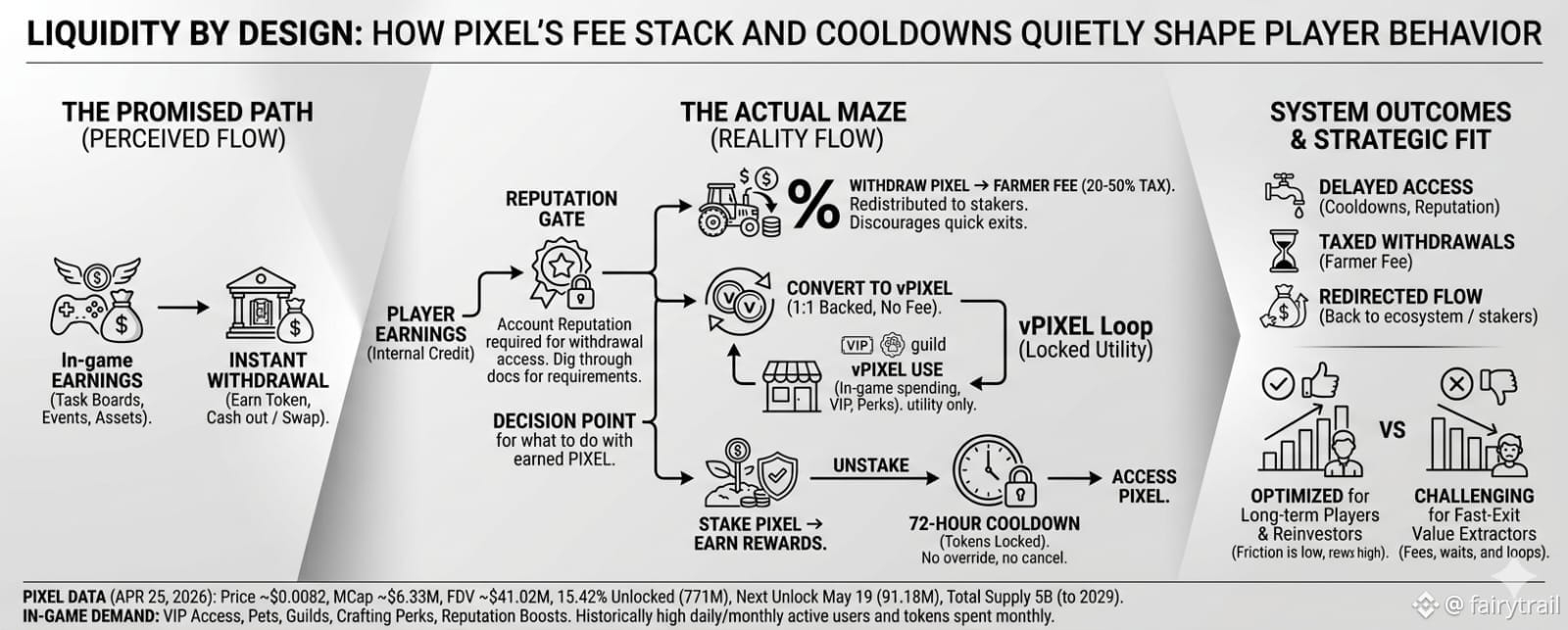
I remember the first time I tried to withdraw my PIXEL. It wasn’t a huge amount—just under 1,200 tokens I’d built up over a few months of playing, grinding tasks, and occasionally flipping in-game assets. In my head, it was simple: earn token, withdraw token, maybe swap it later. That’s how most Web3 games sell the loop.
But what actually happened felt less like a withdrawal and more like navigating a maze with invisible toll booths.
Let’s walk through it the way I experienced it.
At the start, your PIXEL balance isn’t really “money” in the way most players assume. It’s more like store credit. You earn it through gameplay—task boards, events, staking rewards—but it sits inside the game’s internal system. It looks like a token, it behaves like a token, but until you initiate withdrawal, it’s just a number tied to your account.
That distinction didn’t fully hit me until I tried to move it.
The first friction point? Reputation. I didn’t even know this was a gate until I hit it. There’s no clear dashboard telling you, “You need X reputation to withdraw Y amount.” I had to dig through help docs to realize my account wasn’t optimized for extraction. So I had earned something I couldn’t actually access yet. That was the first moment I paused.
Then came the Farmer Fee.
This is where things got real. Depending on your reputation, withdrawing PIXEL means giving up 20% to 50% of your tokens. I did the math on my 1,200 PIXEL and realized I might walk away with closer to 700. That’s not a network fee—that’s a structural redistribution to stakers.
And to be fair, I get the logic. Reward long-term participants. Discourage quick exits. But from a user perspective, it felt like discovering a hidden tax after the work was already done.
I hesitated. I even considered converting to vPIXEL instead.
On paper, vPIXEL looks like a workaround. It’s 1:1 backed, no Farmer Fee on withdrawal, and works for in-game spending. But then you realize—you can’t sell it. You can’t transfer it. It’s essentially locked utility. The only way to turn it into tradeable PIXEL? Deposit it back into the game and withdraw again… triggering the same Farmer Fee you were trying to avoid.
So it’s not really a workaround. It’s a loop.
And if you’ve staked your PIXEL—which many players do for rewards—you’re also dealing with a 72-hour cooldown. I actually made the mistake of unstaking impulsively once, thinking I could react to a price move. That decision locked my tokens for three days. No override. No cancel button.
In crypto, three days is an eternity.
Now layer this system against the current market data.
As of April 25, 2026, PIXEL is trading around $0.008216, with a 24-hour volume of $22.26 million, a market cap of $6.33 million, and a fully diluted valuation (FDV) of $41.02 million. The MCap/FDV ratio sits at roughly 0.15, which tells you most of the supply hasn’t hit the market yet.
Right now, about 771 million PIXEL are unlocked—15.42% of the total 5 billion supply. The next unlock hits May 19, 2026, adding another 91.18 million tokens across multiple allocations: team, advisors, ecosystem rewards, and investors. And this schedule stretches all the way to 2029.
That matters.
Because when you combine a low float with heavy withdrawal friction, you’re effectively shaping supply behavior. Tokens don’t just flow freely—they’re delayed, taxed, or redirected back into the ecosystem.
And the ecosystem itself has real sinks.
PIXEL isn’t just sitting idle. It’s used for VIP access, pets, guilds, crafting perks, and reputation boosts. Historically, the game has shown real demand—over 1 million daily active users at one point, 2.8 million monthly users, and millions of tokens spent monthly. In December 2024 alone, 10 million PIXEL were used in-game.
So the demand side exists. That’s not the issue.
The real question is: who is this system optimized for?
If you’re a long-term player who enjoys the game, stakes regularly, and spends your earnings inside the ecosystem, everything works smoothly. You barely feel the friction. vPIXEL is useful. Auto-staking is convenient. The system rewards your behavior.
But if you’re someone who treats PIXEL as both a game reward and a financial asset—someone who might need liquidity at some point—you’re in a very different position.
You’re paying fees, waiting through cooldowns, and navigating conversion loops.
That’s not accidental. It’s design.
And I think that’s where the disconnect lies.
The onboarding narrative still leans into ownership—earn tokens, own assets, participate in Web3. But the exit path tells a more nuanced story: ownership exists, but liquidity is conditional.
To me, that doesn’t make the system bad. It just makes it specific.
It’s a closed-loop economy with controlled exits.
So if you’re entering now, especially at a price that’s already down over 99% from its $1.02 all-time high, you need to think carefully about your intent. Are you here to play and reinvest? Or are you here to extract value over time?
Because the system treats those two paths very differently.
Personally, I still play. I still earn. But I’ve adjusted my expectations. I treat PIXEL more like in-game capital than liquid crypto. That mental shift made everything clearer.
But I’m curious—how do you see it?
Are these mechanics a smart way to sustain the ecosystem, or do they create too much friction for players who want flexibility? And if you’ve tried withdrawing yourself… did your experience feel straightforward, or something closer to a maze?
$PIXEL @Pixels #pixel $HYPER $AXS
