I used to think the simplest way to understand Pixels was through activity.
You log in.
You farm.
You craft.
You check the Task Board.
You try to move forward.
That is the surface version of the game.
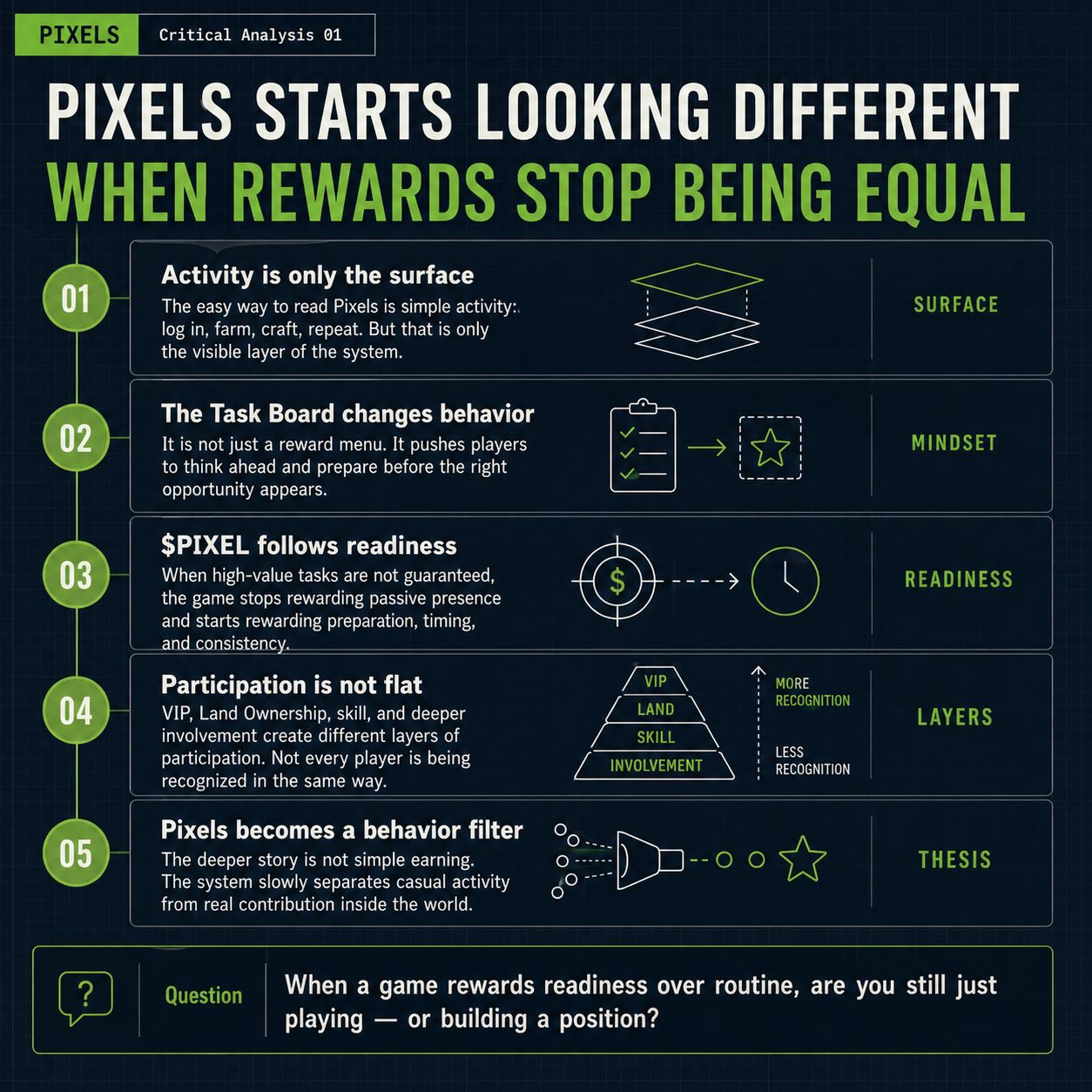
But the more I look at how the system is actually designed, the less I think activity alone is the real story. Activity is only the entry point. The deeper layer is about what kind of player the system slowly starts recognizing.
That difference matters to me.
Because in a normal casual game, showing up is usually enough. The game gives you something to do, you complete a few loops, and the session ends. But Pixels feels more serious when I stop reading it like a simple farming loop and start reading it like a behavior filter.
The Task Board is a good example.
On the surface, it looks simple. Hazel gives tasks, players deliver items, and rewards come back in the form of Coins, EXP, and sometimes $PIXEL. But that simplicity is misleading. The Task Board is not just a reward menu. It changes how players think before they even start playing.
You stop asking, “What should I do today?”
You start asking, “What should I prepare before the opportunity appears?”
That is a different mindset.
And this is where Pixels becomes more interesting than many people realize. If $PIXEL tasks are not guaranteed every day, then the game immediately becomes less about passive earning and more about readiness. You cannot just assume the system will hand you the same path every session. You have to build around uncertainty.
That creates a stronger economy.
Weak game economies reward everyone in a flat way. They treat every user as equal, even when every user is not contributing equally. That usually creates shallow behavior. People show up only when rewards are easy, extract what they can, and leave when the loop becomes harder.
Pixels feels sharper because the structure is not that flat.
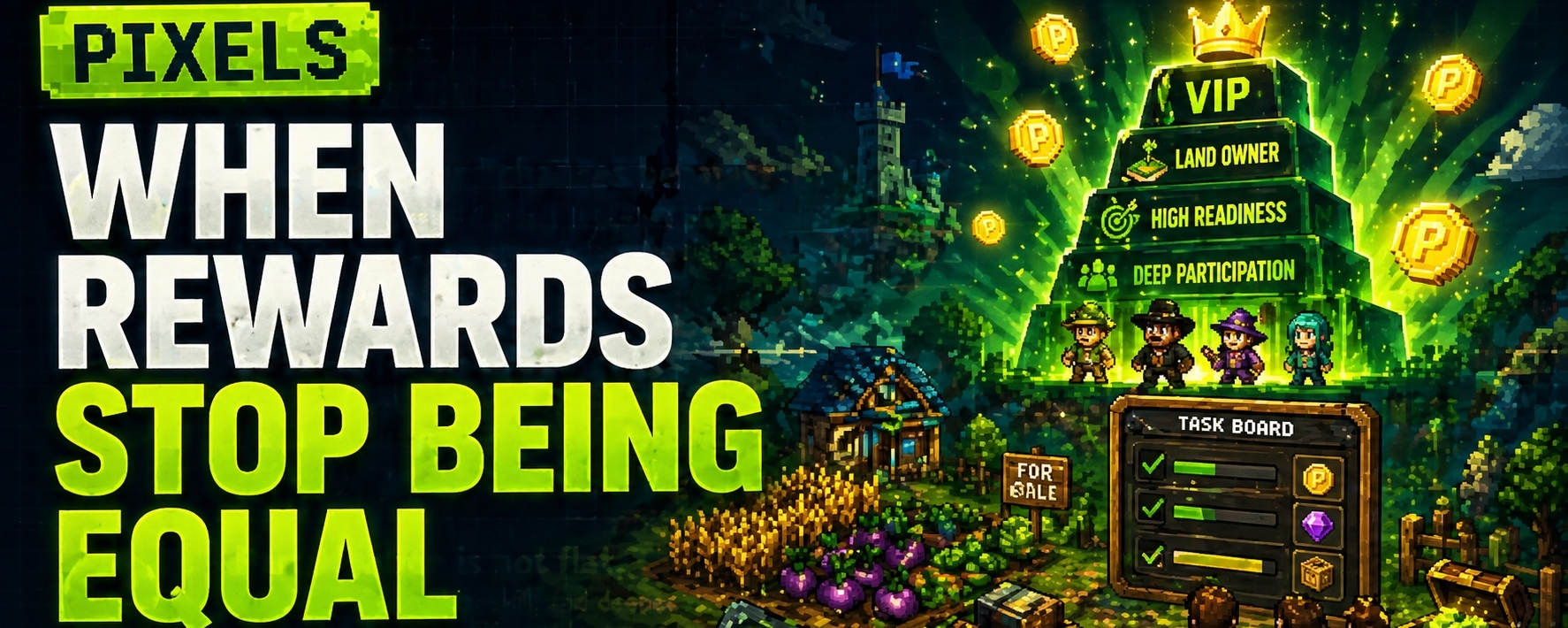
VIP, Land Ownership, skill, reputation, and spending behavior all start to matter in how the world reads a player. That does not mean every player needs to own land or pay to matter. That would be a lazy way to explain it. The better point is that Pixels is building different levels of participation inside one world.
Some players are casual.
Some players are consistent.
Some players are builders.
Some players are land-focused.
Some players become part of deeper production and coordination loops.
That layered design is what keeps catching my attention.
Because once a game can separate different kinds of contribution, the economy becomes harder to fake. Time alone is not enough. Random activity is not enough. The player who understands the system better has an advantage. The player who prepares resources better has an advantage. The player who owns, coordinates, or participates more deeply has a different position inside the world.
That is not just gameplay.
That is economic design.
And honestly, this is where many Web3 games failed before. They confused rewards with retention. They thought if players could earn something, players would stay. But rewards without structure usually attract the weakest kind of attention. People come for extraction, not for the world.
Pixels has a better chance because the reward path is tied to behavior inside the game itself.
Farming matters.
Crafting matters.
Land matters.
Timing matters.
Preparation matters.
Social and economic position matter.
That makes the game feel less like a reward faucet and more like a living system.
The farm is still there, but the meaning of the farm changes. It is no longer just a place where you plant things. It becomes a base for preparation. It becomes a small economic engine. It becomes part of a wider structure where what you own, what you build, and how consistently you participate can shape your position.
That is why I think Pixels is becoming harder to dismiss as “just another farming game.”
A simple farming game gives players tasks.
A stronger economy gives players reasons to think ahead.
That is the difference I keep coming back to.
Pixels does not feel interesting to me because it makes every action look big. It feels interesting because small actions start connecting into a bigger system. The player is not only playing the loop anymore. The player is being measured by how they move inside the loop.
And once that happens, the game starts feeling more serious.
Not louder.
Not more complicated.
Just more intentional.
That is where Pixels feels different to me now.
The reward is not the whole story.
The real story is how the system decides who is actually ready for it.