
I think the easiest mistake to make with Pixels is to treat the $BERRY phase-out like a normal token swap story.
One token out. One token in. Cleaner ticker. Better branding. Move on.The more I read Pixels’ explanation, the more it feels like this was not just a small token change. It feels like they knew the old game economy was getting harder to justify.
That is the part I find interesting.
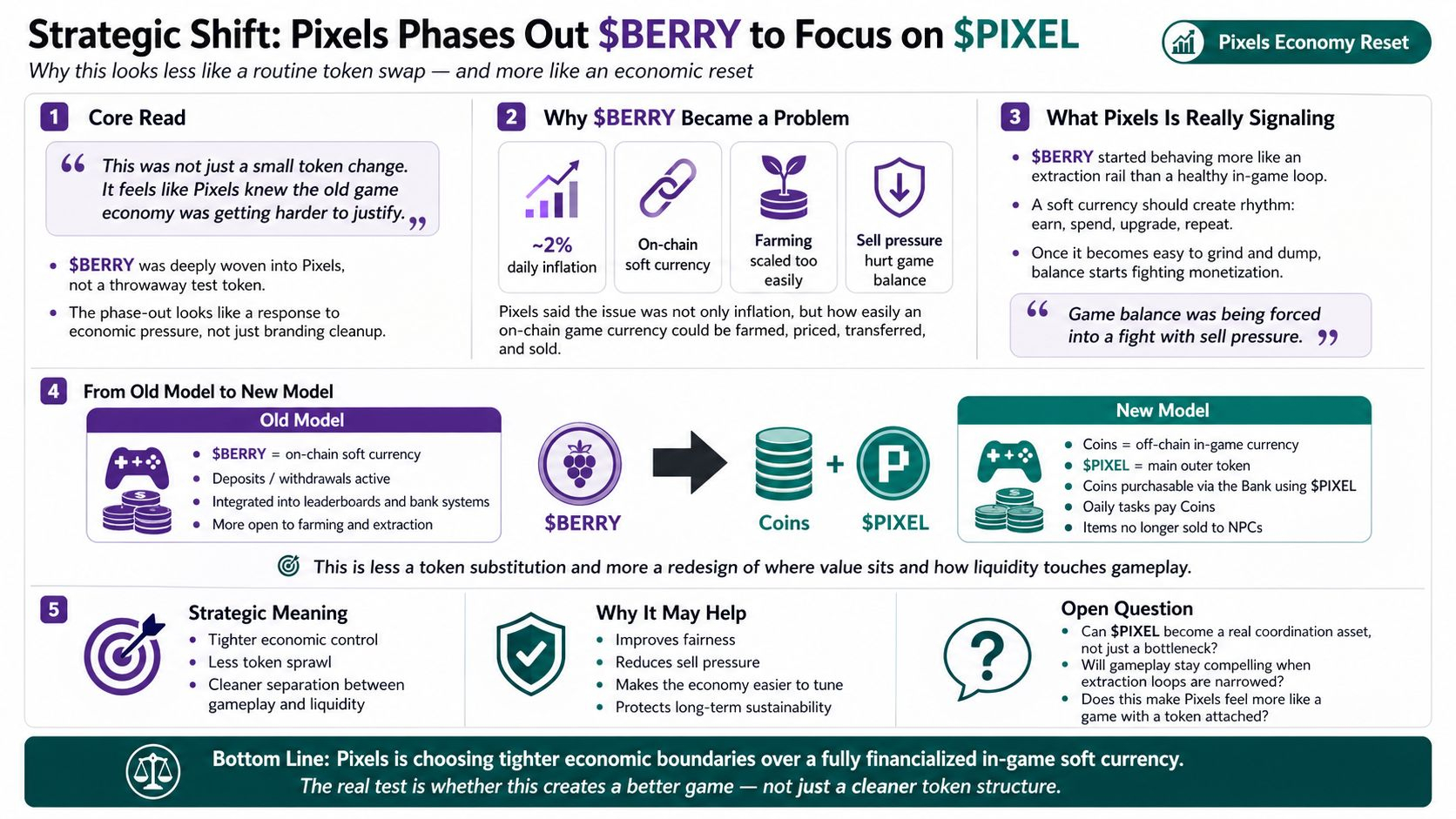
Because $BERRY was not some side feature buried in the game. It had been deeply woven into Pixels’ economy for a long time. The game’s archived updates show $BERRY deposits and withdrawals opening in 2023, $BERRY going live on Ronin later that year, and even in-game systems like leaderboards and bank references built around it. In other words, this was not a disposable test token. It was part of how the game actually functioned.
So when Pixels says it has “evolved how we think about our tokens in-game” and made the “strategic decision to focus on $PIXEL and to phase out $BERRY,” I do not read that as routine housekeeping. I read it as a project deciding that the old dual-token structure was creating more economic drag than strategic value.
And honestly, the reason they give is pretty blunt.
Pixels says $BERRY was experiencing about 2% daily inflation, and that even before Chapter 2 fully addressed the model, they wanted to act early to protect long-term sustainability. They also say the problem was not just inflation in the abstract, but the difficulty of running an on-chain soft currency inside a live game where farming can be scaled and sold too easily. That is a much more revealing explanation than the usual “we are optimizing tokenomics” language projects hide behind
What they are really saying, at least to me, is that $BERRY had started to behave less like a helpful in-game loop and more like an extraction rail.
That distinction matters.
A soft currency inside a game is supposed to help create rhythm. Earn, spend, upgrade, repeat. It gives players motion. But once that currency lives on-chain and becomes easy to grind, transfer, price, and dump, it stops acting like a normal game currency. It starts acting like a monetizable output. And the moment that happens, game balance gets forced into a fight with sell pressure. Pixels more or less says exactly that when it notes that Web3 makes it easier for farmers to grind harder and sell more easily than in traditional MMOs.
That is why I think the real shift here is not just from $BERRY to $PIXEL.
It is from a game with an on-chain soft currency to a game trying to reassert control over its economic layers.
The replacement structure makes that pretty obvious. Pixels introduced Coins as the new in-game currency, and those Coins are off-chain, while still being purchasable using $PIXEL through the Bank. At the same time, the game said players would no longer be able to sell items to NPCs, daily tasks would pay out Coins, and the broader game would start shifting toward the Chapter 2 model. That is not just a token substitution. That is a redesign of where value sits and how liquidity touches gameplay.
And that, to me, is the strategic heart of it.
$BERRY looked like a game currency, but its on-chain design made it harder to keep the game economy from becoming a farming contest. Coins are much less ideologically pure from a crypto perspective, but probably much easier to manage from a game-design perspective. Then pixel becomes the cleaner outer asset: the token that interfaces with premium access, conversion, and broader ecosystem value, without forcing every routine gameplay loop to carry the full burden of an openly tradable inflationary soft currency.
That also explains why Pixels framed the move as protecting $PIXEL, not just replacing $BERRY. Their FAQ says Chapter 2 would require players to strategize and work together for token rewards, while moving $BERRY into an off-chain coin model to improve fairness, reduce sell pressure, and simplify the economy around a single token. That sounds less like expansion and more like consolidation under pressure.
I actually think that is the honest part of the story.
A lot of Web3 games spent years pretending they could have everything at once: a soft currency that feels fun, an on-chain asset that feels liquid, a rewards loop that attracts users, and an economy that does not collapse under farming. Pixels seems to have decided that this balancing act was not worth defending anymore. The move away from $BERRY feels like a quiet rejection of the idea that every in-game currency needs to be freely financialized to matter.
My only hesitation is that simplification does not automatically solve the deeper problem.
Moving $BERRY out and centering pixel can reduce one source of inflationary pressure, yes. It can also make the economy easier to tune. But it also puts more conceptual weight on $PIXEL itself. Once one token becomes the main bridge between gameplay, premium spend, and ecosystem value, the design burden shifts rather than disappears. The question becomes whether the game can make $PIXEL feel like a meaningful coordination asset instead of just a cleaner bottleneck. That part is harder, and I do not think the phase-out alone proves it. The official material explains the transition mechanics clearly, but the long-term success of the model still depends on whether gameplay stays compelling when the extraction loops are narrowed.
Still, I think the direction is pretty clear.
Pixels is no longer trying to let an on-chain soft currency do too much. It is choosing tighter economic control over token sprawl. Less “everything is a market,” more “the game economy needs boundaries.” In Web3 gaming, that is actually a bigger strategic shift than it sounds.
What I’m watching now is simple: whether this makes Pixels feel more like a game with a token attached, or just a better-organized token economy pretending to be a game. That line is still the whole story.