
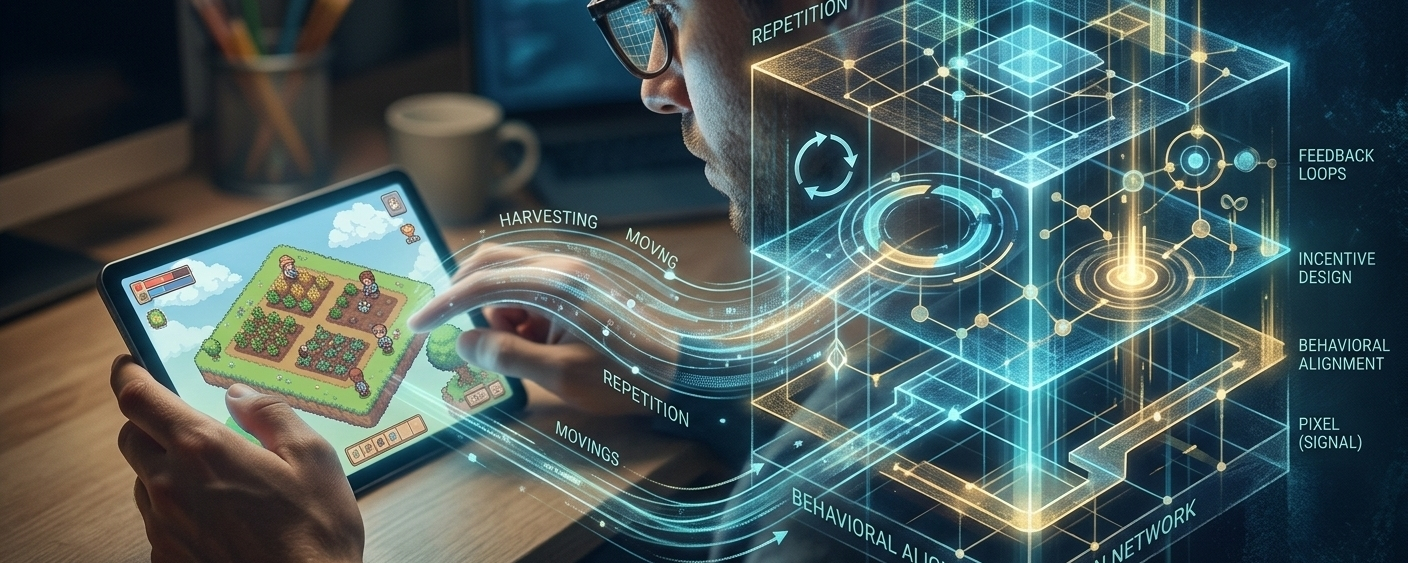
At first, I didn’t really think there was anything to understand.
Pixels just felt like one of those quiet Web3 games you open without expectations. You move around, you farm a bit, you gather resources, you click through simple actions that feel almost too familiar—like something I had already done a hundred times in different forms, just under a new label. Farming, exploring, collecting. Nothing about it immediately suggested depth. It looked like repetition wrapped in novelty.
And honestly, I treated it that way.
A routine. A loop. Something to check in on when there was nothing else to do.
But the strange part was how that “loop” didn’t behave like a normal game loop.
It didn’t collapse into boredom the way I expected it to.
Instead, it started to stretch.
At first, I thought I was just spending more time in it. But slowly I realized it wasn’t just time—it was attention being redistributed. I began noticing that small actions weren’t isolated. Harvesting wasn’t just harvesting. Moving wasn’t just movement. Even idle decisions seemed to sit inside a larger pattern I wasn’t fully seeing yet.
I couldn’t name it, but I could feel it: something was being tracked, reflected, and gently rewarded in ways that weren’t immediately visible.
That’s when my understanding started to shift—not dramatically, but quietly, like a background process updating without notification.
I started paying attention to rewards, expecting them to behave like traditional game systems: do X, get Y. Clean and predictable. But Pixels didn’t feel that linear. The rewards didn’t always match effort in the obvious way. Sometimes they felt delayed. Sometimes indirect. Sometimes tied to things I didn’t even realize I was optimizing for.
At first, it felt inconsistent.
Then it started to feel intentional.
Because I began noticing connections.
Not just between actions and rewards, but between systems themselves. Farming wasn’t just a source of resources—it was feeding into timing, positioning, opportunity. Exploration wasn’t just discovery—it was exposure to new loops, new efficiencies, new patterns of engagement. Even creation, which I initially thought of as decorative or optional, started to feel like a signal rather than a pastime.
It wasn’t that the game had more mechanics than I expected.
It was that the mechanics were talking to each other.
And I wasn’t used to listening in that way.
Somewhere in that phase, I stopped thinking in terms of “doing tasks” and started thinking in terms of “placing actions.”
That was a subtle but important shift.
Because tasks are isolated. Placement implies context.
And context, I realized, is where value actually forms.
That’s when Pixels stopped feeling like a set of features and started feeling like a system of relationships. My actions weren’t just producing outcomes—they were positioning me inside a network of evolving incentives. What mattered wasn’t just what I did, but how what I did interacted with everything else I had already done.
It stopped being about efficiency in the traditional sense.
It started being about alignment.
At that point, even staking and reward-like mechanics—things I initially treated as secondary systems—began to feel more central. Not because they were complicated, but because they acted like amplifiers. They didn’t just reward participation; they reshaped how participation mattered over time. They turned simple engagement into something that accumulated weight, meaning, and direction.
And that’s where the deeper realization landed.
I wasn’t just playing anymore.
I was adjusting.
Not in a reactive way, but in a slow, almost subconscious calibration—like tuning myself to the logic of the system rather than forcing the system to conform to me.
What surprised me most was how natural that transition felt. There was no moment where everything clicked loudly. No single breakthrough. Instead, there was a gradual reorganization of how I interpreted cause and effect inside the game.
Actions stopped being “inputs.”
They became positioning decisions inside a living economy of attention, time, and behavior.
And once you start seeing it that way, it’s hard to unsee it.
Because suddenly you start asking different questions.
Not “what gives me the most right now?”
But “what puts me in the best position later?”
Not “what is the reward for this action?”
But “what does this action connect me to?”
That shift changes how you move through the system.
And maybe more importantly, it changes how the system moves through you.
Now, when I log in, it doesn’t feel like I’m entering a game in the traditional sense. It feels more like stepping into an ongoing structure that I’m already partially embedded in—even when I’m not actively playing. There’s a continuity to it that doesn’t depend on presence alone.
And that raises a strange thought I keep returning to:
If a system continues to shape your position even when you are not actively engaging with it… at what point does participation stop being an action, and start becoming an identity within that system?
Or maybe the more uncomfortable question is this:
Are we playing the system… or are we slowly learning how to recognize the system already playing us?
