


I’ve been thinking about what happens when optimization doesn’t just shape a system… but starts folding back into it 😁
Most of the time, the pattern is simple. Players find the best path, everyone follows it, and the system either breaks or resets. It’s a familiar cycle. Efficiency wins, variety disappears, and everything compresses into one dominant loop.
With Pixels, it doesn’t feel like that cycle has fully played out yet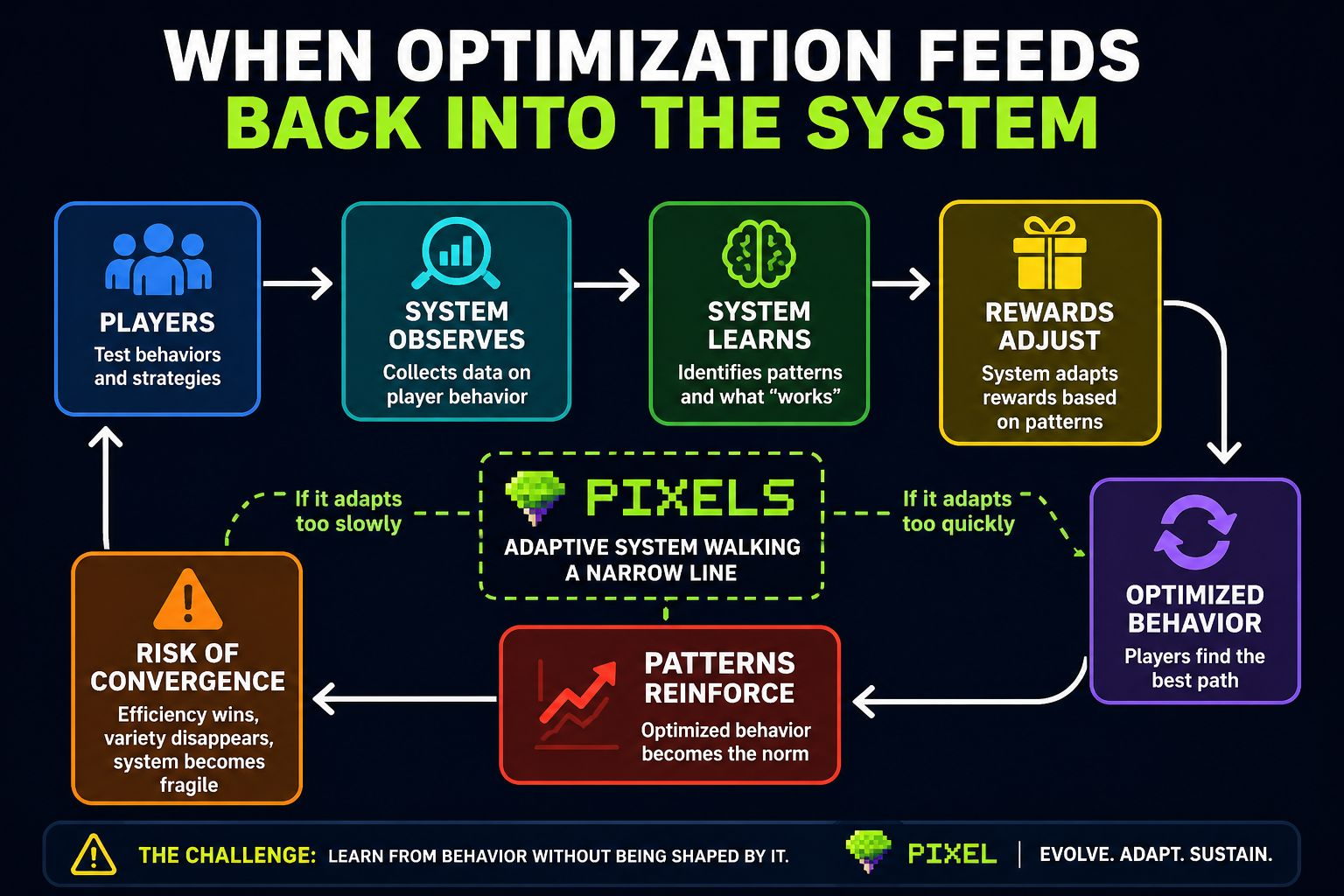
But you can see the early signs of it forming
That’s the part I keep coming back to.
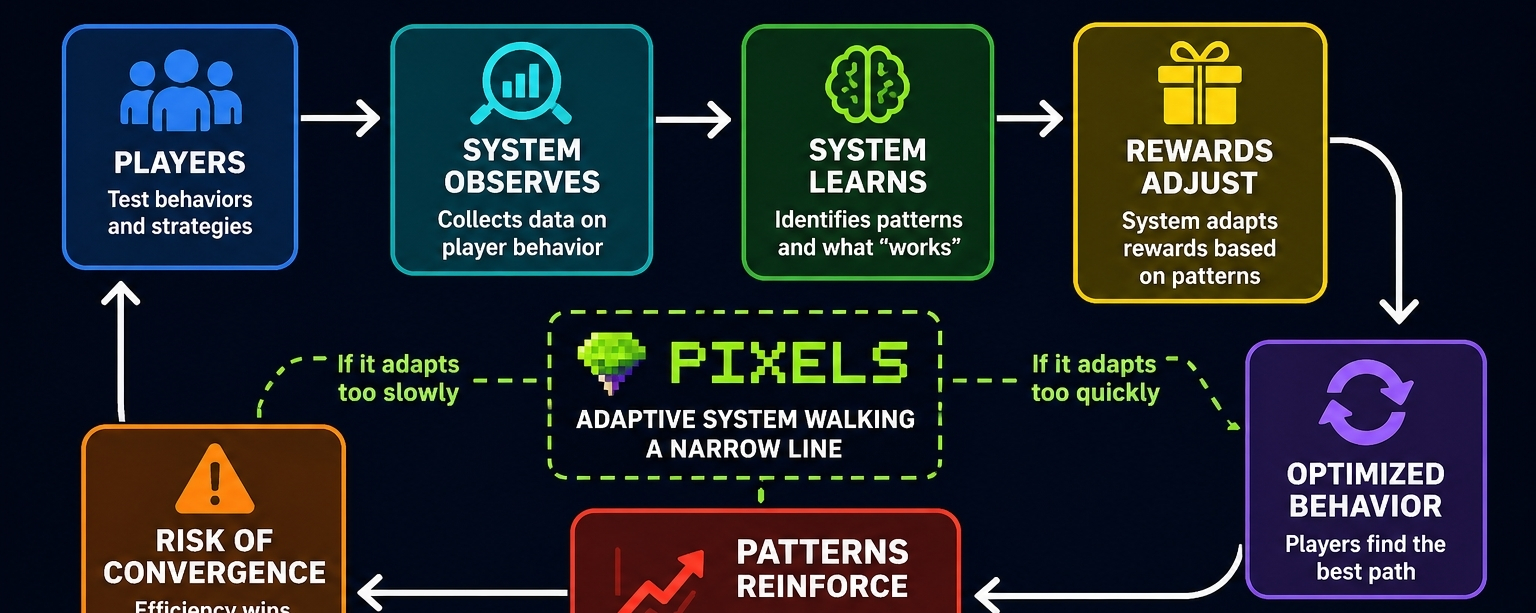
Because if the system is built to adapt, then optimization doesn’t just sit on top of it feeds into it. Players test behaviors, the system learns from those patterns, and then adjusts rewards based on what it sees.
At first, that seems like a solution.
But over time, it can create something more complex.
Because once optimized behavior becomes part of the data the system learns from, it starts reinforcing itself. Not intentionally, just as a side effect of recognizing what appears to “work.” And if enough players converge on similar strategies, those patterns start looking like strong signals 🤔
Even if they’re not sustainable.
That’s where things get a bit fragile.
Because the system might not just respond to optimization…
It might absorb it.
And once that happens, the line between healthy behavior and exploitative behavior gets harder to separate. What looks like engagement could actually be repetition. What looks like value could just be coordination at scale.
I’m not sure there’s a clean way around that $PIXEL
Adaptive systems rely on data, but data reflects behavior — and behavior changes once people understand how to extract value. It becomes a feedback loop that can drift without obvious warning signs.
Slowly, not all at once.
@Pixels seems to be navigating that space right now. Not fully optimized, not fully stable either. Just enough movement to keep things from locking in, but not enough distance to avoid the pressure building underneath.
And that pressure tends to grow over time.
Because the more value enters the system, the more effort goes into finding edges. And once those edges are found, they rarely stay isolated. They spread, get refined, and eventually become the norm
That’s when systems usually collapse into themselves.
Not because they fail technically, but because everything becomes too efficient in the same direction.
I don’t know if Pixels avoids that.
But I do think it’s aware of it, at least structurally. The way it keeps things slightly unstable, slightly shifting, feels like an attempt to prevent full convergence
The question is how long that can hold.
Because if the system adapts too slowly, optimization takes over. If it adapts too quickly, players never fully understand what’s happening. And somewhere in between, there’s a balance that’s hard to maintain.
I’m not sure where Pixels sits on that spectrum yet.
But it does feel like it’s walking a narrow line.
Between learning from behavior & being shaped by it.
And that’s not a static problem.
It’s something that evolves with every player that enters the system.
