
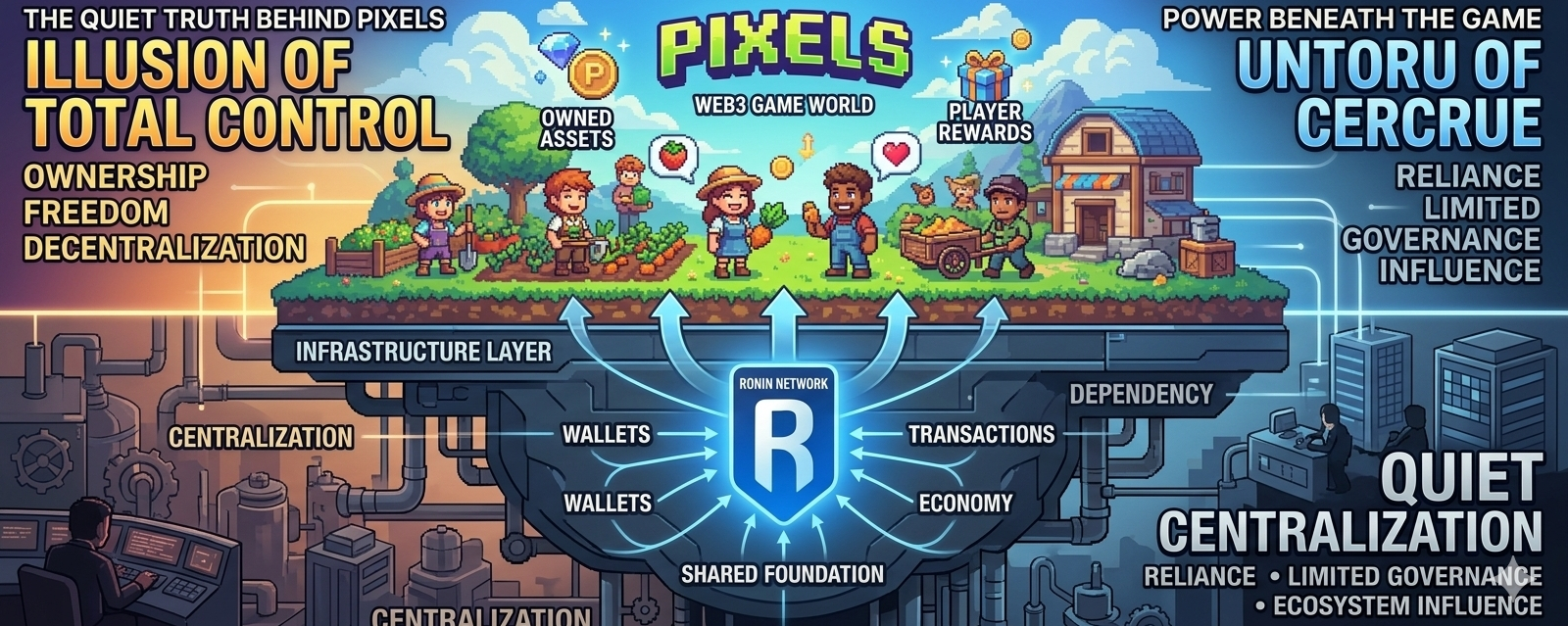
@Pixels There is something very appealing about the way Web3 games are usually described. The language feels empowering. Words like ownership, decentralization, freedom, and player control create the impression that the balance of power has finally shifted away from companies and toward the people who actually play the game. Pixels is often placed right at the center of that conversation. It has grown quickly, built a strong community, and created a space where players can farm, explore, interact, and earn in ways that traditional games never really allowed. On the surface, it feels like a living example of what Web3 promised from the beginning. Players are not just spending time, they are building value. They are not just users, they are participants. But when you look a little deeper, beyond the gameplay and the rewards, the picture becomes more complex than it first appears.
The real structure of a Web3 game does not only exist inside the game world. It lives underneath it, in the systems that most players never stop to think about. For Pixels, that underlying system is Ronin. It is easy to think of Ronin as just another blockchain, but in reality, it plays a much larger role. It connects wallets, moves assets, supports transactions, manages access, and shapes how players enter and interact with the entire ecosystem. Pixels may feel like its own independent world, but a large part of its stability, growth, and accessibility depends on the network it is built on. That means the freedom of the game is not entirely its own. It is tied to the structure that supports it, and that structure has its own rules, limits, and influences.
When Pixels moved from Polygon to Ronin, it was seen as a strong and strategic step forward. The transition brought faster transactions, lower costs, and direct access to a gaming-focused ecosystem that already had momentum. It helped Pixels reach more players and grow at a speed that would have been difficult elsewhere. From the outside, it looked like a clear upgrade. But choices like this are never purely technical. They also shape dependency. By aligning itself with Ronin, Pixels did not just gain better infrastructure, it also placed itself closer to the center of another system’s gravity. The game became more connected, but also more reliant.
This reliance is not always obvious, but it shows itself in subtle ways. The way players log in, the way assets move, the way rewards are withdrawn, and even how the economy flows are all influenced by the network underneath. If Ronin changes how wallets work, Pixels must adjust. If bridge costs or token requirements shift, players feel it immediately. If something goes wrong at the network level, the game cannot fully separate itself from that impact. Even the simplest actions inside the game are often linked to a larger system that operates beyond the control of the game itself. This creates a situation where the game feels independent, but its foundation is shared.
Web3 often promises independence, but in reality, infrastructure creates boundaries. Pixels can design its world, balance its rewards, and build its community, but it does not fully control the rails it runs on. That creates a quiet kind of centralization, one that does not always feel negative but still exists. It does not come from obvious authority, but from reliance. As the game grows, that reliance becomes stronger. The more players, assets, and liquidity are tied to Ronin, the harder it becomes to imagine stepping away from it. Growth, in this case, does not reduce dependence, it deepens it.
Some might argue that blockchain projects always have the option to move if needed. In theory, that sounds simple. In practice, it is anything but. Migration is not just a technical process. It is a risk. It involves rebuilding trust, guiding users through change, protecting liquidity, and maintaining confidence during uncertainty. Pixels has already gone through this once, and while it succeeded, repeating that process at a larger scale would be far more difficult. As the ecosystem becomes more established, every decision carries more weight, and every change becomes more sensitive.
This pattern is not unique to Pixels. It reflects a broader truth across the crypto space. Time and again, projects that appear decentralized on the surface reveal deeper layers of dependency when tested. The Ronin Bridge incident showed how concentrated trust in infrastructure can create massive vulnerabilities. Other networks have faced their own technical or structural challenges, raising similar questions about how decentralized they truly are. Even outside gaming, large failures in crypto have often traced back to hidden points of control that were not immediately visible to users. These moments do not necessarily mean decentralization is impossible, but they do show that it is more complicated than it is often presented.
Pixels exists within this reality. It offers more freedom than traditional games, and that should not be dismissed. Players can own assets, participate in the economy, and feel a sense of connection that goes beyond simple gameplay. The experience is real, and the progress is meaningful. But ownership inside the game does not automatically translate to control over the game’s future. Having a token does not mean having a voice in every decision. Being part of a community does not mean shaping the direction when it matters most.
The idea of community governance is powerful, but it often operates within limits. Players may have influence over rewards, events, or participation systems, but the most critical decisions tend to remain in the hands of those closest to the infrastructure and the core development process. Questions about migration, security, partnerships, or long-term strategy are rarely decided through broad community input. Instead, they are shaped by the people and relationships that hold the system together. This is not necessarily wrong, but it does challenge the idea that power has fully shifted to the players.
Ronin itself has evolved, and there have been real efforts to improve its structure and decentralization over time. Validator participation has increased, and control is not as concentrated as it once was. These are important steps forward. Still, influence is not only measured by technical distribution. It also comes from ecosystem leadership, visibility, and the ability to guide attention and resources. Sky Mavis continues to play a major role in shaping the environment around Ronin, and that influence naturally extends to the projects built within it. Pixels, as one of those projects, is part of that ecosystem dynamic.
This does not take away from what Pixels has achieved. It remains one of the most engaging and active Web3 games available today. It has created a space where players feel involved, where digital ownership has real meaning, and where communities can grow in ways that were not possible before. But it also reflects the limits of where Web3 currently stands. Decentralization, in most cases, is not absolute. It is partial, evolving, and sometimes uneven.
In the end, the question is not whether Pixels is decentralized or not. The more honest question is how decentralized it really is, and where the true control lies when it matters most. Players may shape the experience, but the deeper structure is shaped elsewhere. The game may belong to the community in spirit, but its foundation is still influenced by systems and relationships beyond that community. And until those layers become more transparent and more evenly distributed, Pixels will continue to exist in that space between promise and reality, where ownership is real, but power is still shared in ways that are not always visible.