Honestly... I didn't expect to feel this specific kind of attention reading through how Pixels structures its crafting progression system and what it actually enables for players who pursue it seriously.
Not skepticism. not alarm. something closer to the feeling you get when a mechanic that reads like a standard game skill tree turns out to encode a genuine economic specialization system with real market consequences for the players who understand it deeply.
because there's a pattern in how blockchain games describe their crafting systems that this space accepts without examining what the progression actually produces. the standard framing positions crafting as a value-add loop. gather inputs, combine them, sell outputs for more than the inputs cost. the economy rewards the transformation step and players who invest in crafting earn more than players who only harvest.
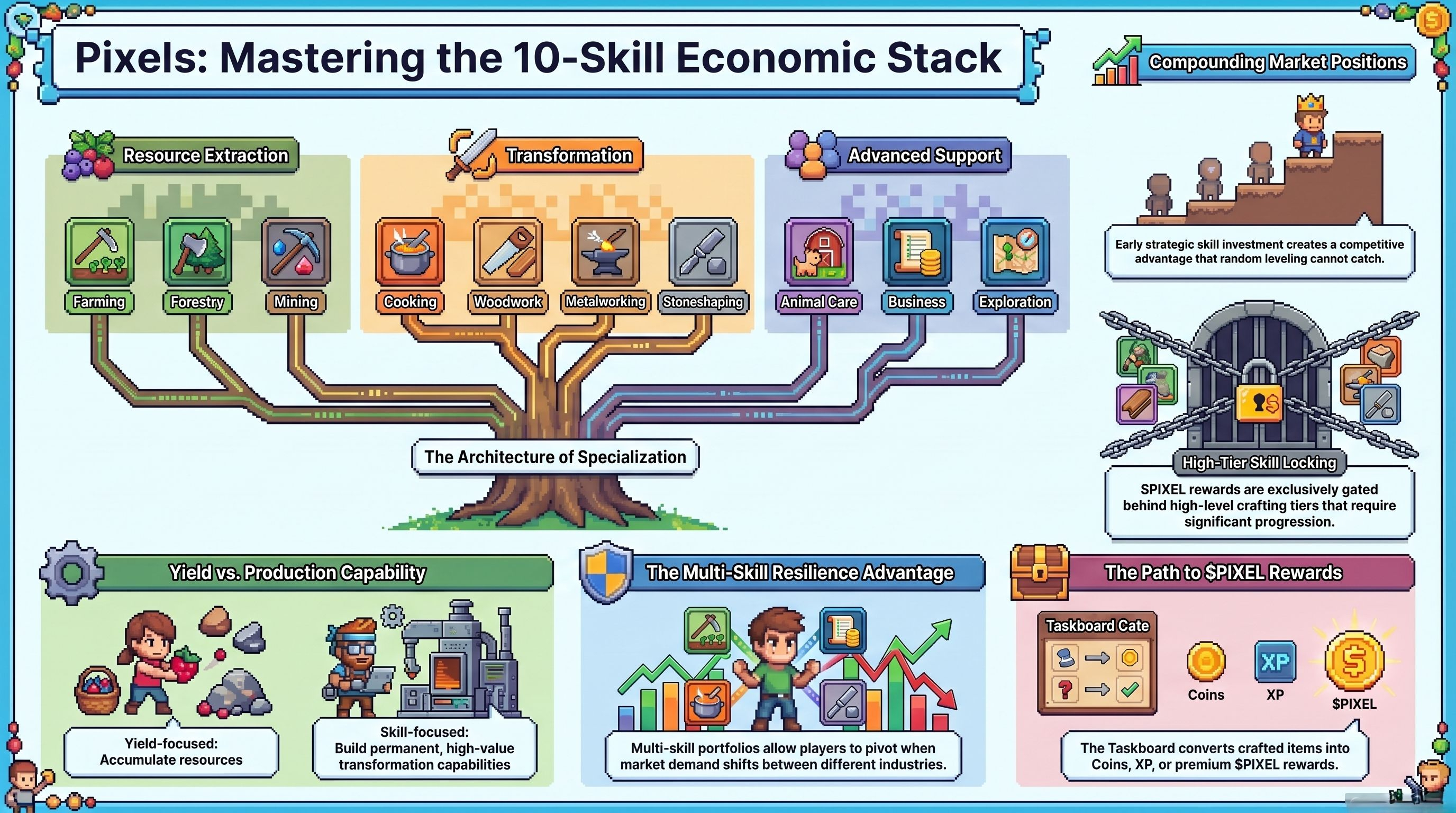
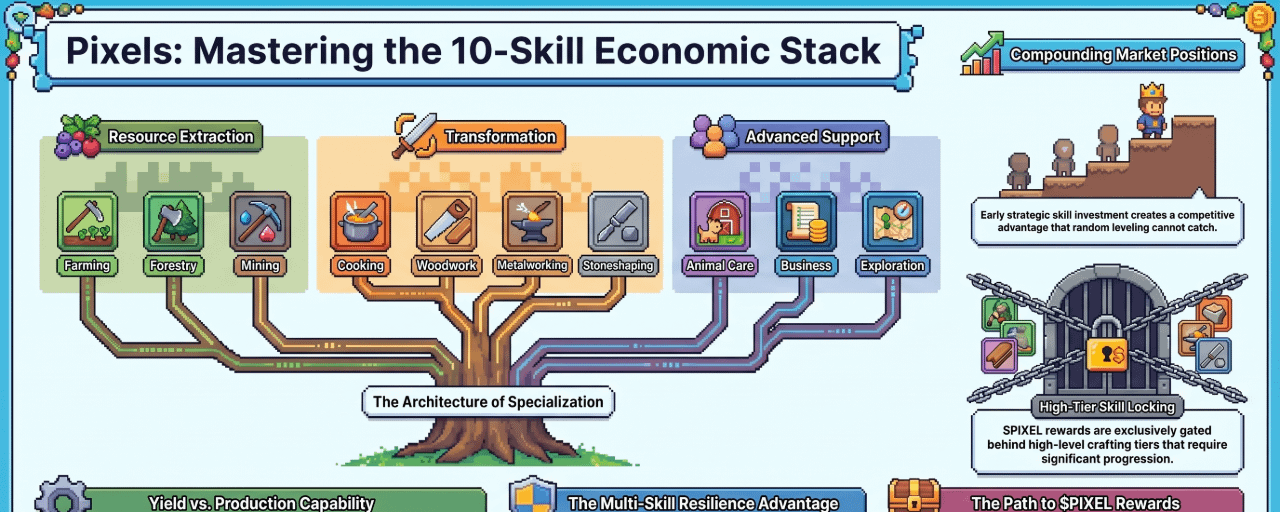
but Pixels built the crafting system on a principle that makes the standard framing incomplete. the ten skill trees in Pixels, Farming, Forestry, Cooking, Mining, Woodwork, Metalworking, Stoneshaping, Animal Care, Business, and the developing Exploration skill, do not just unlock higher-value recipes. they create genuine economic specialization that compounds differently depending on which combination of skills a player develops and which combination the market currently needs most.
because the product they are describing is real. each skill runs from level 0 to 100. higher levels unlock new crafting options and access to higher resource tiers that lower-level players cannot produce. the leveling experience required follows the same curve across all skills, meaning every point of skill progression costs the same energy investment regardless of which skill is being developed. what differs is what each skill unlocks at each tier, and how those unlocks interact with the current state of the crafting economy around them.
so yeah... the skill system is real.
but skill systems have never been the hard part of crafting economy design.
the hard part is the interaction layer. and this is where Pixels is doing something that deserves to be examined much more carefully than the typical skill progression conversation allows.
because here's what I keep coming back to. a player who develops a single skill to high level is a specialist. they can produce outputs that lower-level players cannot. but the market value of those outputs is determined by what the taskboard Orders are currently requesting, what other high-level specialists are already supplying, and how the current season's event mechanics have shifted demand toward or away from that skill's output category. specialization creates capability. capability creates value only when it intersects with current demand.
a player who develops multiple skills to meaningful levels is something different. they are building a production portfolio whose outputs span multiple crafting categories. when the taskboard shifts toward cooking orders, their Cooking skill generates yield. when it shifts toward Woodwork, a different part of their portfolio activates. the multi-skill player is not just more capable in absolute terms. they are more resilient to the demand shifts that make any single specialization temporarily less valuable.
then comes the Orders question. because of course.
and here's where it gets genuinely compelling. the taskboard Orders system is what converts crafting outputs from inventory into yield. an Order requesting a specific crafted item pays coins, XP, or PIXEL on completion. high-tier Orders, requiring higher-level crafted inputs, pay PIXEL specifically. which means the crafting progression system is not just a skill ladder for its own sake. it is the prerequisite structure for accessing the most valuable reward category in the game. a player who has not leveled their crafting skills to the tier required by high-value Orders is locked out of the PIXEL reward category entirely until their skill progression catches up.
that connection between skill level and reward category access is one of the most important economic structures in Pixels and one that most players discover later than they should.
there's also a dimension nobody talks about enough.
crafting skills in Pixels are developed through continuity of production. the more you use an industry, the faster the related skill levels. which means the player who is farming for yield and the player who is farming for skill development are doing the same actions but compounding toward completely different positions over time. the yield-focused player accumulates resources. the skill-focused player accumulates production capability that makes every future resource worth more because it can be transformed into a higher-value output. both are rational strategies. but they compound toward different market positions. and the position you end up in six months from now is a direct function of which one you were optimizing for from the start.
still... I'll say this.
the decision to build ten distinct skill trees that interact with each other, with the biome system, with the Order economy, and with the seasonal event calendar reflects a genuine commitment to economic depth that most Web3 games never attempt. a crafting system where specialization decisions made today have real consequences for market position six months from now is more interesting than one where every player produces the same outputs at the same rate. the skill differentiation creates the economic diversity that makes the Pixels player market feel like a real economy rather than a uniform emit-and-extract loop.
the question is not whether the crafting skill stack creates genuine compounding advantage. it clearly does. the question is how many players currently leveling their skills in Pixels have mapped which combination of skill trees positions them best for the current season's Order economy and the one after it.
and in this space, the players who are building their skill stack with that question already answered are compounding toward a market position that players leveling randomly will spend a long time trying to catch up to.
@Pixels #pixel $PIXEL $ORCA $AGT