
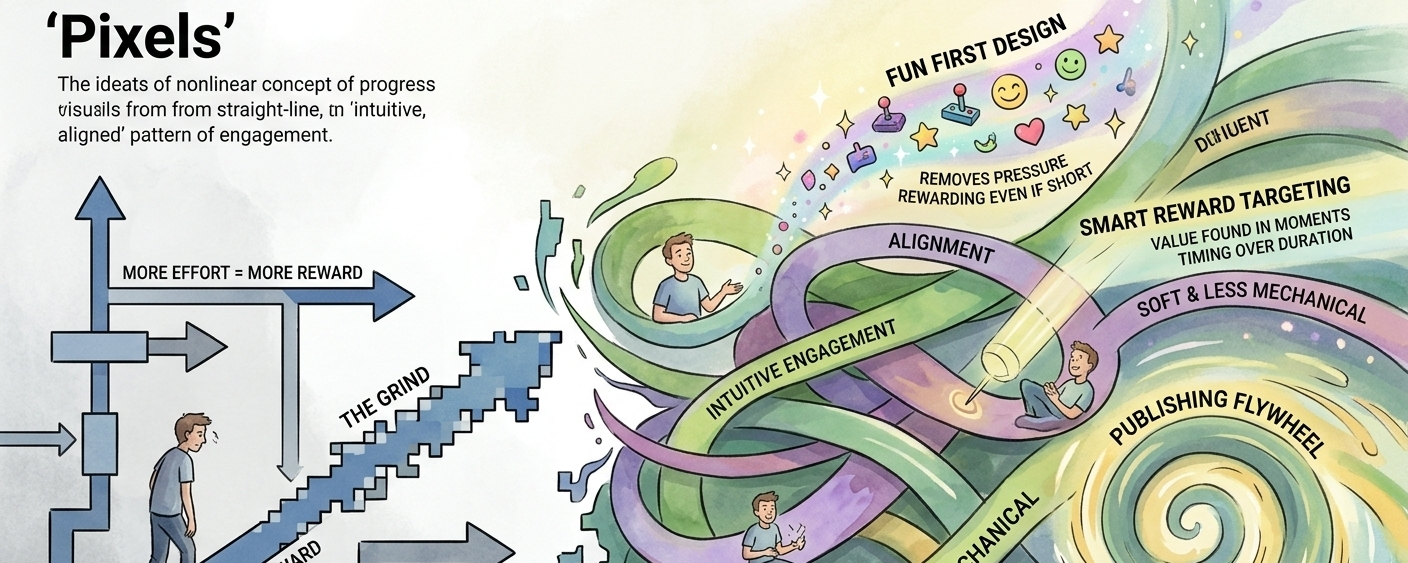
There’s a point in Pixels where the usual way of thinking about progress starts to feel slightly off. Not broken—just less reliable than you expect it to be. You still do the same basic actions, but the relationship between effort and outcome doesn’t stay perfectly predictable. That’s when you start noticing that the game isn’t really structured around “more time = more progress” in a simple way.
What makes it interesting is that it quietly shifts you into a different mindset without announcing it. You don’t get told to change how you play—you just end up doing it anyway.
I didn’t notice this immediately. At first, I treated it like anything else: check in, do a few actions, move on. But after some time, I realized I wasn’t approaching it in fixed sessions anymore. I was just… returning when it felt appropriate, even if I couldn’t clearly define why.
That’s where three underlying systems start to become noticeable in practice: Fun First design, Smart Reward Targeting, and the Publishing Flywheel.
Fun First design changes the pressure profile of interaction. There’s no strong push to extend your session or maximize every login. You can engage briefly and still feel like you’ve “done enough.” That sounds simple, but it removes a kind of internal tension most systems rely on—the feeling that if you stop too early, you’re leaving value behind.
Once that pressure is gone, your behavior becomes less forced. You stop planning around long sessions and start slipping into shorter, more frequent interactions without overthinking it.
Smart Reward Targeting is where the experience starts to feel less evenly distributed. Instead of every action carrying identical weight, the system seems to respond differently depending on timing and context.
It’s not just what you do, but when you do it. And over time, that creates a strange effect: you begin to notice that some moments feel more “aligned” than others. Not necessarily more rewarding in a visible way, but more meaningful in how they fit into the flow.
There were times I logged in briefly, did something small, and left without much thought—only to later realize that moment mattered more than expected. Other times, longer interactions felt less significant than they should have. That inconsistency is what pushes you away from pure grinding behavior. You stop assuming effort is always linear.
Instead, you start paying attention without being told to. And that attention changes your pacing.
Then there’s the Publishing Flywheel, which is less about what you experience moment-to-moment and more about what your participation contributes to over time. Activity doesn’t stay isolated—it becomes part of a broader circulation of visibility and engagement.
The important shift here is psychological. You’re no longer just interacting with a closed system. You’re contributing to something that continues moving beyond your individual actions.
Even if you don’t consciously think about it, that creates a different feeling around participation. It feels less like “playing inside a container” and more like “adding motion to something already in flow.”
When these three ideas overlap, the overall experience stops being about optimization. You can still try to optimize if you want, but the system doesn’t fully reward that mindset in a straightforward way.
Instead, what emerges is something softer and less mechanical: irregular engagement patterns, shorter sessions that still feel meaningful, and a growing sensitivity to timing rather than duration.
The biggest change isn’t visible in a single session. It shows up in how your habits shift without you explicitly deciding to change them.
You don’t stop playing more or less—you just stop organizing your time around it in the same rigid way.
And in that sense, Pixels doesn’t feel like a game you “optimize.” It feels more like a system that slowly teaches you to stop assuming all progress has to move in a straight line.
