
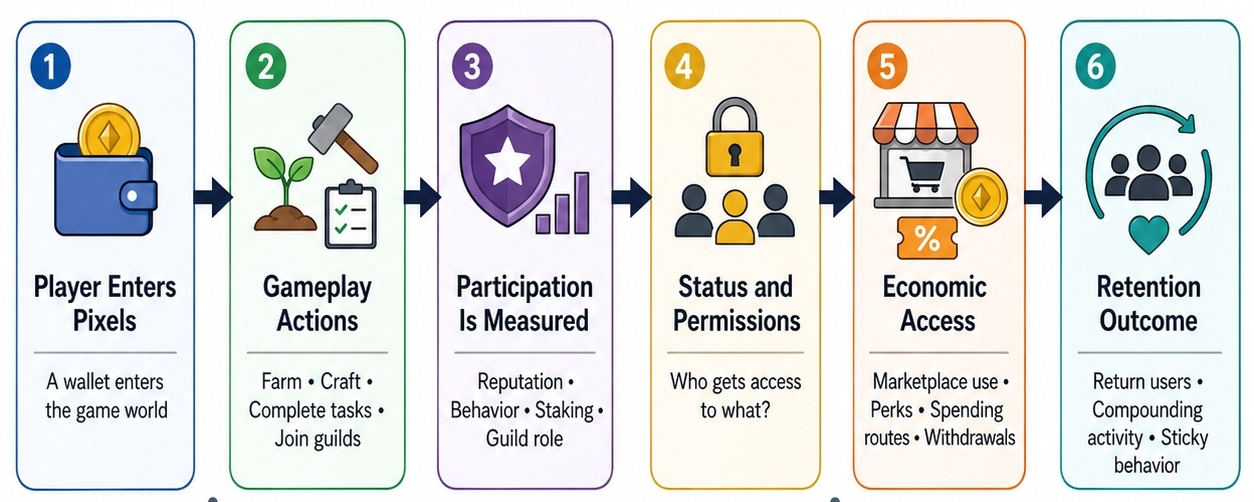

@Pixels i remember opening PIXEL today and feeling that little trader irritation again. Not because the chart was dead. It wasn’t. The token was still moving, still liquid enough to make people look twice. What annoyed me was how easy it is to stare at the candle and miss the actual environment Pixels is building underneath it. Most people still talk about Pixels like it’s only a farming game with a token attached. I don’t think that’s the cleanest read anymore. The more useful question is this: are players entering a game, or are they entering a place where value was already placed before they arrived?
That’s what I mean by a value embedded environment. In a normal game, your activity mostly stays inside the loop. You farm, craft, upgrade, finish tasks, maybe join a guild, and the reward is mainly progress. In Pixels, those actions sit closer to economic routing. The game doesn’t just ask, “Did you play?” It asks, “What kind of participant are you, and what should you be allowed to access?” That difference matters for traders because it turns gameplay into a filtering system. Not every user is equally valuable. Not every action deserves the same reward. Not every wallet should reach the same economic permissions.
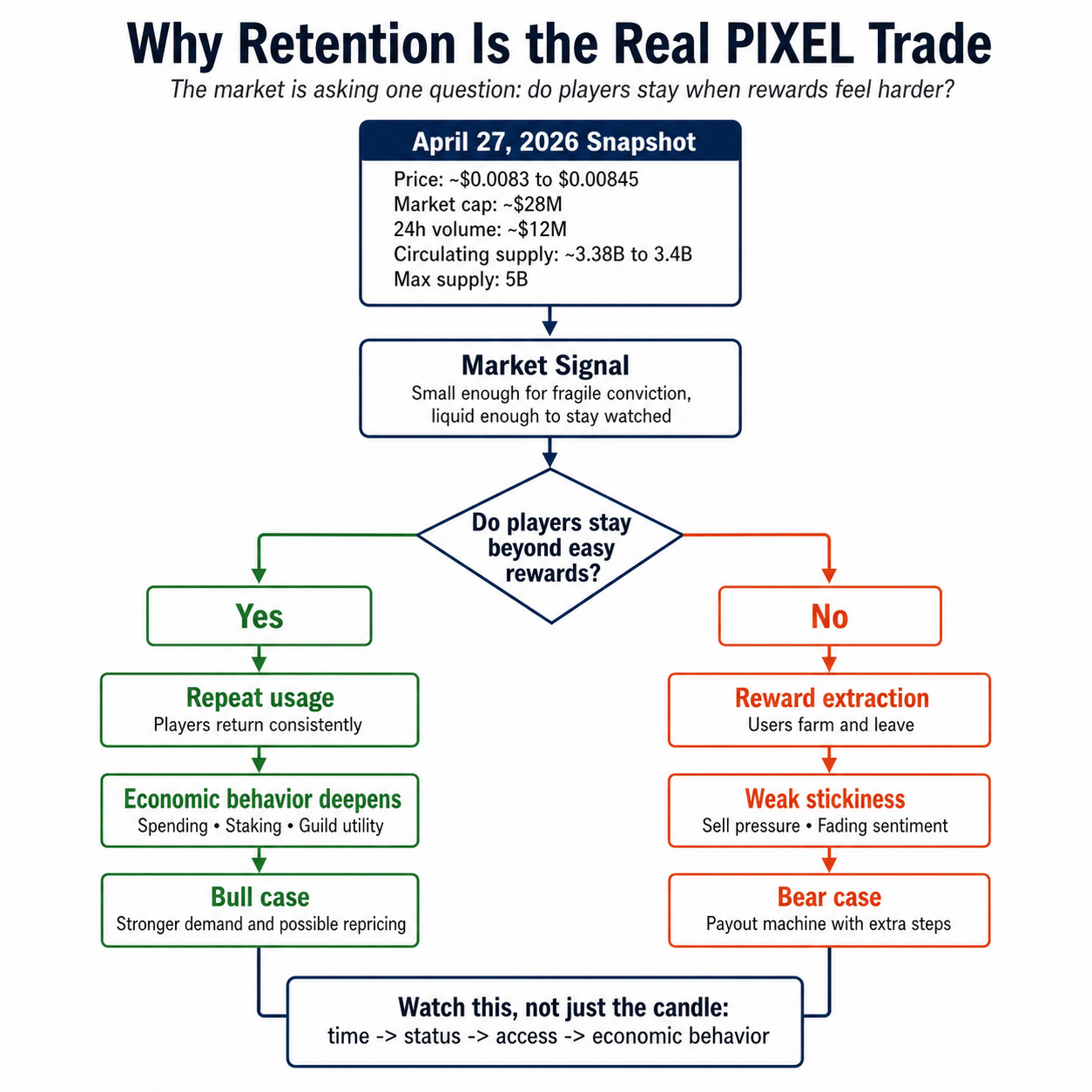
As of April 27, 2026, Binance shows PIXEL around $0.00845, with a market cap near $28.6 million, about $11.9 million in 24 hour volume, and roughly 3.4 billion PIXEL circulating. CoinMarketCap is close, showing PIXEL near $0.00832, about $28.1 million in market cap, $11.99 million in 24 hour volume, 3.38 billion circulating supply, and a 5 billion max supply. Those aren’t massive numbers. That’s exactly why they’re interesting. PIXEL is small enough that conviction is fragile, but liquid enough that the market hasn’t fully ignored it.
Now here’s the thing. A $28 million market cap doesn’t price Pixels like a dominant gaming economy. It prices it like a project still being questioned. The market is basically saying, “Show me that this activity can last.” And honestly, that’s fair. Web3 gaming has burned traders before. A game can look active while rewards are high, then go quiet when extraction gets harder. That’s the Retention Problem. Can Pixels keep users coming back when the easy reward path stops feeling easy?
This is where the value embedded angle gets more serious. Pixels’ own site still leans into ownership, land, rewards, staking, Chapter 2, and the idea that what players build can have economic weight. Its FAQ also explains that Coins are an off chain in game currency that can be purchased using PIXEL, which means not every unit of game value is sitting directly on-chain, but PIXEL still connects to spending and access inside the environment.
That setup has a tradeoff. On one side, it lets Pixels manage the economy without turning every tiny action into a public token event. That can reduce friction and help gameplay feel less like clicking through a wallet popup every few minutes. On the other side, it means traders need to be careful. Off chain value, permissioned access, reputation systems, and platform controlled rules can make the experience smoother, but they also mean the player doesn’t control every layer of value directly. Ownership exists, but it operates inside boundaries.
I actually like that tension. It feels more honest than pretending a live game economy can be fully open with no guardrails. If you let every wallet farm, extract, dump, and repeat without filters, the loyal players usually pay the cost. Pixels seems to understand that a game economy needs judgment. Reputation, guild access, staking perks, marketplace behavior, and withdrawal logic all become part of the same question: who is adding value, and who is just passing through?
For traders, that’s the real bull case. Not “PIXEL pumps because gaming is back.” That’s lazy. The bull case is that Pixels keeps converting casual activity into measured participation. If 3.38 billion PIXEL is already circulating against a 5 billion max supply, then the project is not in the earliest supply phase anymore. There’s still supply risk, but the market has already absorbed a large chunk of the token base. If volume keeps holding near the $10 million to $25 million daily range while the market cap stays around $28 million, it means PIXEL is still heavily watched relative to its size. That kind of turnover can cut both ways, but it also means there’s enough attention for a repricing if retention data improves.
The realistic bull case is simple. Pixels doesn’t need to become the biggest game in the world to matter from here. It needs to prove that its users return for more than rewards. It needs players joining guilds, using PIXEL-linked features, spending inside the economy, staking for practical benefits, and treating the environment like a place where their actions compound. Think of it like a shopping district. A single store can get traffic from discounts. A district becomes valuable when people keep coming back because the location itself creates opportunity.
But I’m not fully comfortable calling it clean. The bear case is still sitting right there. PIXEL is down massively from its old highs, and a token this small can look liquid until sentiment turns. If players only show up when rewards are attractive, the system becomes a payout machine with extra steps. If staking perks don’t feel necessary, if guild activity becomes too capital-heavy, or if the average player feels like value is already reserved for insiders, then the environment starts to feel closed instead of valuable.
That’s my biggest frustration with Pixels as a trader. The design is more thoughtful than the price suggests, but thoughtful design doesn’t automatically create demand. The market doesn’t reward complexity by default. It rewards proof. Repeat usage. Sticky behavior. Real spending. Real reasons to hold PIXEL beyond hoping the next event brings a candle.
So if you’re watching PIXEL, don’t only watch the price. Watch whether the game keeps turning time into status, status into access, and access into economic behavior. That’s where the story either becomes real or breaks. A value-embedded environment only matters if people believe the value is worth staying for. And in Pixels, staying is the whole trade.