
@Pixels The easiest way to misunderstand Pixels is to look at it like just another Web3 farming game with a token attached.
That was the old habit across the sector anyway. A game launches, a token appears, rewards start flowing, and suddenly the whole community begins measuring the experience through extraction. Not whether the world is fun. Not whether the loop is sticky. Just whether the payout still feels worth the time.
What makes Pixels more interesting to me now is that it seems to be trying to move the center of gravity away from that.
Not fully. Not cleanly. And definitely not without risk. But the direction is there.
The clearest signal is in Pixels’ own description of $PIXEL.
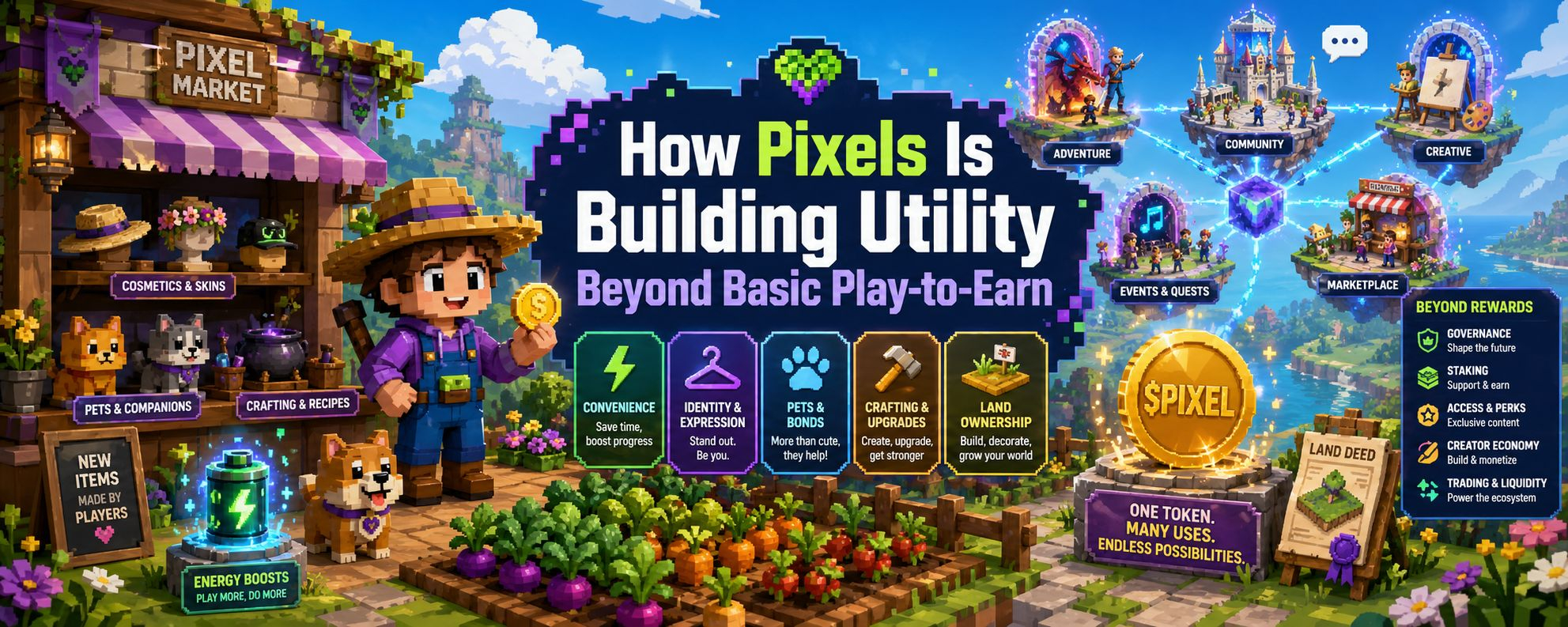
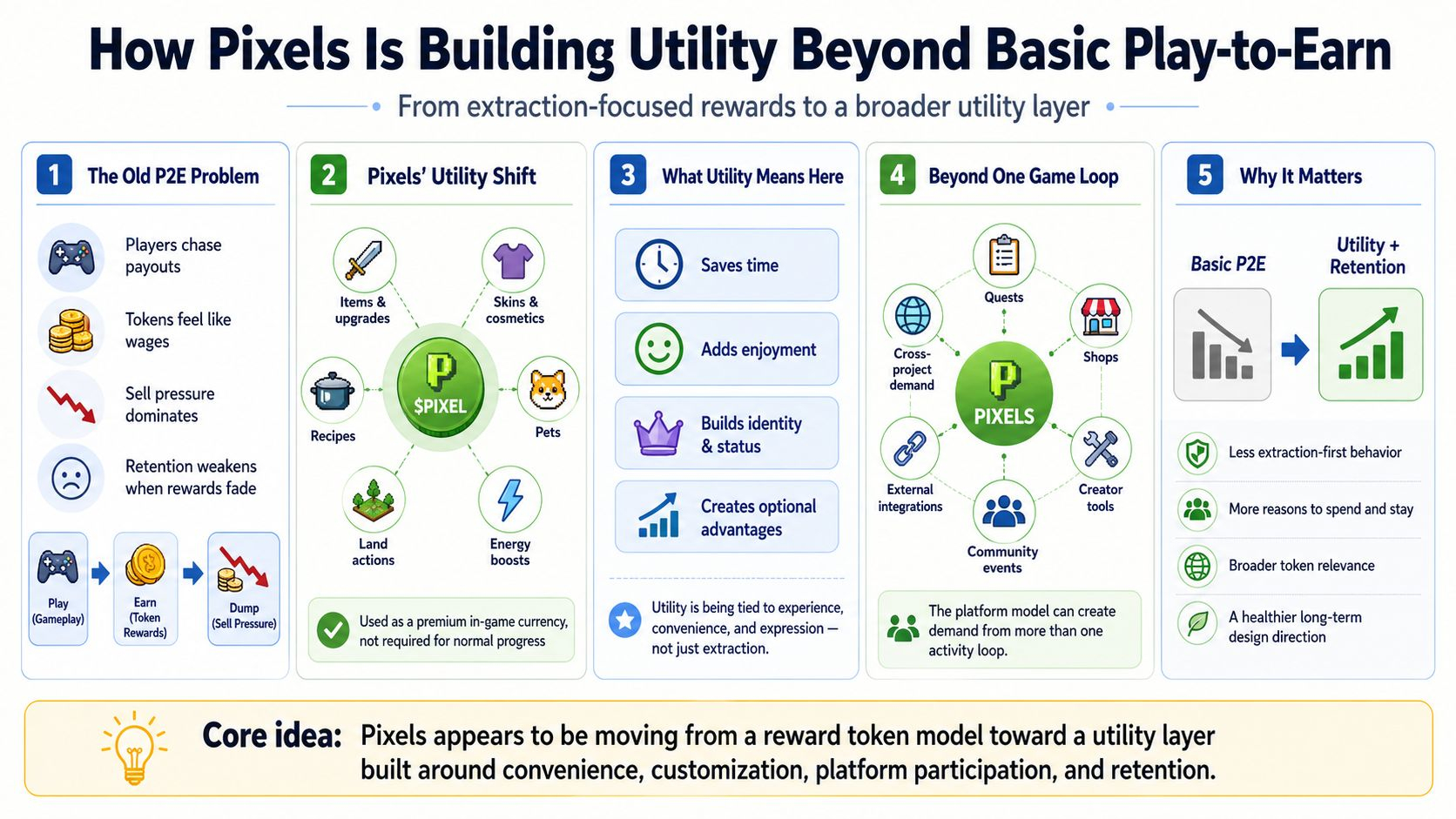
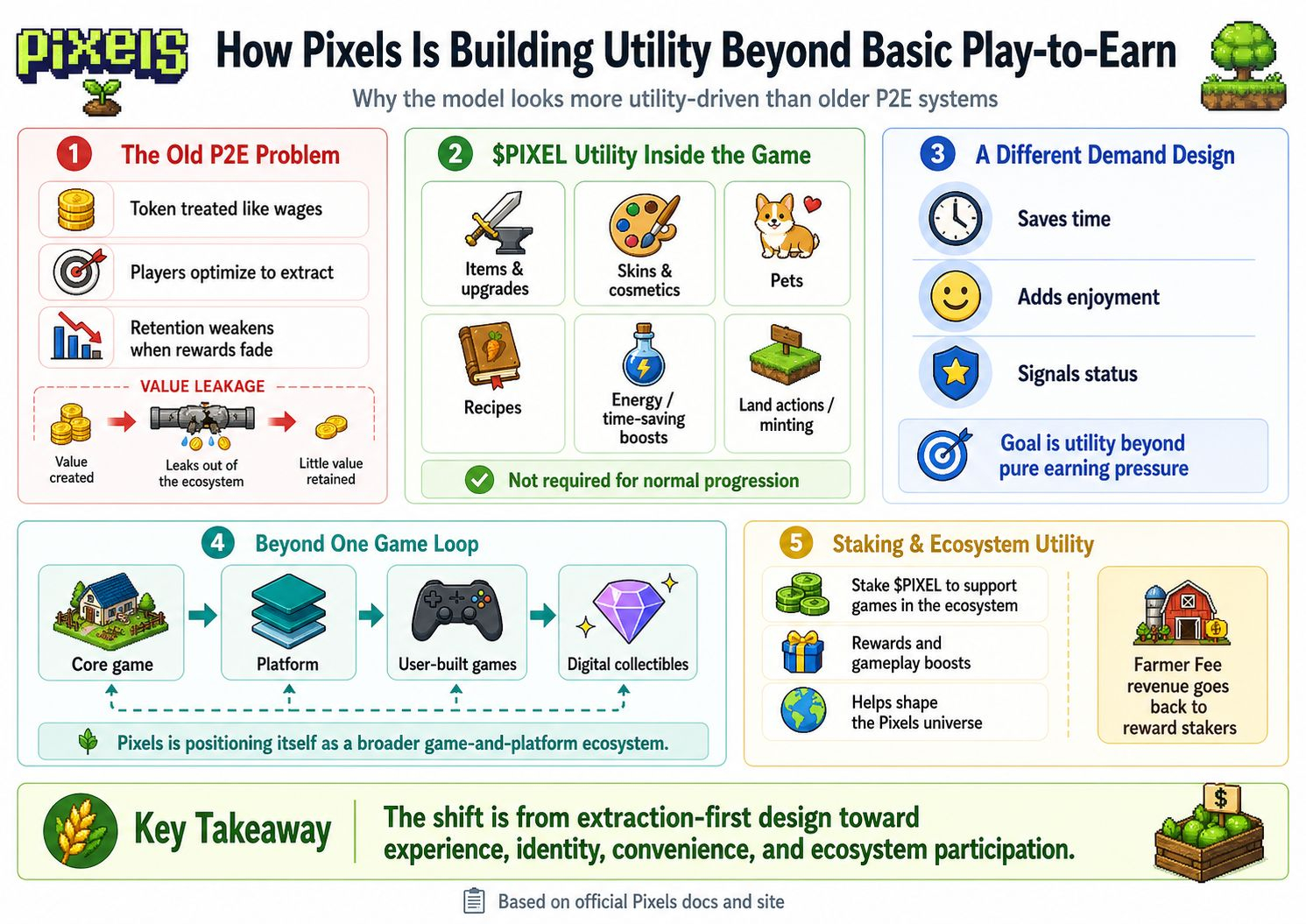
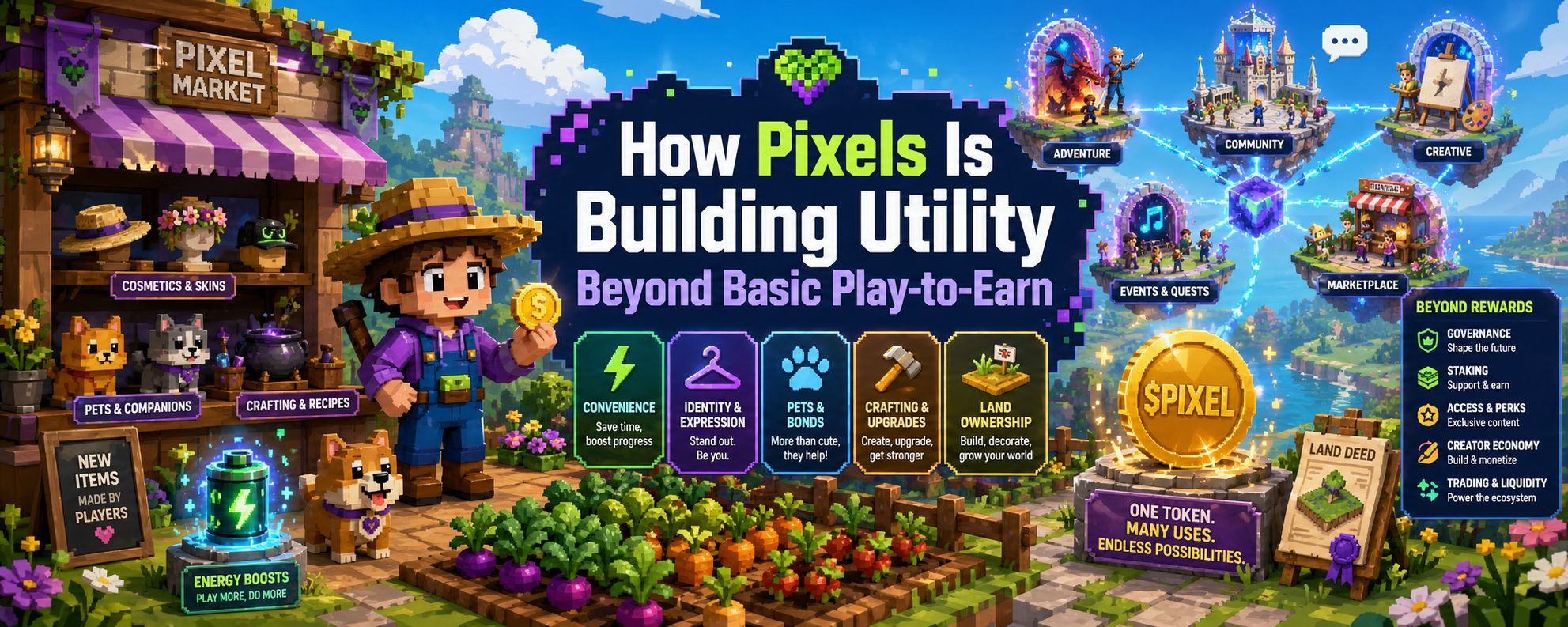
$PIXEL is not framed as a basic requirement for normal gameplay. It is more like a premium currency for added features, including better items, upgrades, cosmetics, pets, crafting recipes, energy boosts, land minting, and similar extras.More telling than that, the demand section explicitly says the token should save time, buy social status, or provide enjoyment, and not be designed around increasing future earnings. That is a pretty direct rejection of the usual play-to-earn psychology.
That detail matters more than it sounds.
Because basic play-to-earn usually trains players to treat the token like wages. Once that happens, almost everything gets flattened. Cosmetics become sell pressure. Progress becomes labor. Retention becomes mercenary. The player is not really asking, “Do I want this?” They are asking, “Can I justify not dumping this?”
Pixels seems to understand that problem.
Its token design, at least in the docs, looks like an attempt to make $PIXEL behave less like a paycheck and more like a premium layer around convenience, identity, speed, access, and expression. That does not make the economy perfect. But it does change the emotional tone of the system. A token tied to optional enhancement creates a different kind of demand than a token tied mainly to extraction.
I think that is where the real utility story starts.
Not with “more use cases.” That phrase is too cheap now. Every project claims more use cases. The better question is whether the new utility changes player behavior in a healthier direction.
In Pixels, some of the listed uses are surprisingly revealing. Speeding up build times, boosting energy, unlocking skins, recipes, pets, and special land items all point toward utility that sits around the play experience rather than replacing it. Even the analogy in the docs is telling: they compare pixel to premium gems in a mainstream game, not to an income stream.
That is a much smarter place to build from if the long-term goal is retention.
But Pixels is also pushing beyond its own game borders, and that part may matter even more. The older platform docs describe Pixels as tooling for persistent multiplayer worlds where projects can create maps, items, stores, NPCs, quests, and events, with blockchain integration built in. They also describe support for external token integration, including stores for other projects and burn mechanisms where outside communities can offer items in exchange for their own tokens. In plain terms, Pixels has been sketching a model where the game is not just a destination. It is infrastructure for connected economies
That is where “utility beyond P2E” starts to become a serious idea rather than a slogan.
If a token only matters inside one repetitive loop, it stays fragile. The minute that loop gets boring, the token loses its emotional anchor. But if the surrounding platform expands into identity, status, integrations, social features, creator layers, and maybe even cross-project demand, then utility begins to diversify. The token stops depending on one single reason to exist.
Pixels’ public site leans in that direction pretty openly now. It describes the project as a platform where users can build games that natively integrate digital collectibles, and it pairs that with staking language around rewards, gameplay boosts, and shaping the Pixels universe. The same site also puts social and platform language front and center: communities, land, friends, pets, updates, and user-owned progress. That does not read like a project trying to survive on raw emissions alone. It reads like one trying to turn its token into part of a broader game-and-platform stack.
Still, this is the part where I hesitate.
Because utility is easy to list and hard to make felt.
A token can have ten official use cases and still behave like a speculative chip if players do not care about those uses enough to hold and spend it. That is always the trap. On paper, the sink design looks reasonable. In practice, the market decides whether those sinks feel meaningful or optional in the wrong way.
And with Pixels, there is another complication: some of the most detailed docs around token utility and platform integrations are older. The core design logic is still useful, but it means the market has to watch how much of that cross-project and platform vision actually gets refreshed, shipped, and made native to current player behavior.
So my take is not that Pixels has already solved utility.
It is that Pixels seems to understand the real problem better than many older P2E systems did. The problem was never just inflation. It was that the entire experience trained users to think like extractors first and players second. Pixels’ version of utility looks like an attempt to reverse that training by tying pixel to convenience, identity, enhancement, platform participation, and possibly broader ecosystem use instead of making it purely the reason people show up.
That is a better direction.
Now the harder part is proving those utilities are strong enough to become habits, not just bullet points.