
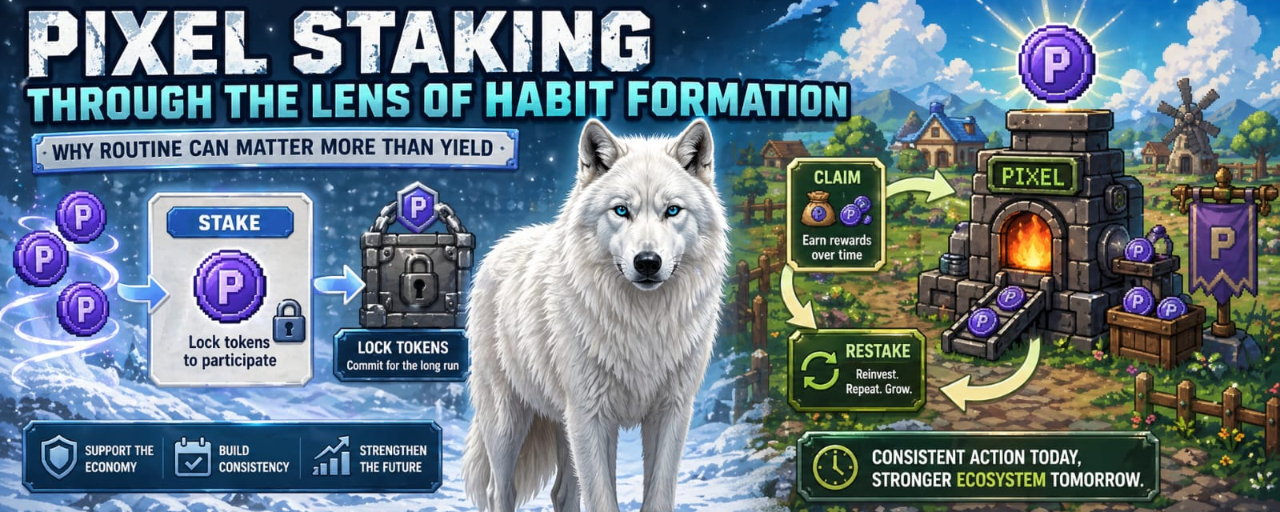

I used to think staking was mostly a financial decision. You lock tokens, wait for rewards, and decide later whether the yield was worth the risk. But the more I look at PIXEL staking, the less I think the real story is yield. The stronger story is routine.
The common mistake is to treat staking as a passive mechanic. On the surface, it looks like stillness. Tokens sit somewhere. A user waits. Rewards accumulate. But underneath, staking can quietly train behavior. It gives people a reason to return, check, claim, compare, restake, and keep mentally attached to the ecosystem even when they are not actively playing.
That is my main read on PIXEL staking. It is healthiest when it becomes a rhythm that supports play, not a machine that replaces play.
The current numbers make that distinction matter. PIXEL’s market cap is around $28 million, with about 3.38 billion tokens circulating out of a 5 billion max supply. That tells me this is not a deep, highly insulated asset. It is still sensitive to behavior, liquidity, and belief because a relatively small change in demand can move the structure more than people expect.
The 24-hour trading volume is around $12 million, which is roughly 43% of market cap. On the surface, that looks active. Underneath, it also means the token can turn over quickly. A lot of movement is not automatically loyalty. It may be trading, rotation, farming, or short-term positioning. Staking matters here because it can slow some of that movement by giving users a repeated reason to stay connected instead of treating the token as something to touch once and exit. 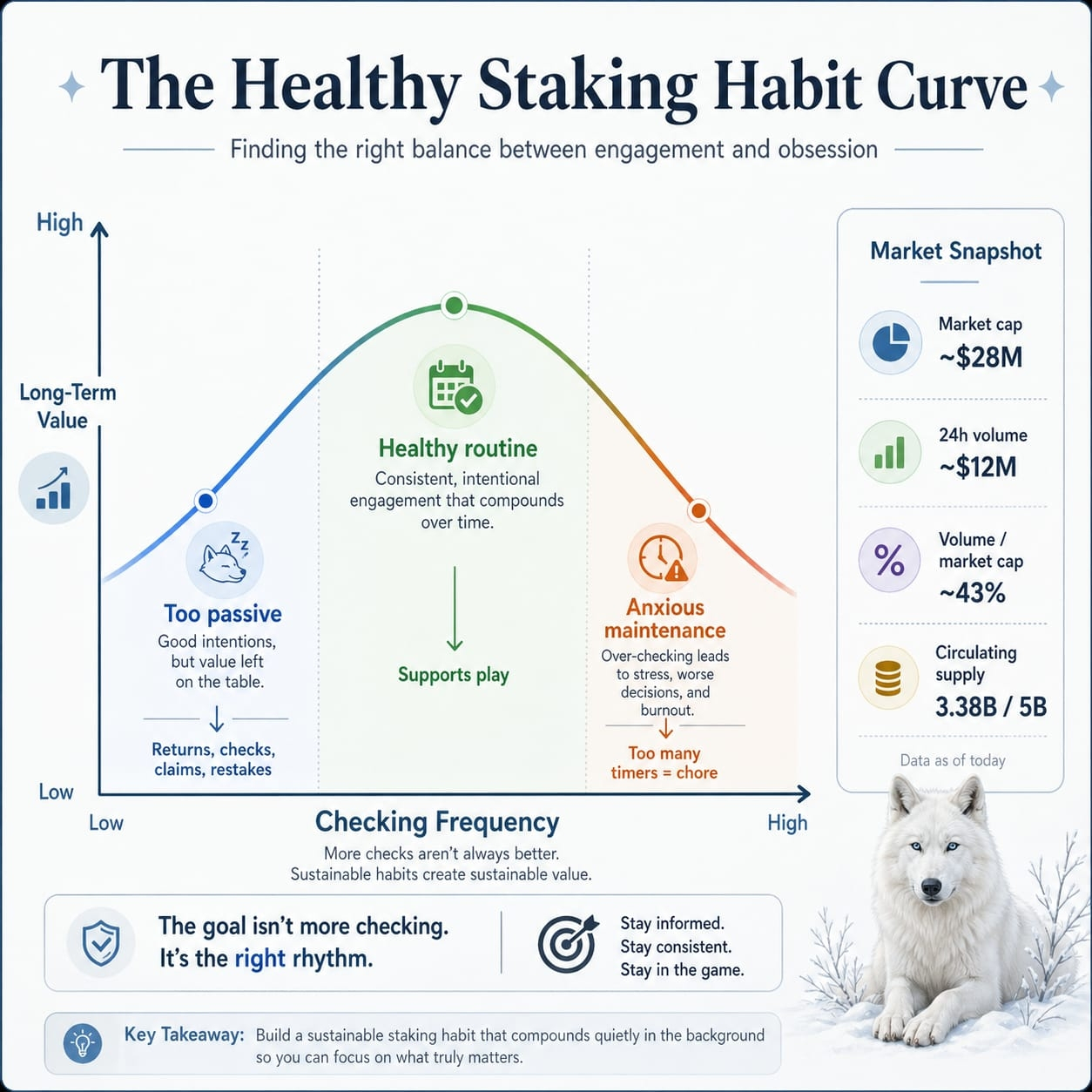
But habit formation is delicate. A good habit feels like it belongs inside the user’s normal pattern. A bad habit feels like a chore wearing a reward label. If staking asks users to return at a natural pace, it can create consistency. If it pressures them into constant checking, it becomes anxiety. The line is thin.
This is where game economies are different from normal token markets. In a pure market, people may stake for yield, governance, or scarcity. In a game-linked economy, staking has to sit beside emotional behavior. People already have routines: logging in, completing tasks, managing resources, upgrading, trading, preparing for events. Staking becomes stronger when it fits into those loops like a quiet checkpoint.
What it enables is predictability. For the system, staked tokens can reduce immediate sell pressure. For users, staking can turn commitment into something visible and repeatable. For developers, it can help separate tourists from participants. A person who repeatedly stakes, claims, restakes, and still plays is sending a different signal from someone who only appears when rewards spike.
The wider crypto market makes this even more important. Total crypto market value is around $2.68 trillion, while stablecoins sit near $317 billion, about 11.8% of the market. That means liquidity is present, but it is also cautious. A large stablecoin base often shows that capital is waiting, rotating, and judging where risk is worth taking. Small gaming tokens cannot assume that liquidity will arrive just because a reward exists. They have to earn repeated attention.
ETF flows show the same pressure from another angle. Spot Bitcoin products saw about $2.1 billion in net inflows over eight straight days through April 23. That kind of flow pulls attention toward larger, cleaner, more liquid assets. For smaller tokens, the question becomes sharper: why should capital stay here instead of moving toward the safer, more institutionally understood trade? 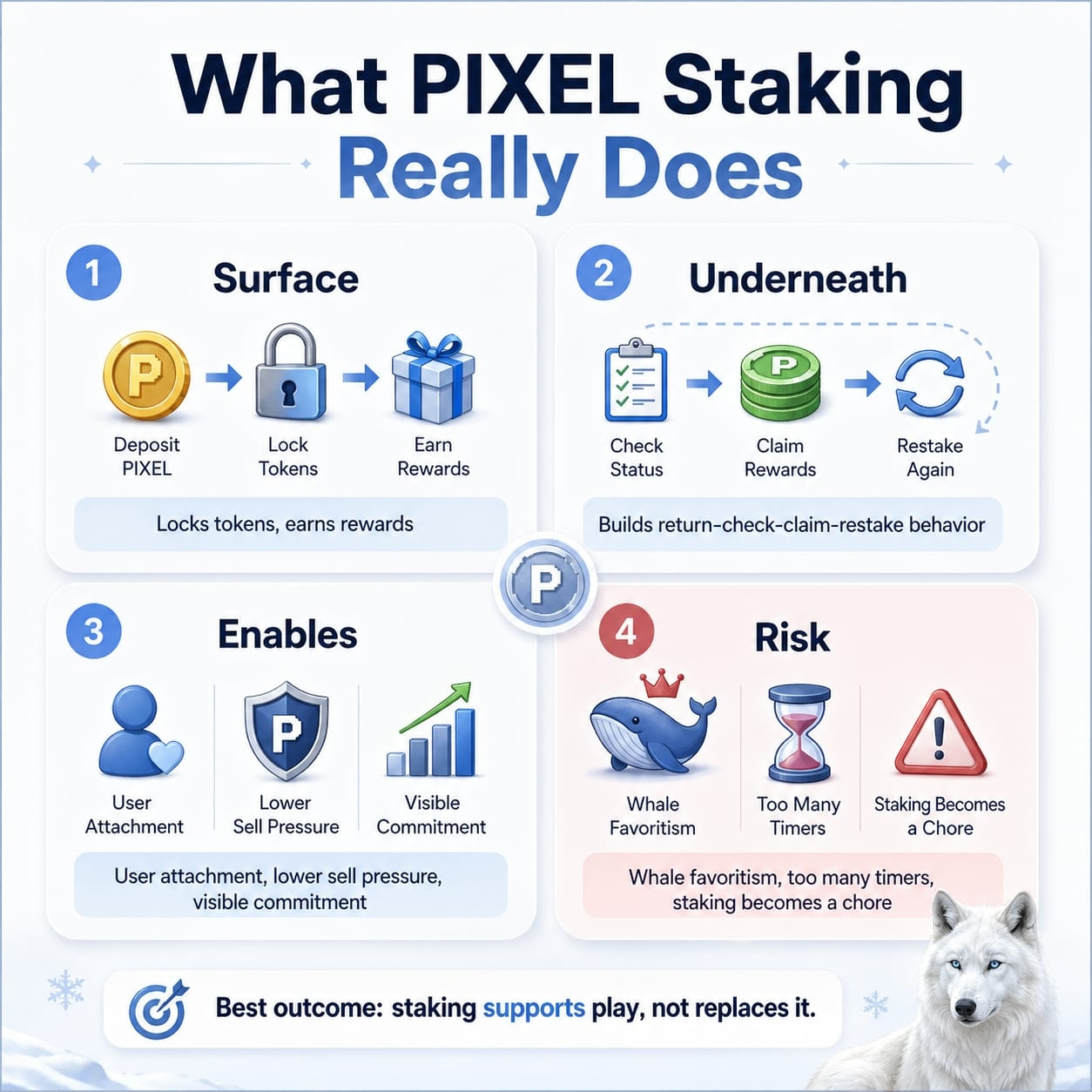
Staking can answer part of that, but only if it creates behavior, not just lockup statistics. Locking tokens without strengthening user attachment is weak design. It may delay selling, but it does not build conviction. Real habit design works when the user feels that staking is connected to identity, progress, and participation.
There is also a fairness problem. If staking rewards only favor the largest holders, it can make the system feel closed. Smaller users may still show up, but they stop believing their routine matters. That is dangerous because games survive on many small habits, not only a few large wallets. The system has to reward consistency without pretending that all users carry equal weight.
The risk is over-design. Too many timers, claims, boosts, multipliers, and reminders can make staking feel like maintenance. At that point, the user is no longer choosing commitment. They are servicing a machine. And once a game economy starts feeling like work without enough meaning, the habit breaks.
So I do not see PIXEL staking as only a token sink. I see it as a test of whether the ecosystem can turn financial commitment into a calm behavioral rhythm. The best version does not shout for attention. It gives users one more reason to return with intention.
A staking system becomes powerful only when the lockup feels less like a cage and more like a routine people would have kept anyway.