I have started looking at depth in games a little differently.
More systems can look impressive.
More recipes can look serious.
More layers can make a world feel bigger.
But bigger is not always better by itself.
Sometimes a game becomes deeper in a way that makes players more attached. Sometimes it becomes deeper in a way that makes the experience feel heavy, confusing, or harder to return to. That difference matters to me, and it is the reason I keep thinking about @Pixels from this angle.
Pixels is clearly not staying in the simple farming box anymore.
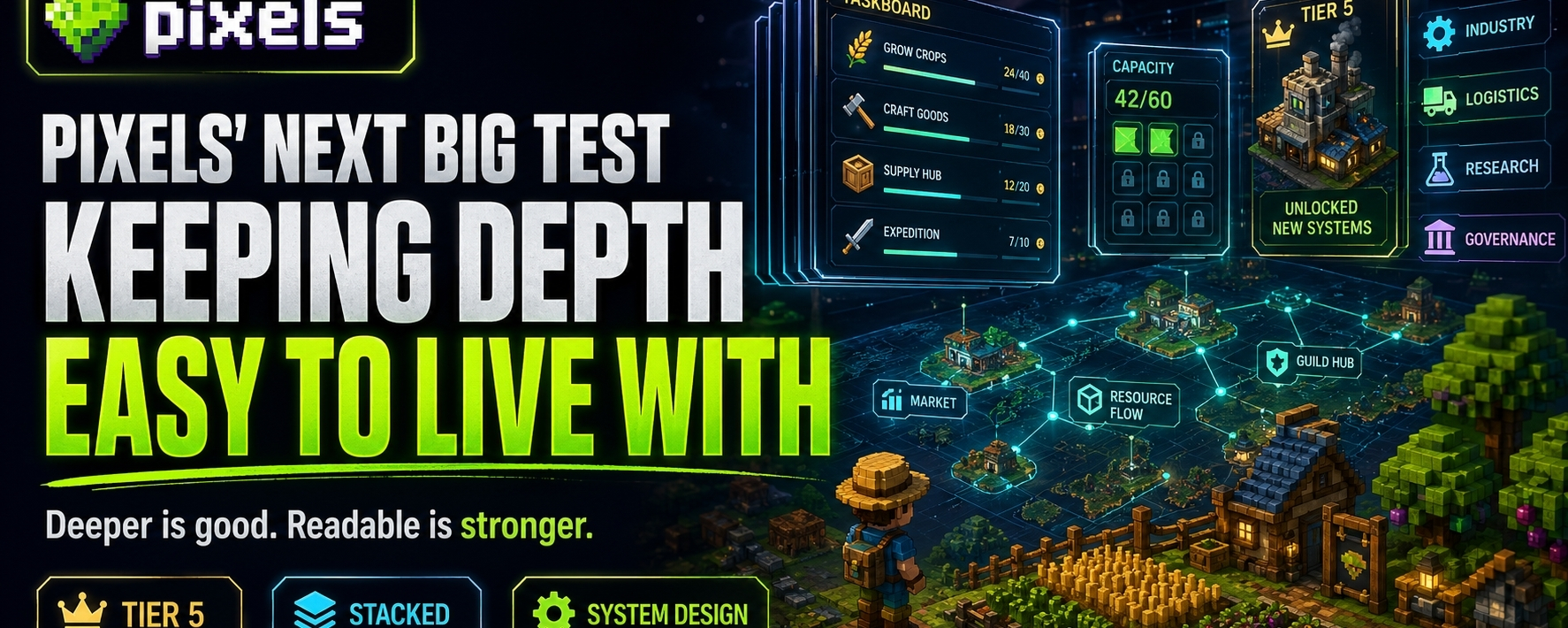
The recent Tier 5 update shows that. It added new resources, updated crafting industries, 105 new recipes, new Taskboard tasks, and exclusive materials through the Deconstruction system. It also builds on top of the existing Tier 1–4 industries instead of replacing them, which makes the progression feel layered rather than disconnected.
That is a real expansion.
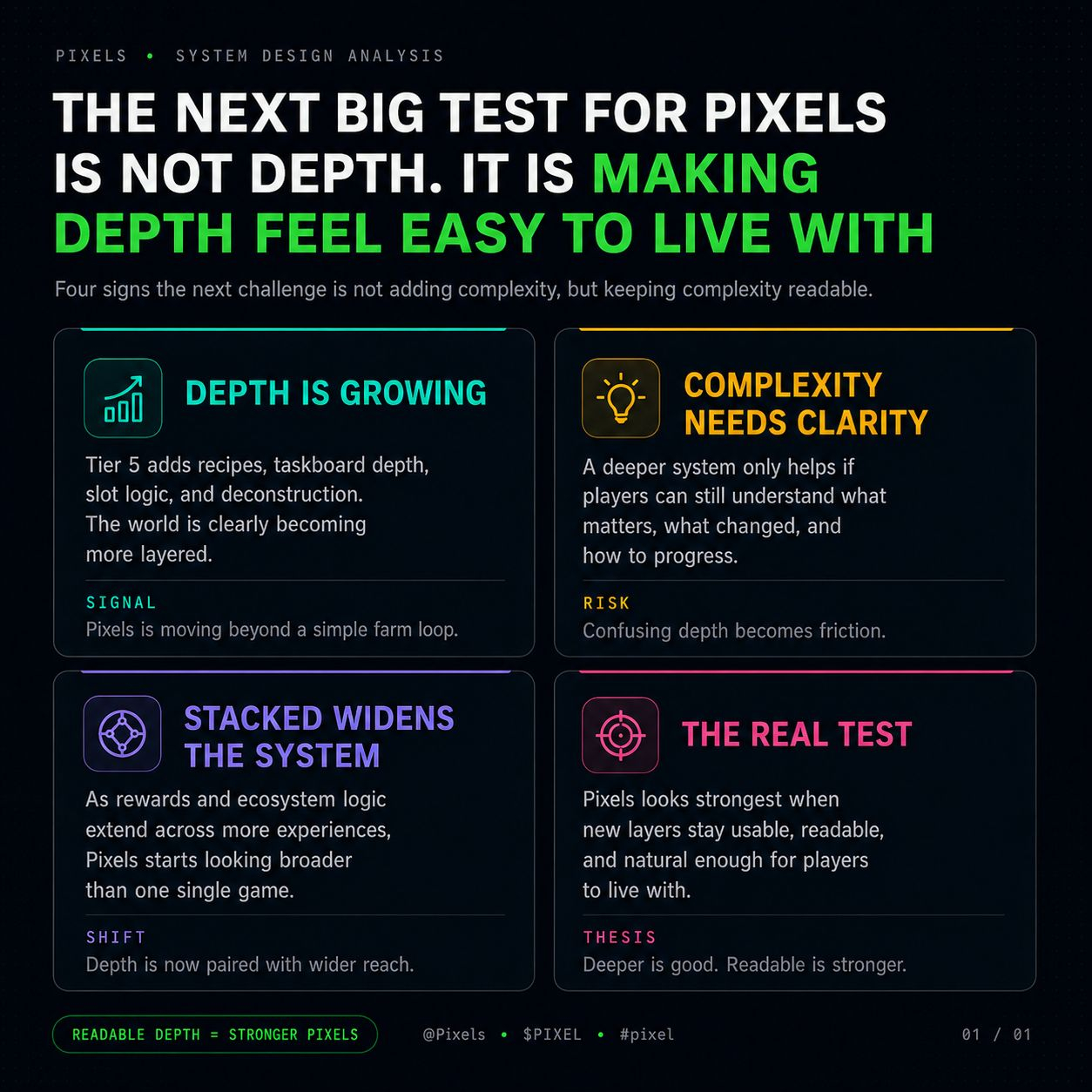
But the more important question is not whether Pixels is becoming deeper. It obviously is. The real question is whether that depth will still feel readable enough for players to live with.
That is where the next big test begins.
A lot of games make the mistake of thinking complexity itself is progress. They add more systems, more choices, more requirements, and more moving parts. For a while, that can feel exciting. It gives serious players something to study. It gives creators something to explain. It gives the project a bigger story.
But if the player starts feeling buried under the system, depth becomes friction.
That is the line Pixels has to walk carefully now.
Tier 5 makes the world more interesting because progress is no longer just about doing the same loop again. Players now have to think more about capacity, recipes, deconstruction, materials, and how different parts of the economy connect. T5 industries are also tied to NFT Lands, and Slot Deeds are part of how capacity gets unlocked, which makes land feel more like productive infrastructure instead of just a place on the map.
That gives Pixels more weight.
But weight has to be handled properly.
Because the strongest game systems are not the ones that simply throw depth at players. They are the ones that let depth reveal itself gradually. The player should feel like the world is getting richer, not like the world is becoming harder to understand every week.
That is what makes this moment important for Pixels.
The farm still matters because it gives the game an easy emotional entry point. People understand farming. They understand routine. They understand returning to a familiar world and slowly building something. That surface is valuable because it keeps the game human.
But the deeper systems now have to sit behind that surface without breaking it.
That is not easy.
Stacked adds another layer to this same challenge. Pixels describes Stacked as a rewards app for players and a rewarded LiveOps engine for games. For players, it connects games, missions, streaks, rewards, and cash-out across a growing ecosystem. For studios, it becomes the system underneath: event tracking, targeting, reward logic, fraud controls, payouts, testing, attribution, and an AI game economist that helps teams decide what to reward and why.
That is powerful.
But again, power is not enough.
If Stacked is meant to help Pixels grow beyond one game, the experience cannot feel like a complicated machine that only analysts understand. It has to feel simple enough for players to use and clear enough for builders to trust. That is where platform ambition either becomes real or stays stuck as a narrative.
This is why I think Pixels is entering a harder phase.
Earlier, the challenge was proving that the game could attract attention. Then the challenge became making the economy more sustainable. Now the challenge feels different. Pixels has to keep adding depth without making the system feel too heavy for the people inside it.
That is a serious design problem.
Because different users need different levels of complexity. Casual players need the world to stay approachable. Serious players need the deeper systems to feel worth mastering. Builders need the platform layer to be understandable. The project has to serve all of them without turning the whole experience into confusion.
That balance is where the real strength will show.
A weaker project grows by adding more things.
A stronger project grows by making those things feel connected.
That is the part I keep coming back to with Pixels.
Tier 5 can make the game deeper.
Stacked can make the ecosystem wider.
But the real win is if both still feel usable.
Because depth only matters when players can live inside it.
That is why Pixels feels important to watch right now. It is not just adding more content. It is entering the phase where the system has to prove that its complexity can stay clean, readable, and meaningful.
That is a much bigger test than just becoming deeper.
A deeper game is good.
A deeper game that still feels natural is stronger.