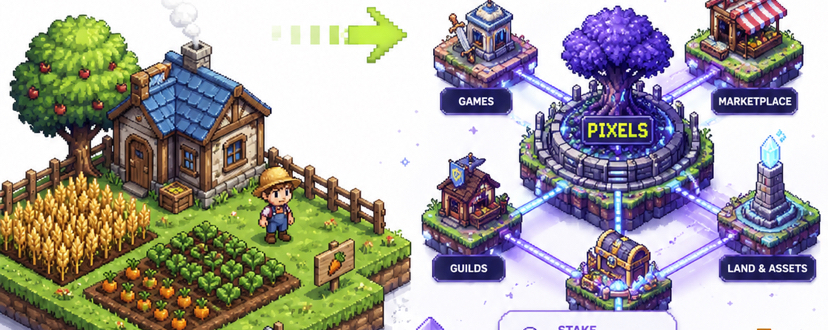

At first, it is a bit hard to understand exactly where that change is happening. When Pixels was first talked about, many people saw it as a simple Web3 farming game. Honestly, I also thought the same thing.But now, standing here in 2026, it feels different.Maybe it was never just a game from the beginning.#pixel @Pixels $PIXEL
If I am being really honest, what we are seeing now feels more like an economic signal than a normal game loop. Have you ever noticed how even the smartest system, in the end, slowly changes people’s behavior? That is exactly the feeling I get when I look at Pixels’ staking and publishing model.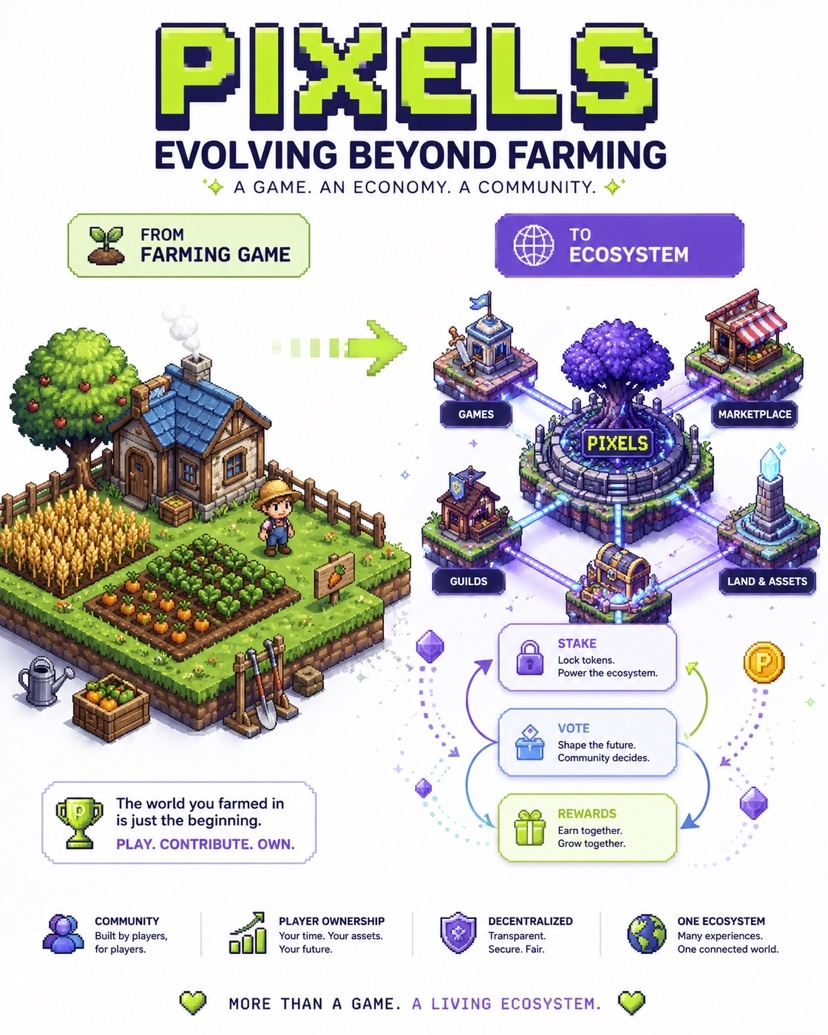
From the outside, everything looks clean.Stake-to-Vote. Reward allocation. Daily cadence. It feels like a beautifully arranged engine.But once you look inside, something more interesting appears. It is not only the game being optimized here. Human behavior is also being optimized. And the funny part is, people are enjoying that process too.
In the beginning, this was not so obvious.I remember when Web3 gaming mostly meant “play and earn.” You play a little, you get some rewards, and that was the basic calculation. Simple. Almost mechanical.Now it feels more serious, but also more playful at the same time.A strange combination.When you first hear about the Stake-to-Vote model, your first thought might be, “Okay, this is some kind of democracy.” You stake PIXEL, you support a game, and the game with more support gets more rewards.
But if you stop for a second, another question appears.How much of this is really “one person, one vote,” and how much of it is “one wallet, more weight”?Because here, it is not equal. It is proportional.And that proportionality is actually driving the whole ecosystem.
After Chapter 3, Pixels has become more than just a game. It is slowly becoming a hub. That sounds simple when you say it quickly, but in reality, it is not simple at all.Now, it is not only Pixels inside the picture. Other games are also entering this ecosystem, and they are competing with each other.
There is a weird feeling here.Games are no longer built only for players to have fun.Now, they also have to win attention, earn support, and prove why players should keep caring.
In a way, games are also fighting for survival.Who can attract more stakes?
Who can hold more attention?
Who can convince players to support them?
It sounds a little funny, but games are no longer just trying to entertain players. They are also trying to win the hearts of players.
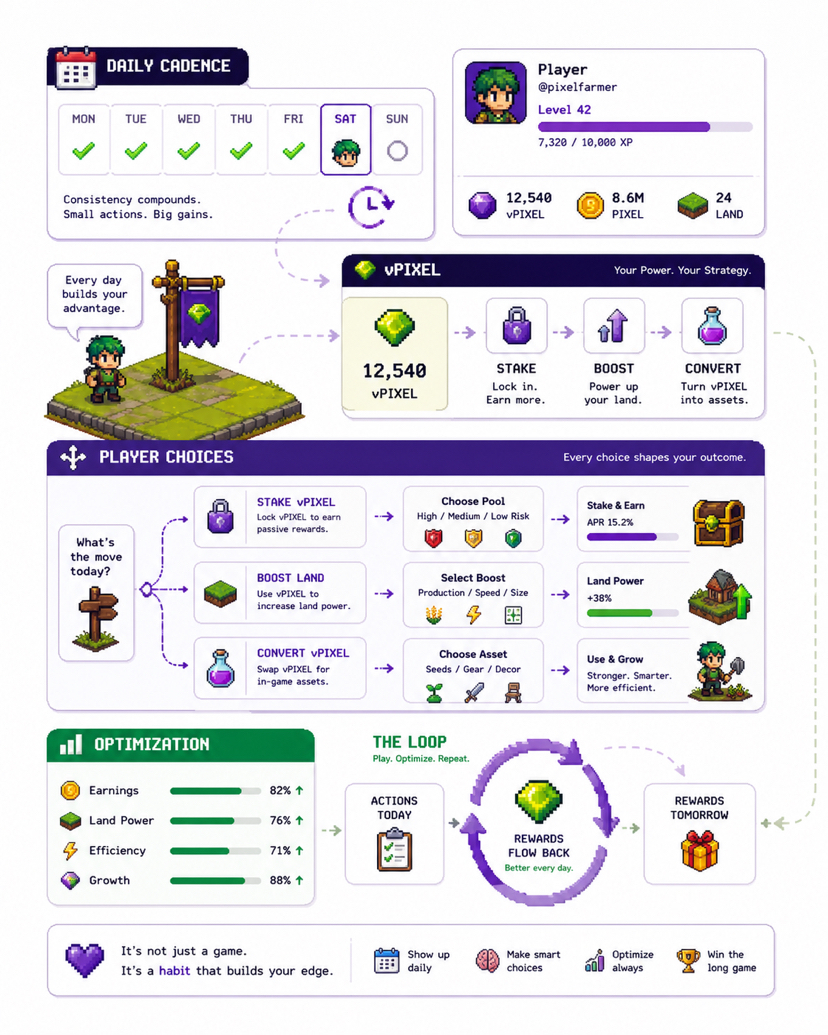
And the players… they think they are simply making decisions. Things became even more interesting after the daily cadence arrived.Before, people might have checked once a week to see what happened with rewards. Now it is every day. That changes the feeling completely.Engagement is no longer an event.It becomes a routine.And once something becomes routine, people do not question it as much. You are no longer coming back occasionally. You are staying inside the loop.That is where the psychological shift quietly starts.Then there is vPIXEL.At first, it sounds like just another upgrade token. But actually, it feels more like a behavioral shortcut. You are not directly paying a fee in the same painful way. You are using a more system-friendly currency.And people like it because it feels less heavy.Less painful.More natural.Land-Boost also creates an interesting picture.Someone holds a bunch of NFTs, and suddenly they become 10% more powerful. On the surface, it sounds almost like a cheat code in a video game. But in reality, it looks more like capital efficiency.I stop here and think:
Is this unfair?Or is this just early advantage being formalized?The answer is not simple.But one thing is clear. Pixels is using ownership not only as an asset, but also as influence. And surprisingly, people are accepting it.After the T5 update, another strange feeling appeared.Rewards are no longer just rewards.They are starting to feel like production inputs again.
What you earn does not just sit there as a reward. It can be used to build, improve, or unlock something new inside the system.So the loop does not really end after earning. It starts moving again.It turns back into the system.In a way, it feels like an economic snake eating its own tail.But somehow, it still feels stable.From a real-world angle, Pixels brings back one old question:
Are people really playing only for the rewards, or are they slowly becoming used to living inside the system itself?Pixels is blurring that boundary.And the most interesting part is that it does not feel forced. It makes you feel like you are choosing everything yourself.That is why it is slightly funny.Because here, the line between choice and design is very thin.The Ronin to Ethereum L2 migration is also important. Technically, it is a big move. But emotionally, it feels like a signal.The system is no longer acting like a small experiment. It is moving toward a scaling phase.And scaling means something different.Not just more players.More capital.More expectations.More pressure.More attention.Everything starts becoming bigger.But interestingly, even while all this is happening, many people still think of Pixels as just a game.Maybe that is the cleverest part.So at the end, I am standing in a strange place.Is Pixels really becoming a decentralized system?Or is it a well-designed engagement economy that explains itself using the language of decentralization?The answer is not completely clear yet.But one thing is clear to me.People are not only participating in Pixels anymore.They are adapting to it.And maybe that is the real point. Because no matter how complex a system becomes, it does not survive only because of technology.It survives because of habits.And Pixels is slowly creating those habits quietly, regularly, and very carefully.So maybe the real question is not whether this is good or bad.#pixel @Pixels $PIXEL
The real question is:How much of this system do we truly understand, and how much of it are we simply getting used to as part of the game?