
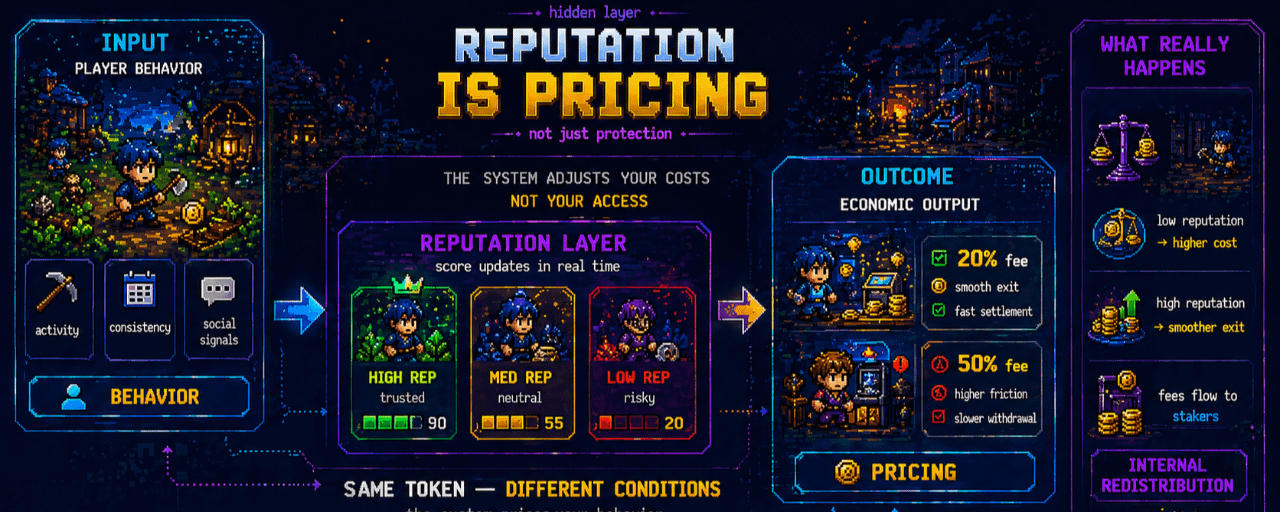
I was going through the reputation docs of Pixels and got stuck on one sentence from an AMA. Something like the farmer fee isn’t there to punish withdrawals, it’s there to encourage the “right” behavior.
At first I thought okay, standard Web3 wording. But the more I sat with it, the more it didn’t sound like a game feature anymore.
It sounded like pricing.
From what I understand, your Reputation Score affects almost everything. What you can trade, how much you can sell, and especially how much fee you pay when withdrawing PIXEL. Somewhere between 20% and 50%, which is… not small. But that range isn’t random. It depends on how you’ve behaved over time. Social connections, quests, farming, owning land, all of that feeds into it.
And that’s where it starts to feel different.
Because this isn’t just blocking bots. It’s grading users.
The more I think about it, the more it reminds me of systems outside gaming, like how platforms rate trust or reliability. Higher score, better conditions. Lower score, more friction. Except here it’s applied directly to money flow inside the game.
Then there’s the part I didn’t pay attention to at first: where the fee goes.
It doesn’t disappear. It gets redistributed to people staking PIXEL. So every time someone exits and pays a higher fee, someone else who stays benefits. No new tokens, just value shifting inside the system.
That’s when the whole thing started to connect a bit differently in my head.
You’ve got reputation acting like a credit layer. The farmer fee acting like dynamic pricing. And then vPIXEL sitting there as an alternative path where you can spend inside the ecosystem without touching that fee at all.
So if you keep your activity inside, friction is low. If you try to extract value out, friction increases. Not by banning you, but by making it more expensive over time.
I don’t know… it’s subtle, but it feels intentional.
Most people I see are still looking at DAU or token price when talking about PIXEL. Which is fair, that’s how we usually read game tokens. But this system feels like it’s trying to measure something else underneath. Like how value moves, not just how many players there are.
I’m not even sure yet if this model scales cleanly or if it creates other problems later. Also not sure how it behaves when player behavior changes outside Pixels’ usual pattern.
But it does feel like they’re not just building a game economy. More like a controlled environment where behavior actually changes your economic terms.
Still watching how this plays out in real data, especially how much fee is actually flowing back to stakers over time.
Feels like one of those things that won’t show up in announcements, only in numbers after a while.