
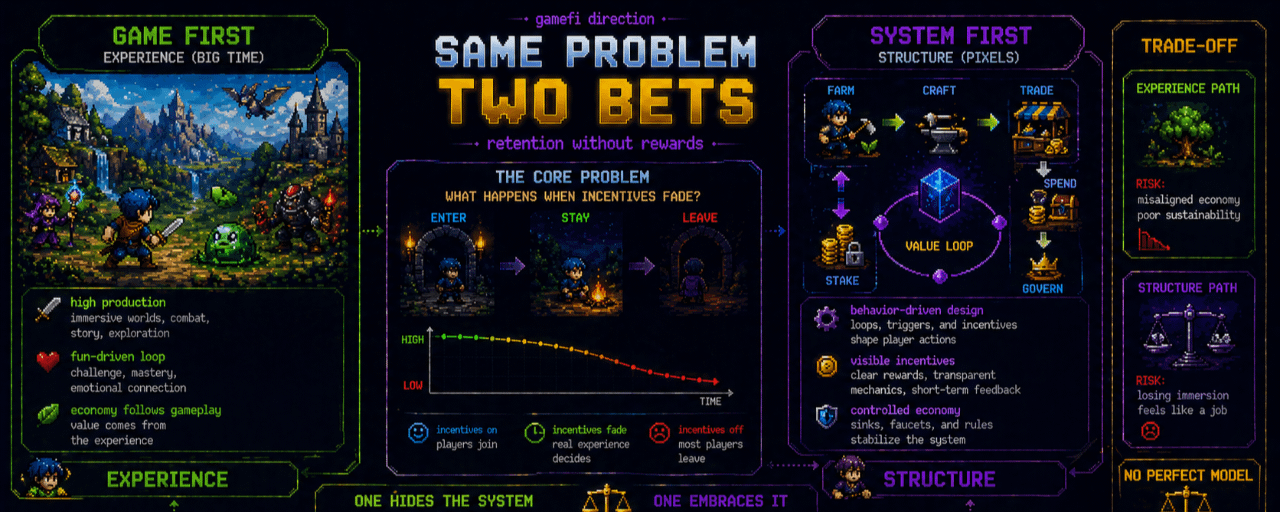
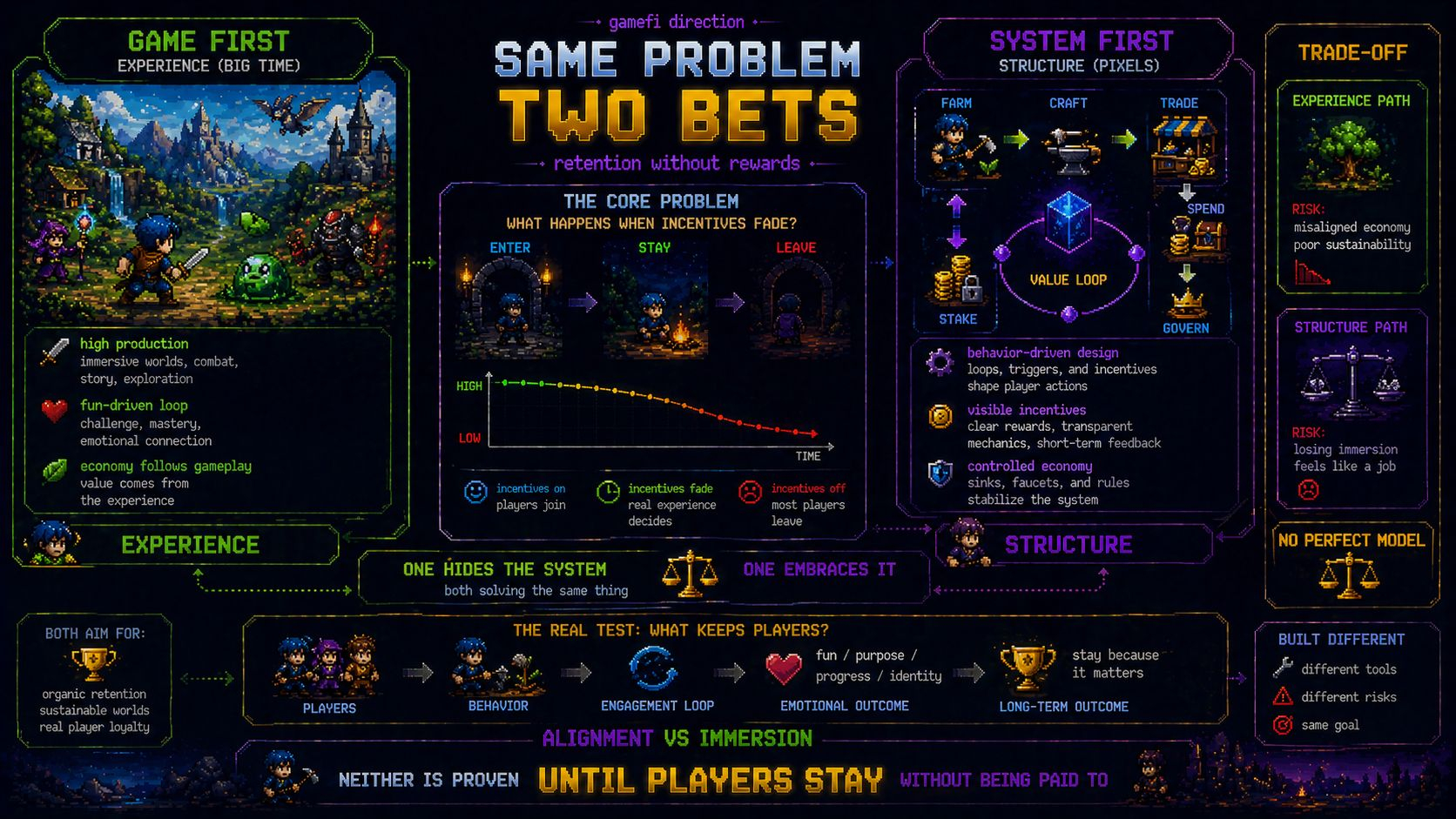
I’ve seen this pattern enough times that it’s hard not to recognize it early. New cycle, new framing, new mix of game + token + economy. It looks fresh at first, cleaner UI, stronger narrative, but the underlying feeling is familiar. People show up for the upside, stay while it still feels worth it, then drift away once the balance quietly breaks.
At a glance, Pixels and Big Time can easily get grouped together. Same broad category, same ingredients on paper. But the more I sit with them, the more it feels like they’re actually making very different bets.
The core problem they’re both facing hasn’t changed. It’s not tech, not TPS, not which chain is faster. It’s behavior. More specifically, how do you keep players around when the initial financial incentive starts fading. That’s the part that keeps breaking systems, no matter how polished they look at launch.
A lot of projects tried to brute force that problem. More rewards, stronger incentives, faster growth. It works… for a while. But it also creates this dependency where players are effectively being paid to stay, not choosing to stay. And once that payment weakens, so does everything else.
From what I can tell, Big Time leans toward a more familiar direction. High production value, real gameplay focus, loot-driven progression, NFT layer on top. The idea seems straightforward: build a good enough game, and the economy will settle around it. It sounds right, and honestly it should work in theory.
But there’s a friction I’ve seen before in that model. The players who care about gameplay don’t necessarily care about extracting value. The players who care about value don’t necessarily care about the game. And when those two groups don’t overlap enough, the economy starts pulling in opposite directions. One side creates, the other side drains.
Pixels feels like it’s approaching from almost the opposite angle. Not better or worse, just different. It doesn’t try too hard to hide the economic layer. If anything, it leans into it. It feels less like “a game with an economy” and more like “an economy you interact with through a game.”
That changes the tone.
Big Time feels like it’s saying, “this is a game, enjoy it, the rest will follow.”
Pixels feels more like, “you’re inside a system, and this is how you move within it.”
There’s something oddly honest about that. It doesn’t rely on the player forgetting about incentives. It assumes the player already understands them. And in crypto, that assumption probably isn’t wrong. People aren’t naive anymore. They know what loops look like, they know when they’re being paid to participate.
So the question shifts a bit. It’s not about hiding the economic layer better. It’s about designing a system where that layer doesn’t break the experience.
Still, all of this is just interpretation for now.
None of it really matters until usage proves something. Big Time only works if players keep playing when short-term incentives aren’t the main driver. Pixels only works if its economy can hold together when growth slows and behavior stabilizes.
I don’t think there’s a clear answer yet.
It feels like Big Time is betting on experience.
Pixels is betting on structure.
One trusts that good gameplay will anchor everything.
The other trusts that if the system aligns well enough with behavior, stability might emerge from that.
Both make sense. Both have failed in different forms before.
That’s probably why I’m still watching. Not because I’m convinced, but because I’m curious how these two directions play out when the easy phase is over and the system actually has to hold on its own.