
There’s a version of the “open economy” story that sounds almost too perfect. You log in. You play. You earn. What you earn is yours. Simple. Clean. Fair. For a long time, that idea carried a kind of quiet promise. It suggested a world where effort translates directly into ownership—no friction, no gatekeeping, no hidden layers. Just action and reward, neatly connected. But the longer you sit inside these systems—especially the ones that don’t disappear after the first wave of excitement—the more that simplicity starts to feel… incomplete. Not wrong. Just unfinished. Because what looks like openness from the surface often turns out to be something more carefully arranged underneath.
The Difference Between “Open” and “Structured”
Most players don’t notice it at first. Why would they? Everything feels open. You can move freely. You can grind as much as you want. You can craft, trade, experiment, optimize your routes, and build your own rhythm. There are no loud restrictions, no hard stops blocking your progress. The system doesn’t scream control. And that’s exactly why it works. Because the structure isn’t placed at the beginning of your actions… it’s placed at the end.
Where Pixels Starts to Feel Different
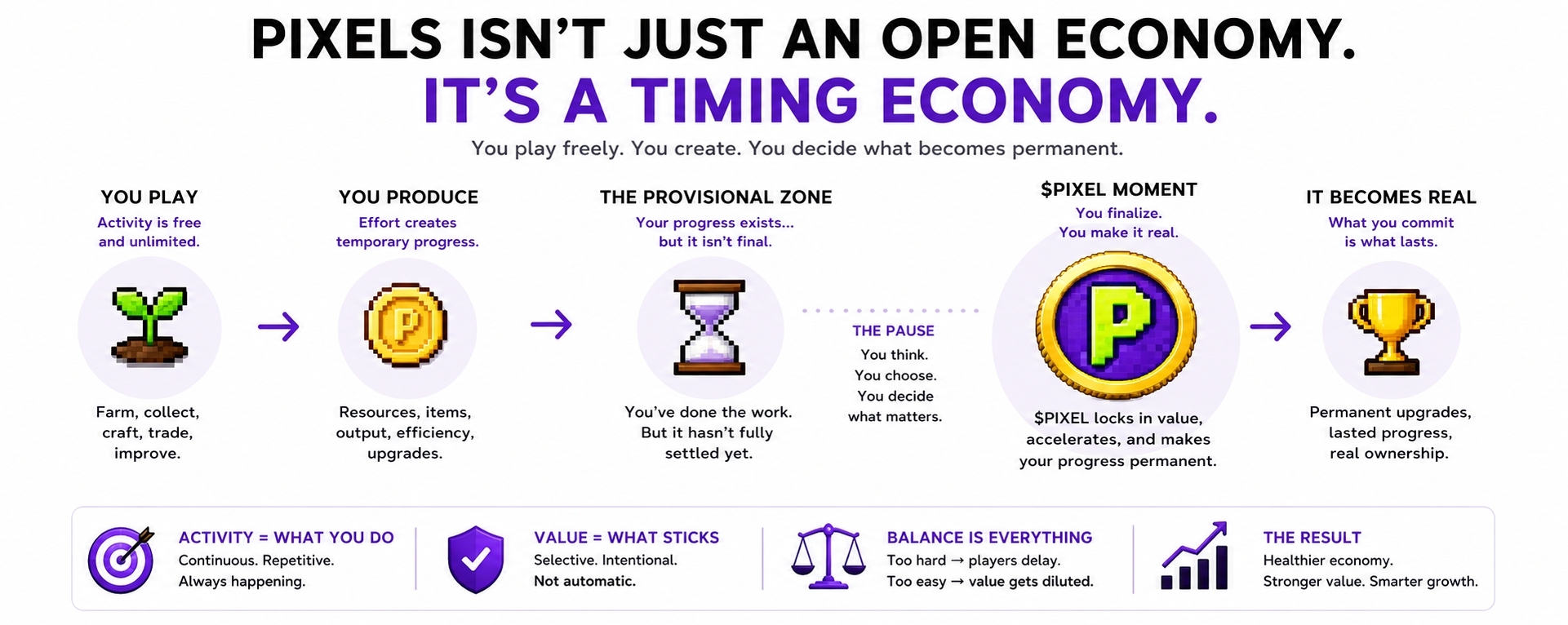
This is where Pixels quietly separates itself. At first, it behaves like any other living game economy. You log in and immediately find yourself doing things—farming, collecting, crafting, improving efficiency. The in-game currency keeps everything flowing. Activity is constant. The world feels alive. But after a while, something subtle begins to stand out. There’s a gap. A small, almost invisible space between doing something and that thing actually becoming meaningful in a lasting way. You can play for hours. You can generate output. You can stack progress. But not all of that progress feels equally final. It exists… but it hasn’t fully settled. And the game never directly tells you this. You just start to feel it.
Activity vs. Value: A Hidden Separation
This is the core shift that changes everything. Most game economies collapse these two ideas into one: if you did the work, you’ve created value. But Pixels doesn’t fully agree. Instead, it quietly separates activity—what you do—from value—what the system recognizes and preserves. That separation creates a new kind of space, a provisional layer where your effort lives before it becomes permanent. You’re not blocked from playing. You’re not stopped from producing. But you’re also not automatically guaranteed that everything you produce will carry forward as lasting value. That transition is selective.
Enter $PIXEL — Not at the Beginning, but at the End
Most people look at PIXEL and assume they understand it instantly. Premium token. Speeds things up. Unlocks features. Standard. And on the surface, that’s not wrong. But it’s also not the full picture. Because $PIXEL rarely shows up when you start doing something. It shows up when you decide something should matter. Not emotionally. Not visually. Economically. Persistently.
The Moment That Changes Everything
Imagine this: you’ve spent hours building progress—farming resources, optimizing your workflow, stacking output. You reach a point where you can make a meaningful upgrade or decision. In most games, this is automatic. You click the button, upgrade done, move on. But here, there’s a pause. Not because you’re forced to stop, but because you choose to think. Is this the right moment? Should I commit this now? Is this worth finalizing? That hesitation is new. And it’s powerful. Because it transforms a simple game action into something closer to a decision.
Why That Hesitation Matters
In traditional play-to-earn systems, everything converts instantly. You act, it counts, it’s final. The result is high activity and constant output, but weak long-term value. Because when everything is equally final, nothing feels worth protecting. Players optimize extraction. Systems inflate. Value thins out over time. Pixels takes a different approach. It doesn’t stop activity. It just delays finality.
The Provisional Zone: Where Most Players Actually Live
What emerges is a fascinating middle state. You’re active, productive, engaged—but not everything you do is fully locked in. You exist in a kind of economic in-between. You’ve created something but haven’t committed it. You’ve progressed but haven’t finalized it. You’ve earned but haven’t fully converted it. And that space is where most of the game actually happens. Not at the start. Not at the end. But in the middle.
$PIXEL as a “Timing Mechanism”
This is where the role of PIXEL becomes clearer—and much more interesting. It’s not just pricing speed. It’s not just selling access. It’s doing something far more subtle. It’s pricing timing. Specifically, when do you decide your effort becomes permanent value? That’s a very different question, and different players answer it differently.
Uneven Behavior, Uneven Demand
Once you understand this, the economy starts to look less predictable—and more human. Some players finalize quickly and prefer certainty. Others wait, stack resources, and optimize before committing. Some stay in the provisional zone as long as possible. This creates a system where activity is continuous but token demand is irregular. Instead of smooth growth, you get quiet periods and sudden spikes tied to decisions.
The Fragile Balance Holding It Together
This design is elegant—but fragile. Because everything depends on maintaining the right level of friction. If PIXEL becomes too expensive, players delay finalization and value remains uncommitted. If it becomes too easy, everything settles instantly and overproduction returns. So the balance isn’t just important—it’s critical.
The Invisible Design Advantage
What makes this system powerful is that most players don’t consciously understand it. They don’t think in technical terms. They just feel small instincts—“not yet” or “now feels right.” And that’s enough. Because behavior doesn’t require awareness, just influence.
Beyond Games: A Bigger Idea
This design hints at something larger. One of the biggest challenges in blockchain systems is deciding what should be recorded and when. Record everything immediately and you get noise. Delay too much and you lose trust. Pixels experiments with a middle ground. Let activity happen freely, introduce a cost at finalization, and let users decide when to cross that boundary.
The Unanswered Question
Does this hold under real pressure? That’s still uncertain. Because once players understand the system, timing becomes strategy, and behavior shifts. Systems like this don’t break loudly—they drift.
The Pattern You Can’t Unsee
But once you recognize it, you can’t unsee it. Pixels doesn’t feel fully open anymore. It feels sequenced. First you act, then you accumulate, and only later you decide if it should last. That final step is intentional.
And That’s Where PIXEL Lives
Not at the start. Not in every action. But at the moment you ask: is this worth making real? It doesn’t answer for you. It simply makes the question unavoidable—and in doing so, it shapes the entire economy one decision at a time.