


Most GameFi economies die the same way.
They start with hype, they print rewards, farmers rush in, grinders optimize every possible loop, bots show up, emissions get dumped, and eventually the token becomes a slow-motion exit door.
I’ve seen it too many times.
The chart goes down. Rewards get weaker. The serious players leave. Casuals get bored. The economy loses depth. The game turns into an empty map with a token attached.
So when people ask me why I still pay attention to Pixels, my answer is simple: because Pixels at least understands the disease it is trying to avoid.
And that disease is the GameFi death loop.
Pixels looks cozy from the outside. Popberries, farms, land, crafting, tasks, cute avatars, a social world, all of that. But if you are actually spending hours inside the game, you start noticing something more important underneath the farming layer.
The game is not just trying to keep you busy.
It is trying to stop the economy from eating itself.
That is where energy friction comes in.
I know, I know. Nobody loves running into limits. Farmers want to farm. Grinders want to grind. When you are locked in, when you know exactly what you want to do, when you have your route planned and your resources mapped out, energy friction can feel like the game is standing in your way.
But here is the uncomfortable truth...
Without friction, your grind becomes worthless.
If everyone can produce endlessly, then nothing you produce has value. If every player can farm resources all day with no meaningful limit, the market gets flooded. Popberries, crafting inputs, materials, whatever the current loop is pushing... it all starts losing weight. Prices weaken. Rewards get thinner. The player-driven economy turns into a race to the bottom.
And who wins that race?
Not regular farmers.
Not the grinders who actually care.
Bots win. Multi-account farmers win. Mercenary capital wins. The people who are here only to extract win.
The rest of us become exit liquidity.
That is why energy friction is a necessary evil. It forces decisions. It makes you ask: where should I spend my actions today? What is actually worth my energy? Am I pushing taskboard progress, stacking resources, crafting, helping my Union, optimizing land activity, or preparing for the next seasonal objective?
That decision-making is what protects the time we put in.
A game economy needs limits the same way a real economy needs scarcity. If there is no scarcity, there is no market. If there is no market, there is no reason to specialize. If there is no reason to specialize, every player becomes the same extraction machine.
Dead economy.
Pixels is trying to avoid that by making activity matter more than raw clicking.
That brings me to the Union system.
For me, this is one of the most important shifts Pixels has made. The Bountyfall update did not just add another event layer. It changed the way players think about contribution. Instead of only asking “what can I farm for myself today?” the game starts asking “where does my effort fit inside the larger fight?”
Wildgroves. Seedwrights. Reapers.
Pick your side.
Now your grind has a social direction. You are not just dumping resources into a void. You are contributing, competing, helping your Union, watching the rankings, thinking about timing, and paying attention to what other groups are doing.
That matters more than people realize.
Old play-to-earn games were mostly individual extraction machines. You logged in, farmed rewards, sold rewards, repeated until the math stopped working. There was no real social pressure to stay. No identity. No group-level pride. No reason to care beyond yield.
Pixels is trying to add something stickier.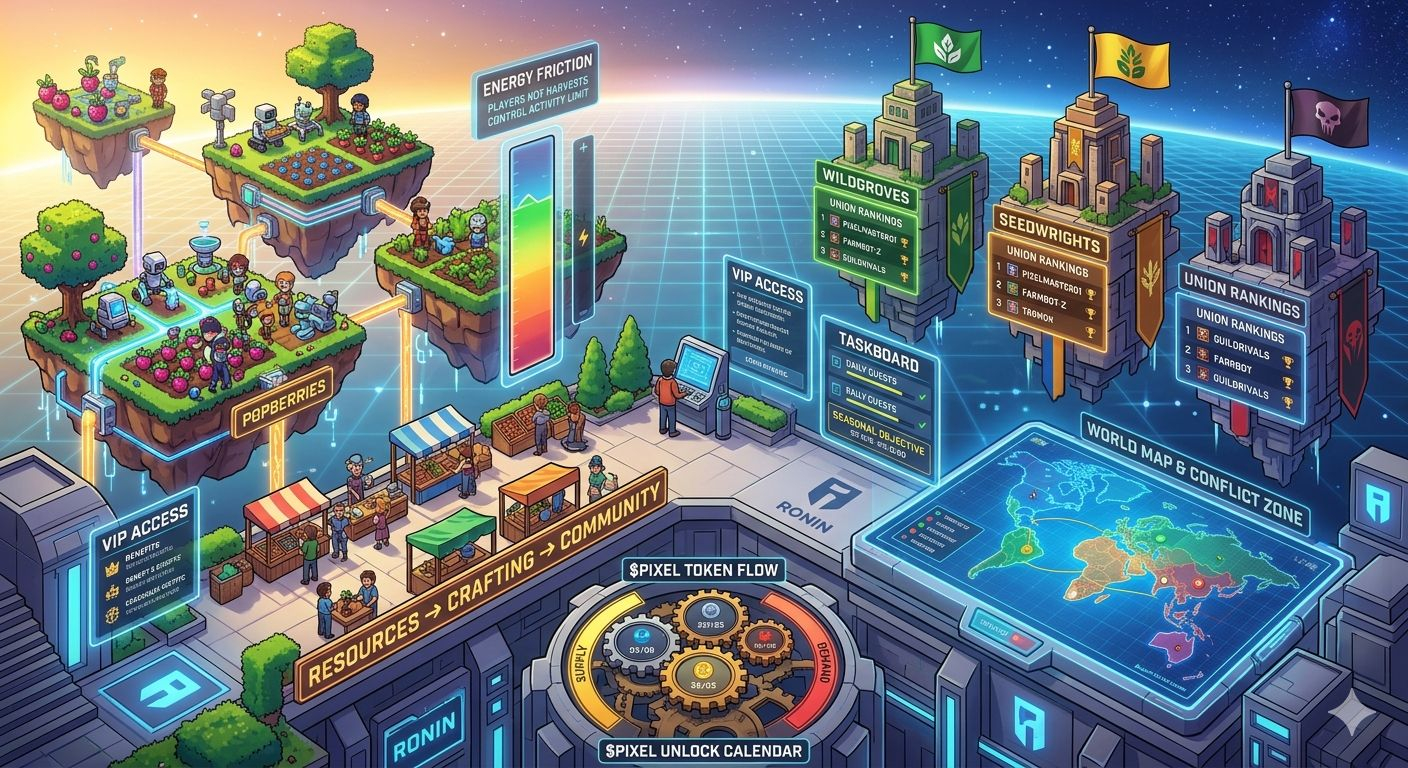
Union systems create identity. They create rivalry. They create contribution history. They make players care about more than their own wallet. And once players care about more than personal extraction, the economy gets harder to kill.
Is it perfect?
No.
Nothing in GameFi is perfect.
But the direction is right.
The Union model also helps fight the problem of mercenary players. A wallet that appears only to farm emissions should not have the same weight as someone who shows up daily, contributes to objectives, spends resources intelligently, and actually participates in the world. Reputation and contribution-based rewards can help separate real players from pure extractors.
That is huge.
Because if Pixels wants to survive, it cannot reward every wallet equally just for existing. It has to reward behavior that strengthens the game.
Grinding should matter.
But mindless extraction should not.
There is a difference.
When I look at Pixels, I see a game trying to build value flow instead of just token flow. That is the key. A weak GameFi economy pushes value in one direction: from the game to the player’s wallet, then out to the market. A stronger economy creates loops. You earn, you spend, you upgrade, you craft, you compete, you contribute, you reinvest.
The value keeps moving.
That is how a player-driven market survives.
If resources have uses, if crafted items have demand, if land has utility, if VIP systems create desirable sinks, if seasonal objectives create urgency, if Unions make contribution feel meaningful, then the economy has more places for value to go.
If value only goes out, the game dies.
Simple.
This is also why Ronin matters. I do not think Pixels would feel the same if it were just sitting on a random general-purpose chain. The move from Polygon to Ronin changed the community energy. Polygon gave Pixels infrastructure, sure. But Ronin gave it a gaming home.
That vibe shift was real.
Ronin players already understand Web3 gaming. They understand wallets, assets, markets, land, rewards, speculation, and the dangers of bad economies. That does not mean they are magically loyal forever, but it does mean the user base is more aligned with what Pixels is trying to build.
Games need sticky infrastructure. Not just cheap gas. Not just a chain logo. They need marketplaces, wallets, culture, liquidity, and players who already know why digital assets matter inside a game world.
Pixels found that on Ronin.
And for farmers and grinders, that matters because your time investment is only as strong as the ecosystem around it. If the market is fragmented, if liquidity is thin, if players are scattered across chains, if every action feels like a bridge-and-wallet nightmare, the game loses momentum.
Ronin reduces that friction.
The good kind of friction should be inside the economy.
Not in the user experience.
That is the balance Pixels is chasing.
Energy friction inside the game? Healthy, if tuned well.
Friction just to use the blockchain? Terrible.
Now, let’s be honest about the risk.
$PIXEL still has a ticking unlock calendar. No serious player should ignore that. Future supply matters. Unlocks matter. Emissions matter. If new token supply enters the market faster than real demand grows, price pressure hits. It does not matter how cute the game looks. It does not matter how strong the community sounds on social media.
Supply is supply.
The question is whether Pixels can build enough demand before unlock pressure becomes the main boss fight.
And I mean real demand.
Not influencer hype.
Not “next 100x gaming coin” nonsense.
Real demand means players spending because they want access, efficiency, upgrades, cosmetics, VIP benefits, seasonal positioning, better market opportunities, and stronger Union performance. Real demand means the token is useful inside the world, not just tradable outside it.
That is the line between survival and death loop.
If Pixel is only something farmers earn and dump, it will struggle.
If Pixel becomes something players earn, spend, and strategically use, it has a chance.
That is why I keep coming back to energy and Unions. They may seem like small design choices, but they are not. They are economic defense systems.
Energy protects production from becoming infinite.
Unions protect participation from becoming purely selfish.
Together, they make the game harder to exploit and more rewarding for people who actually care.
Farmers, I know friction can be annoying.
Grinders, I know you want maximum efficiency.
But the thing that slows you down today might be the same thing that keeps your progress from becoming worthless tomorrow.
That is the tradeoff.
A zero-friction GameFi economy feels amazing for a few weeks. Then everything collapses.
A sustainable economy feels a little tighter. A little more demanding. A little more strategic. You have to think. You have to choose. You have to coordinate. You have to care.
That is not a bug.
That is the game growing up.
My take is that Pixels has a better shot than most because it is not pretending emissions can carry the economy forever. It is building around controlled production, social competition, player-driven markets, land utility, VIP sinks, and Ronin-native community stickiness.
Will that be enough?
I do not know.
No one does.
The unlock calendar is still coming. Market cycles are still brutal. Mercenary capital is always waiting. And if player demand does not grow fast enough, Pixel will feel the pressure like every other gaming token.
But Pixels is at least fighting the right battle.
It is not just trying to make farming fun.
It is trying to make farming economically survivable.
That is the difference.
And in GameFi, that difference might be everything.