
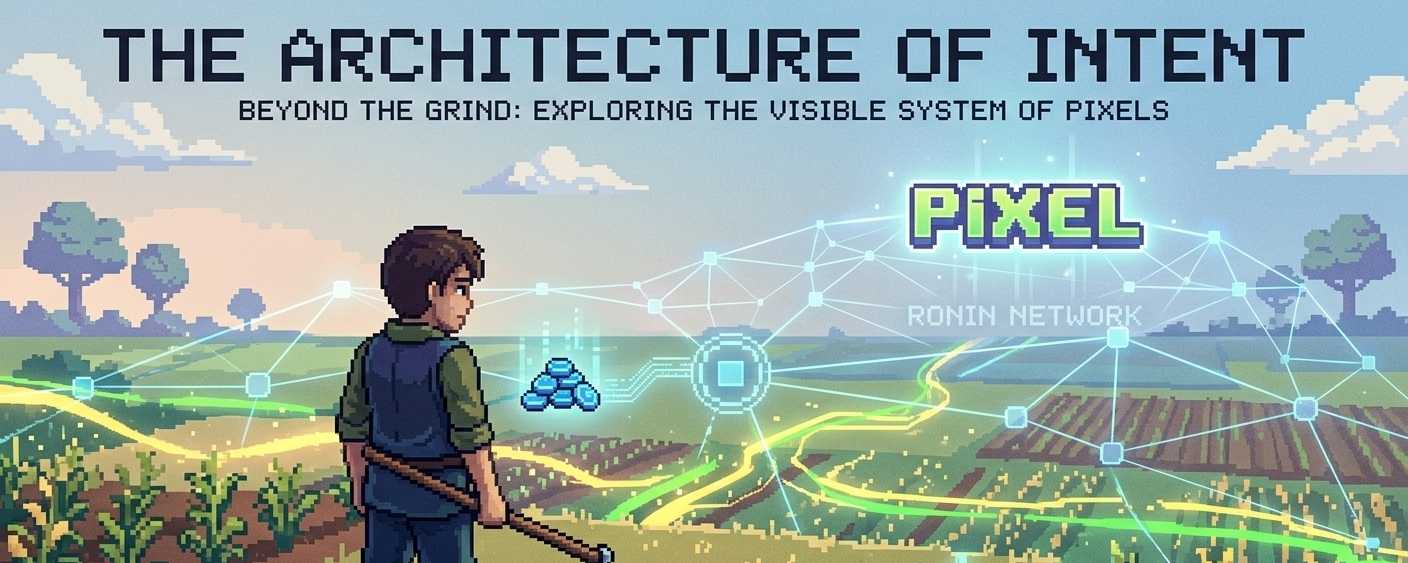
At first, Pixels (PIXEL) didn’t feel like a system at all. It felt like a place — soft, open, almost forgiving. I planted crops, wandered through fields, clicked through tasks without really questioning why. Rewards appeared, tokens accumulated, and I accepted them the way you accept small wins in a casual game: without thinking too deeply about where they came from or what they meant.
Even the connection to Ronin Network felt distant. I knew it powered the game, but that knowledge sat in the background, abstract and unimportant. I wasn’t playing because it was Web3. I was just playing.
But over time, something started to feel… structured.
It was subtle. The way certain actions seemed to matter more than others. The way some players progressed faster, not because they spent more time, but because they made different choices. I began to notice patterns — not in the crops or the map, but in behavior. Mine, and everyone else’s.
At first, I thought rewards were just outputs. You do something, you get something. Simple. But that idea started to crack. Because not all actions were equal. Some actions positioned you. Others just kept you busy.
I remember the moment it shifted. I wasn’t farming for resources anymore — I was farming for timing. For alignment. For opportunity.
The tokens I once treated like points started to feel like signals. They reflected decisions, not just effort. And suddenly, the game didn’t feel like a loop. It felt like a network of choices, quietly influencing each other.
Exploration connected to ownership. Ownership connected to rewards. Rewards connected to behavior. And behavior… that was the real currency.
That’s when staking — something I had ignored before — began to make sense in a different way. It wasn’t just about locking assets for returns. It was about declaring intent. A kind of commitment to a direction inside the system. Not passive at all, but deliberate.
And once I saw that, I couldn’t unsee it.
The players who seemed ahead weren’t grinding harder. They were aligning earlier. They treated the game less like a place to play, and more like a system to exist within. Their actions weren’t random — they were coordinated, even if unconsciously.
I started to change how I moved.
Less clicking, more observing. Less reacting, more anticipating. I stopped asking “what gives rewards?” and started asking “what shapes outcomes?”
And strangely, the game became quieter after that. Not less interesting — just more… precise. Every action carried weight. Every decision echoed somewhere else in the system.
It made me realize something uncomfortable: maybe I wasn’t late to understanding the game.
Maybe I had just been participating without ever truly engaging.
Because the deeper layer isn’t obvious. It doesn’t announce itself. It waits — until you start noticing connections instead of features.
And now I wonder:
If a system rewards alignment more than effort… were we ever really playing the game, or were we slowly learning how to position ourselves within something much bigger than it first appeared?
