

$PIXEL sits in an interesting position within the broader evolution of GameFi and onchain gaming economies where the industry is slowly shifting away from pure incentive driven participation toward systems that try to behave more like living economies... In earlier cycles most play to earn models were built on a relatively simple loop inject rewards attract users scale activity and hope the token economics could hold under pressure. What usually followed was predictable short bursts of engagement followed by inflationary imbalance reward dilution and declining user retention. $PIXEL by contrast attempts to frame itself less as a reward token and more as a coordination layer across gameplay progression and social interaction. The idea is not just to pay players for activity but to connect different layers of participation into a unified system where value is generated through engagement rather than simply distributed as an incentive. This shift is subtle but important because it moves the conversation from how much can users earn to what kind of behavior sustains the ecosystem over time. In that sense $PIXEL is part of a larger experiment happening in Web3 gaming whether economies can be designed to reward meaningful interaction without collapsing under their own incentive structures.
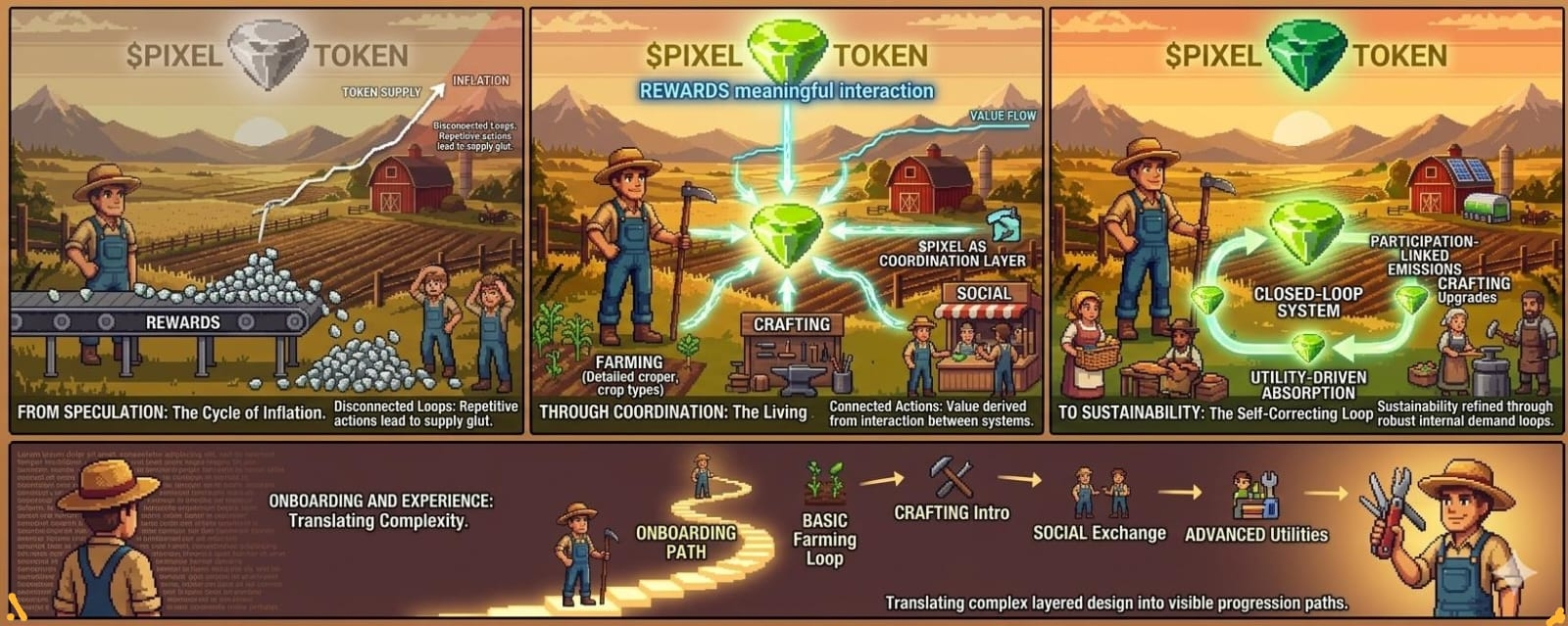
At the core of this design philosophy is the attempt to reduce fragmentation. Traditional GameFi ecosystems often suffer from disconnected loops one system handles rewards another handles crafting another governs social engagement and yet another controls progression mechanics. Each layer may function independently but the lack of cohesion often results in a disjointed experience where users optimize for short term gain rather than long term participation. $PIXEL approach leans toward integration where different actions within the game are not isolated events but part of a continuous value chain. Completing quests engaging in crafting systems participating in social dynamics or contributing to in game economies are all intended to feed into a broader loop that reinforces sustained activity. The important distinction here is that value is not simply extracted from time spent but derived from how different systems interact with each other. This creates a more networked form of engagement where players are not just consumers of rewards but active participants in shaping economic flow. However this design ambition also introduces complexity. The more interconnected a system becomes the harder it is for users to immediately understand how their actions translate into value which leads to one of the most critical challenges $PIXEL faces clarity.
Sustainability is another major dimension that defines how $PIXEL will ultimately be evaluated. Any tokenized economy must deal with the tension between emission and utility how much value is introduced into the system versus how much is naturally absorbed or cycled back through usage. In early stage GameFi projects emissions often act as the primary growth driver but without strong sinks or utility mechanisms they eventually destabilize the system. $PIXEL’s conceptual strength lies in its attempt to link emissions more directly to participation rather than passive holding or repetitive farming behaviors. This is an important step forward because it aligns rewards with activity that ideally contributes to the health of the ecosystem. However alignment alone is not enough the system still depends on robust internal demand loops. If tokens are generated through gameplay but lack meaningful ingame sinks such as crafting systems upgrades progression gates or social/economic utilities then inflationary pressure can still emerge over time. The sustainability question therefore is not just about how tokens are distributed but how deeply they are embedded into the functioning of the game itself. A well designed GameFi economy must behave like a closed loop system where value is continuously recycled not just emitted outward. $PIXEL long term success will depend heavily on how well it can refine this balance between reward creation and value absorption...
Another important aspect of $PIXEL trajectory is user experience particularly in how new players interact with the system. One of the recurring issues in Web3 gaming is the gap between conceptual depth and practical accessibility. Many systems are intellectually interesting but operationally overwhelming especially for users who are not already deeply familiar with blockchain mechanics or token driven economies. $PIXEL layered design featuring quests crafting progression paths and social interactions creates a rich environment for engagement but it also risks raising the barrier to entry. If a user cannot quickly understand what actions lead to progress or value early retention becomes fragile. This is where onboarding design becomes critical. A successful ecosystem in this category must translate complexity into guided simplicity allowing users to gradually discover deeper mechanics rather than confronting all systems at once. In practice this often means structuring early gameplay around intuitive loops clear feedback mechanisms and visible progression indicators that help users form mental models of how the economy works. Without this clarity even well designed systems can feel opaque leading to disengagement before users reach the more rewarding layers of the ecosystem.
Beyond mechanics and onboarding there is also a cultural dimension to consider. Web3 gaming is not just about systems it is about participation narratives. Players increasingly expect their actions to carry meaning beyond isolated gameplay loops whether that meaning comes from social recognition governance participation or contribution to a broader ecosystem identity. $PIXEL attempt to unify participation signals into a shared economy touches this idea where engagement is not just transactional but expressive. However building culture is more difficult than building mechanics. It requires consistency in design communication and reward alignment so that users feel part of something continuous rather than episodic. If participation feels fragmented or overly optimized it can reduce the sense of belonging that often drives long term retention in digital ecosystems. The challenge for $PIXEL is therefore not only technical but psychological shaping an environment where users feel that their ongoing activity contributes to something evolving rather than something static.
Looking at the broader landscape $PIXEL represents a transitional model in GameFi evolution. It sits between older reward heavy systems and future intent driven economies where behavior contribution and social interaction become the primary sources of value creation. This transitional position is both an opportunity and a risk. On one hand it allows the project to experiment with hybrid structures that combine familiar reward loops with more advanced economic design. On the other hand it exposes the system to scrutiny from both sides users expecting simple earning mechanics may find it too complex while users expecting fully mature economic depth may find it still evolving. The success of such systems often depends on iteration speed and the ability to refine economic feedback loops based on real user behavior. If $PIXEL can continue adjusting its balance between accessibility, sustainability and depth it has the potential to contribute meaningfully to how future game economies are designed.
Ultimately $PIXEL should be understood less as a finished product and more as an evolving framework. Its value proposition is rooted in the attempt to connect fragmented gameplay mechanics into a coherent economic structure where participation is both meaningful and sustained. However like all early stage systems in this space its long term trajectory will depend on execution rather than intention. Sustainability mechanisms onboarding clarity token utility depth and cultural cohesion will all play decisive roles in determining whether the ecosystem can move from experimental design to durable infrastructure. What makes $PIXEL worth observing is not just what it currently is but what it is attempting to become a step toward game economies that behave less like reward machines and more like interconnected digital societies.