
I keep coming back to the same uncomfortable thought about PIXEL… the numbers look alive, but I’m not fully convinced the users are.
I’ve seen this pattern before, not just in crypto, but in real life. A few years ago, I helped a friend run a small online marketplace for digital art. At one point, traffic exploded. Daily users were climbing, transactions were happening constantly, and on paper, everything looked like success. But when we looked closer, most of the activity came from a handful of users cycling through the same behavior—buying, flipping, repeating—because there was a short-term incentive to do so.
When that incentive faded, the entire system went quiet almost overnight.
That experience stuck with me. And lately, I’ve been noticing echoes of it in how I think about $PIXEL.
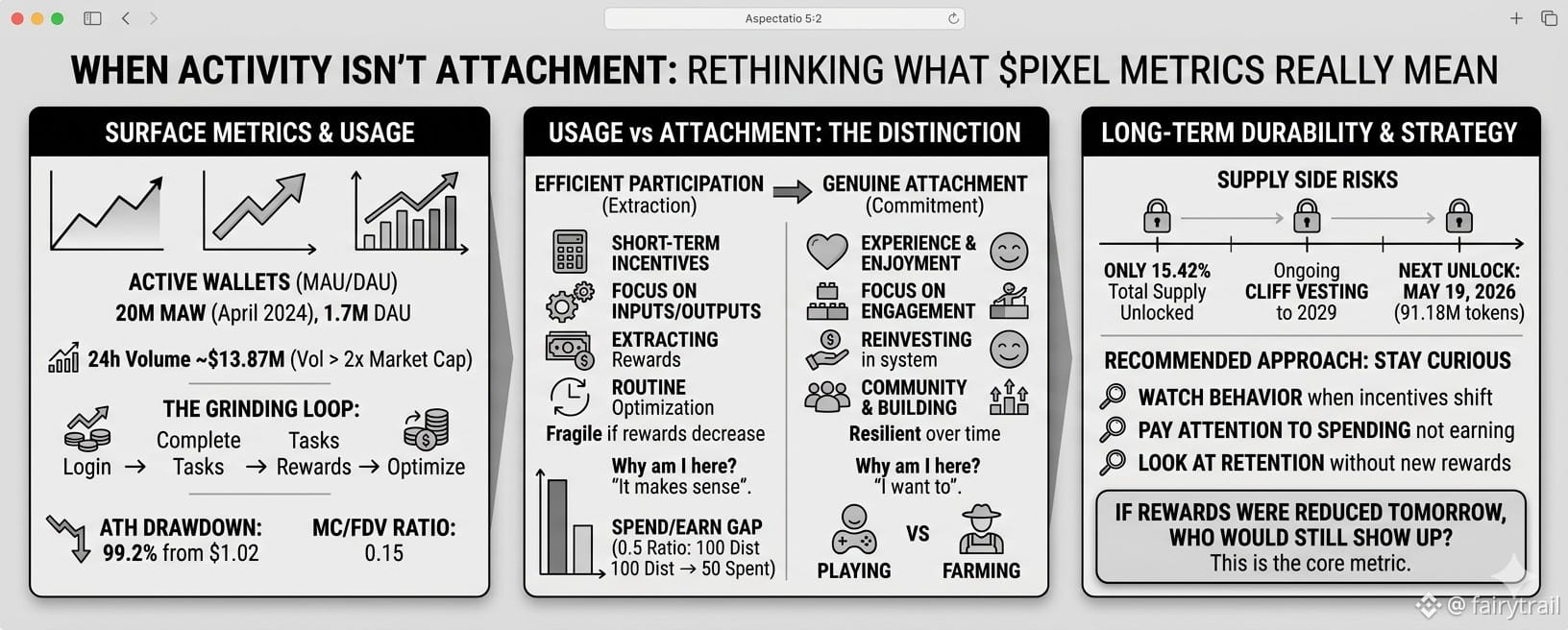
Right now, PIXEL is trading around $0.008337, with a market cap of roughly $6.42M, 24-hour volume near $13.87M, and a fully diluted valuation of about $41.66M. Circulating supply sits at around 770M out of a max 5B. On the surface, that’s a lot of activity relative to its size—volume is more than double the market cap, which usually signals heavy participation.
But again… what kind of participation?
Pixels as a game has done something undeniably impressive. At its peak, it pulled in massive traction—20M monthly active wallets in April 2024, 48M unique wallets in Q2, and still over 1.7M daily active users later in the year. It even generated around $20M in revenue in 2024. Those are not small numbers. That’s real usage.
Still, I can’t shake the distinction between usage and attachment.
The core loop of Pixels is efficient. You log in, hit the Task Board, complete actions, earn rewards, and optimize your routine. PIXEL becomes the premium layer—used for land minting, speeding builds, cosmetics, pets, VIP perks, even staking into the broader ecosystem. It’s a well-designed economy.
But efficiency can be misleading.
When I tried something similar myself—grinding a play-to-earn loop in another game—I noticed something strange. I wasn’t actually enjoying the process. I was optimizing it. I was thinking in terms of inputs and outputs, not experience. And I kept showing up, not because I wanted to, but because it made sense to.
That’s the tension here.
Pixels reports that paying wallets grew 75% to 109k by December 2024, and in-game PIXEL spending hit 10M tokens in that same month. But the return-on-rewards ratio ended at 0.5. That means for every 100 PIXEL distributed, only 50 PIXEL was being spent back into the system.
That gap matters more than it looks.
It suggests that while users are active, they may not be deeply reinvesting in the experience. They’re participating, but possibly extracting more than they’re committing. And that’s where long-term durability gets tested.
Then there’s the supply side.
Only about 15.42% of total supply is currently unlocked—roughly 771M tokens. The rest is still scheduled, mostly through cliff vesting running into 2029. The next unlock is coming on May 19, 2026, with 91.18M PIXEL entering circulation across team, treasury, advisors, ecosystem rewards, and private investors.
That’s not just dilution—it’s timing pressure.
Because if the current activity is still largely incentive-driven, then additional supply hitting the market could amplify that fragility. More tokens mean more distribution, but not necessarily more attachment.
And the market seems aware of this.
PIXEL is down about 99.2% from its all-time high of $1.02. That kind of drawdown isn’t just volatility—it’s a full reset of expectations. The current market cap to FDV ratio of 0.15 tells a clear story: the market is pricing this more like a slow utility token with ongoing dilution than a high-growth narrative.
Which brings me back to the core question.
What are we actually measuring?
Daily active users? Transactions? Volume? These are all visible metrics. They’re easy to track, easy to compare, and easy to build narratives around. But they don’t tell us why users are there.
And that “why” is everything.
If users are showing up because the loop rewards them, then activity can stay high right up until the moment it doesn’t. But if they’re showing up because they genuinely enjoy the experience—because they’re attached—then the system behaves differently. It becomes resilient.
The tricky part is that both scenarios can look identical from the outside.
You won’t necessarily see a spike when engagement becomes real. You won’t get a clean signal. The same users will log in, complete tasks, and interact with the system. The difference is internal—and much harder to measure.
I noticed this once with a small gaming community I was part of. At first, people were there for rewards and competitions. Over time, some stayed even after the rewards dried up. They kept playing, chatting, building things. The activity didn’t increase—but it didn’t collapse either. That’s when I realized the nature of engagement had changed.
I’m not sure Pixels has crossed that line yet.
Maybe it has, quietly, beneath the surface. Maybe the current structure is slowly converting routine into genuine attachment. Or maybe the system is still too tightly coupled to its incentives.
Right now, it feels unresolved.
And that’s where things get interesting.
Because markets don’t like ambiguity. They tend to fill gaps with assumptions—either bullish ones that assume growth is inevitable, or bearish ones that dismiss everything as farming.
But reality is usually somewhere in between.
If you’re looking at PIXEL today, I think the more useful approach is to stay curious rather than certain. Watch how users behave when incentives shift. Pay attention to spending patterns, not just earning. Look at retention when new rewards aren’t introduced.
And maybe most importantly—ask yourself: if the rewards were reduced tomorrow, who would still show up?
That’s the real metric.
So I’m still watching. Still trying to understand.
Do you think Pixels is building real engagement… or just very efficient participation?
And how would you even tell the difference before it’s obvious?
$PIXEL @Pixels #pixel $ZKP $BROCCOLI714 #ArthurHayes’LatestSpeech #BinanceLaunchesGoldvs.BTCTradingCompetition #StrategyBTCPurchase #EthereumFoundationUnstakes$48.9MillionWorthofETH
