
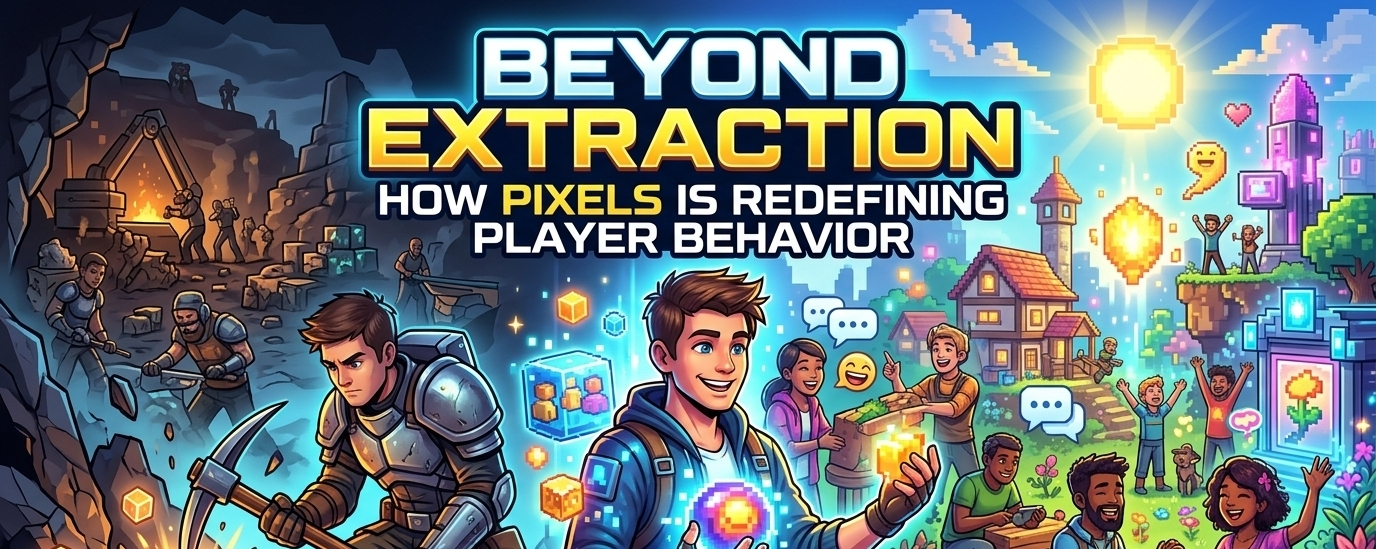
There’s a quiet shift happening in Web3 gaming that doesn’t show up in announcements or dashboards. You notice it instead in the way people log in. Fewer bursts of frantic activity fewer conversations about “what’s the fastest route and more small, repeated check-ins that don’t need to justify themselves. That change in rhythm has been especially visible in Pixels over the past few updates. It doesn’t feel like a redesign. It feels like a recalibration of intent.
Recent changes haven’t tried to expand the game outward as much as they’ve tried to stabilize what already exists. There’s been a subtle tightening of progression loops less about adding new mechanics more about making sure the existing ones don’t collapse under pressure. That’s a very different kind of update cycle from what most Web3 projects default to. Instead of chasing novelty, Pixels seems to be testing durability.
Part of that shows up in how resource flows have been adjusted. Earlier versions of the game allowed certain behaviors to scale too efficiently. Players who approached it like a system to be optimized could extract outsized value relative to their time. The recent updates appear to smooth those edges not by removing optimization entirely but by introducing diminishing returns in places where growth used to be linear. It’s a small shift in design but it changes the mindset required to engage with the game.
What’s interesting is how the player base responds to these constraints. In the early phases, users tended to converge on similar strategies. Efficiency dominated. Now there’s more divergence. Some players lean into social or exploratory behaviors while others still pursue optimization but with more friction. That diversification matters because it reduces systemic fragility. When everyone plays the same way the system becomes easier to break.
The role of the PIXEL token has also evolved quietly. It hasn’t disappeared from the conversation but it’s no longer the only lens through which activity is measured. Recent updates seem to position it more as a coordination tool than a primary motivator. That distinction is subtle but important. When a token becomes the sole objective behavior compresses. When it becomes one of several considerations behavior expands.
There’s also been a noticeable shift in how time is treated inside the game. Earlier, time could be compressed players would stack actions optimize sequences and effectively solve their daily loop. The newer structure resists that compression. Some processes now require spacing patience or simply stepping away. It introduces a kind of enforced pacing that feels closer to traditional game design than financial systems.
The infrastructure beneath it particularly its reliance on Ronin Network continues to shape what’s possible. Low transaction costs and fast confirmations allow for frequent lightweight interactions which supports this slower more habitual style of play. But it also means the system has to guard against abuse at a behavioral level, not just a technical one. The recent updates suggest a growing awareness of that responsibility.
Community behavior has become a more reliable indicator of health than any single metric. You can see it in how players talk to each other. There’s less urgency, fewer “now or never” narratives, and more casual sharing of experiences. That tone isn’t accidental. It emerges when users believe the system won’t punish them for not maximizing every moment.
Another subtle development is how the game handles edge cases. Instead of reacting quickly to every exploit or imbalance there’s a sense of measured response. Fixes come but not always immediately. That delay can be frustrating but it also signals that changes are being considered in the context of the whole system not just the most visible problem. It’s a slower form of iteration but often a more stable one.
Retention patterns reflect these changes. Rather than dramatic spikes tied to updates, there’s a steadier baseline of activity. Players don’t necessarily stay longer in a single session, but they return more consistently. That kind of engagement is harder to manufacture because it depends on trust trust that the game will still feel coherent tomorrow.
There’s also a growing separation between short-term participants and long-term residents. Earlier the line between the two was thin. Now it’s more pronounced. Some users still enter with extractive intent but they tend not to stay unless they adapt. The system doesn’t exclude them; it simply doesn’t cater to them as heavily as before.
What hasn’t happened is just as important as what has. There’s been no sudden expansion into complex financial mechanics, no aggressive push to increase token velocity, no attempt to redefine the game overnight. That restraint suggests a prioritization of continuity over excitement. It’s not the fastest way to grow, but it’s one of the few ways to avoid collapse.
The broader implication is that Pixels may be moving from being an experiment to something closer to infrastructure. Not in the sense of becoming invisible, but in the sense of becoming dependable. A place where behaviors can stabilize where systems don’t need constant reinvention to remain relevant.
If this trajectory continues the most interesting outcome won’t be a headline moment. It will be the gradual normalization of a different kind of interaction one where players aren’t constantly calculating where systems don’t demand urgency and where value isn’t the only reason to participate. That’s not a dramatic shift but it’s a meaningful one.
