A Fundamental Limitation: Blockchains Can’t Access the Real World
Blockchains are designed to be deterministic and isolated. Every node processes only the data available on-chain, which means smart contracts cannot directly access external (off-chain) information.
Yet DeFi heavily relies on real-world data:
Asset prices
Interest rates
Market conditions
Macro data and external events
Without this data, smart contracts are just logic without context.
DeFi Without Oracles: A Fragile System
Without oracles, DeFi effectively operates “blind,” creating serious risks:
Delayed liquidations → leading to bad debt
Inaccurate collateral valuation → increasing systemic risk
Inefficient trading → opening harmful arbitrage opportunities
Outdated risk parameters → misaligned with real-time markets
In volatile conditions, even seconds of delay can have major financial consequences.
Oracles: Critical Infrastructure for DeFi
Oracles act as the bridge between off-chain and on-chain worlds, delivering external data so smart contracts can function properly.
But they do more than just deliver data they define:
How fast protocols react
How accurate decisions are
How resistant systems are to manipulation
In many ways, the quality of an oracle determines the quality of DeFi itself.
The Problem with Traditional Oracles
As DeFi evolves, limitations of older oracle designs become clear:
High latency → data isn’t fast enough for real-time markets
High costs → constant updates are expensive
Inefficient push models → data is sent even when not needed
Lack of flexibility → hard to tailor for specific use cases
These issues become even more critical in complex sectors like derivatives and Real World Assets (RWA).
RedStone: A More Adaptive Oracle Approach
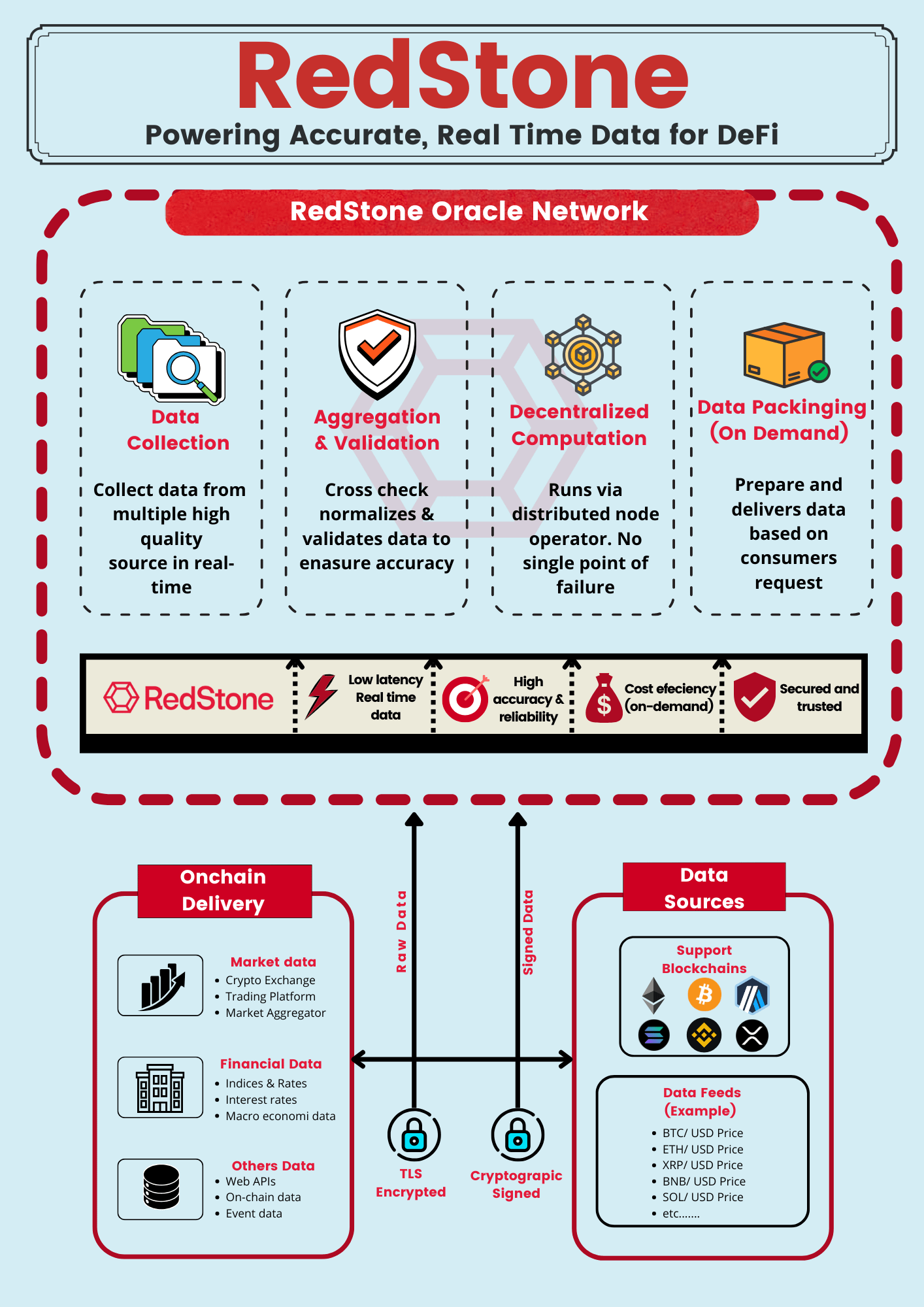
This is where newer approaches like RedStone come into play. Instead of relying on traditional models, RedStone introduces a more modular and efficient design:
- On-demand data delivery → data is provided only when needed
- Low-latency feeds → faster response to market changes
- Customizable data streams → tailored to each protocol’s needs
- Off-chain processing + on-chain verification → efficiency without sacrificing security
This shifts the paradigm from continuous data pushing to context-aware data delivery.
What This Means for the Future of DeFi
With more advanced oracle infrastructure:
Protocols can reduce operational costs
Systemic risks can be minimized
Market responsiveness improves significantly
New use cases like RWA and advanced derivatives become more viable
DeFi is no longer just about liquidity it’s about data quality and speed.
Final Insight
If DeFi is built on smart contracts, then oracles define how those contracts understand reality.
And moving forward, the edge won’t just belong to those with the most liquidity but to those with the fastest, most accurate, and most relevant data.