
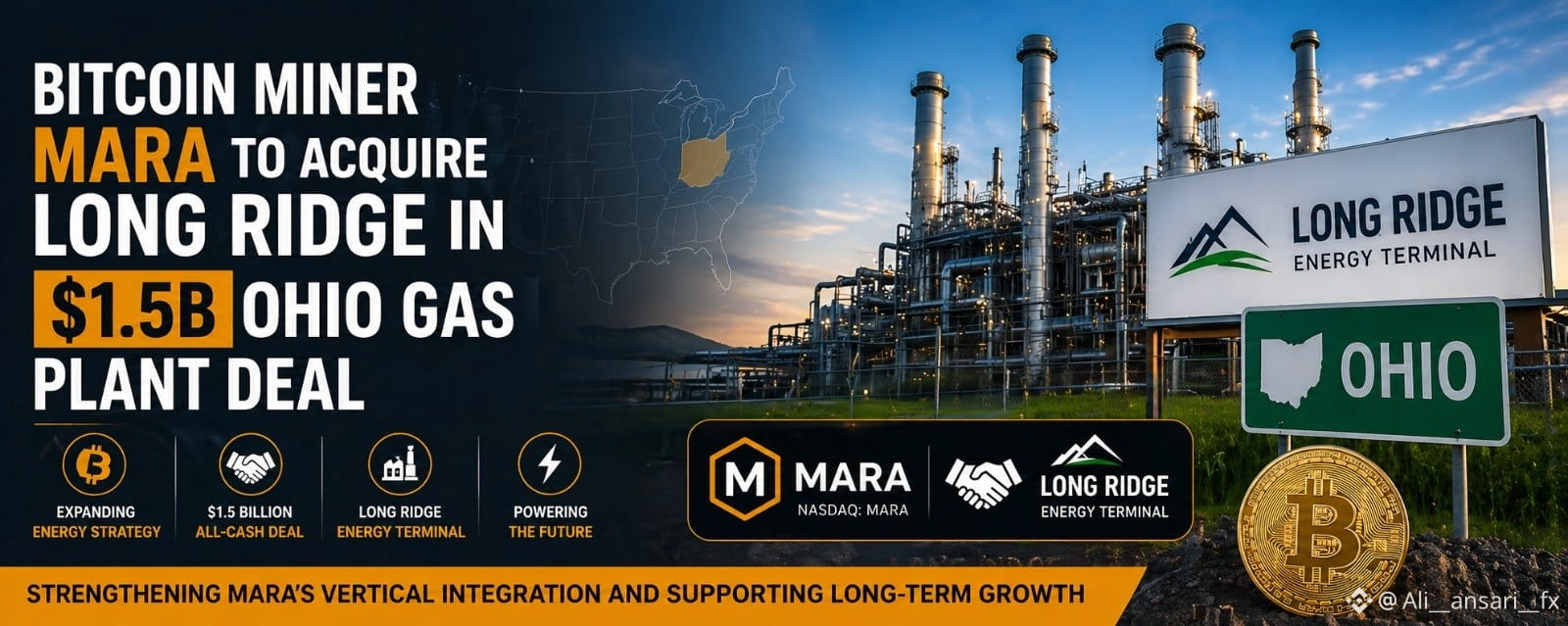
There’s a point where Bitcoin mining stops being just about rigs and hash rate and starts looking a lot like the energy business. That’s exactly the shift I see in Marathon Digital Holdings’s reported move to acquire a stake in the Long Ridge natural gas plant in Ohio. A $1.5 billion deal tied to power infrastructure isn’t just expansion—it’s a statement about where mining is heading.
At its core, this deal is about vertical integration. Instead of relying on third-party energy providers, Marathon is stepping closer to controlling its own power source. The Long Ridge facility, a gas-fired plant, has already been linked to crypto mining operations in the past, making it a natural fit. By securing energy at the source, Marathon isn’t just buying electricity—it’s buying stability.
What stood out to me is how this reflects a broader evolution in mining strategy. A few years ago, the conversation was dominated by location—cheap electricity in remote regions, often with questionable sustainability narratives. Now, it’s shifting toward ownership and efficiency. Controlling energy supply reduces exposure to volatile electricity prices, which have become a major risk factor for miners, especially during market downturns.
Timing matters here. The mining industry has been under pressure from multiple sides: rising energy costs, increasing network difficulty, and tighter margins following Bitcoin’s halving cycles. In that environment, operational efficiency isn’t optional—it’s survival. Moves like this suggest Marathon is positioning itself to stay competitive even when conditions tighten.
There’s also a strategic narrative developing around energy reuse and optimization. Some gas plants, particularly those connected to older infrastructure, operate below capacity or struggle with consistent demand. Pairing them with Bitcoin mining creates a steady, flexible energy consumer. Mining can ramp up or down depending on grid needs, potentially stabilizing revenue for the plant while giving miners predictable access to power.
Compared to other miners, Marathon’s approach leans more toward infrastructure ownership rather than pure operational scaling. Some competitors focus on expanding hash rate through partnerships or hosting agreements. This move, by contrast, is about controlling a critical input. It’s a different kind of bet—less about immediate output, more about long-term resilience.
That said, this strategy isn’t without risk. Energy assets come with their own complexities. Operating or holding stakes in a gas plant involves regulatory oversight, environmental scrutiny, and capital intensity. It’s not as simple as plugging in mining rigs. There are long-term commitments, maintenance costs, and potential political pressure, especially as conversations around energy and emissions continue to evolve.
Another layer to consider is market dependency. Even with cheaper or more stable energy, mining profitability still depends heavily on Bitcoin’s price and network conditions. If margins compress significantly, owning energy infrastructure doesn’t eliminate risk—it just shifts where that risk sits.
Personally, I see this as a calculated move rather than an aggressive gamble. What I find most interesting is how it blurs the line between tech and traditional industry. Marathon isn’t just a mining company anymore; it’s edging into being an energy participant. That changes how it should be evaluated—not just on hash rate, but on how effectively it manages physical assets.
One thing I would watch closely is execution. Deals like this look strong on paper, but integration is where challenges usually appear. How efficiently Marathon can align its mining operations with the plant’s output will determine whether this becomes a competitive advantage or a heavy burden.