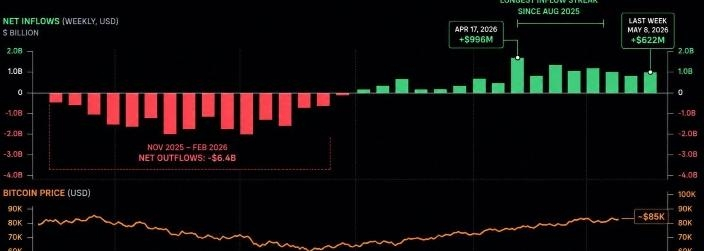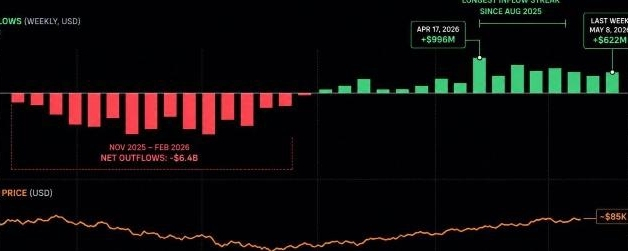

The 2025 correction didn’t just push prices lower—it reset market psychology. Bitcoin ETFs experienced sustained outflows for months, with an estimated $6.4 billion leaving between late 2025 and early 2026. Funds reduced exposure, traders were shaken out, and momentum disappeared.
But beneath the surface, that kind of washout often clears the way for a new phase. Weak hands exit, conviction gets tested, and positioning resets.
Six Weeks of ETF Inflows Signal a Shift
Recently, Bitcoin ETFs have recorded six consecutive weeks of net inflows, totaling roughly $3.4 billion.
The standout signal isn’t just the amount—it’s the consistency. The strongest week alone saw nearly $1 billion in inflows, followed by continued positive flows rather than reversal.
This pattern is typically associated with gradual positioning rather than emotional chasing. Large players tend to accumulate quietly, spreading entries over time instead of reacting to short-term price spikes.
Accumulation vs. Speculation
Retail-driven rallies usually look fast, loud, and volatile. They are driven by momentum and fear of missing out.
Institutional accumulation behaves differently. It is slower, more methodical, and often appears unremarkable in real time.
The current ETF flow trend fits that second profile: steady inflows without explosive price reaction. That’s why many market observers interpret it as early-stage accumulation rather than speculative frenzy.
Bitcoin vs. Ethereum: A Divergence in Flows
A notable divergence is emerging between Bitcoin and Ethereum ETFs.
While Bitcoin products have attracted billions in inflows, Ethereum funds have struggled with weaker demand and periods of net outflows.
This gap reflects more than short-term performance—it highlights a preference in uncertain conditions. Institutions often prioritize assets with clearer narratives, deeper liquidity, and simpler valuation frameworks.
Bitcoin increasingly fills that role as the “default” crypto exposure.
Bitcoin as the Emerging Digital Reserve Asset
Bitcoin’s positioning within institutional portfolios is evolving. It is increasingly treated less like a speculative tech asset and more like a reserve-style macro holding within crypto markets.
Much like gold or sovereign bonds in traditional finance, Bitcoin tends to attract capital during uncertainty due to its perceived scarcity and simplicity.
Ethereum, despite strong developer activity and broad utility, remains more complex for traditional allocators to underwrite at scale.
The Halving and Supply Pressure Dynamics
The 2024 halving is now interacting with ETF-driven demand in a more visible way.
The mechanism is straightforward but slow-moving: reduced block rewards mean fewer new bitcoins entering circulation each day. At the same time, ETFs and other regulated products continue absorbing supply.
Over time, this creates structural pressure if demand persists.
The key dynamic is not immediate price impact, but gradual tightening of available supply.
Macro Uncertainty and the Role of the Federal Reserve
Macroeconomic conditions are adding another layer of uncertainty. Market participants are not only reacting to inflation data but also to leadership changes and policy expectations at the Federal Reserve.
Uncertainty around future policy direction can influence risk appetite broadly.
In such environments, capital often shifts toward assets perceived as scarce and politically neutral—characteristics frequently attributed to Bitcoin.
ETFs as the Institutional Gateway
For traditional investors, Bitcoin ETFs serve as the primary entry point into crypto exposure.
They remove operational friction: no wallets, no private keys, no exchange accounts. Exposure is gained through familiar brokerage infrastructure.
This accessibility has turned ETFs into a key bridge between legacy capital and digital assets, making flows into these products an important signal of institutional sentiment.
Risks Still Remain
Despite recent inflows, the trend is not guaranteed to continue.
ETF flows can reverse quickly during macro shocks, inflation surprises, or shifts in monetary policy expectations. Risk assets remain sensitive to broader financial conditions.
Short-term volatility is still a core feature of the market.
The Bigger Picture
What stands out most is not the idea of immediate price acceleration, but the behavioral shift underneath the market.
After a prolonged period of outflows and caution, capital is quietly returning to Bitcoin through regulated channels while broader sentiment remains hesitant.
If sustained, this type of slow re-entry phase is often how larger market expansions begin—not with euphoria, but with steady accumulation that goes unnoticed until later.