
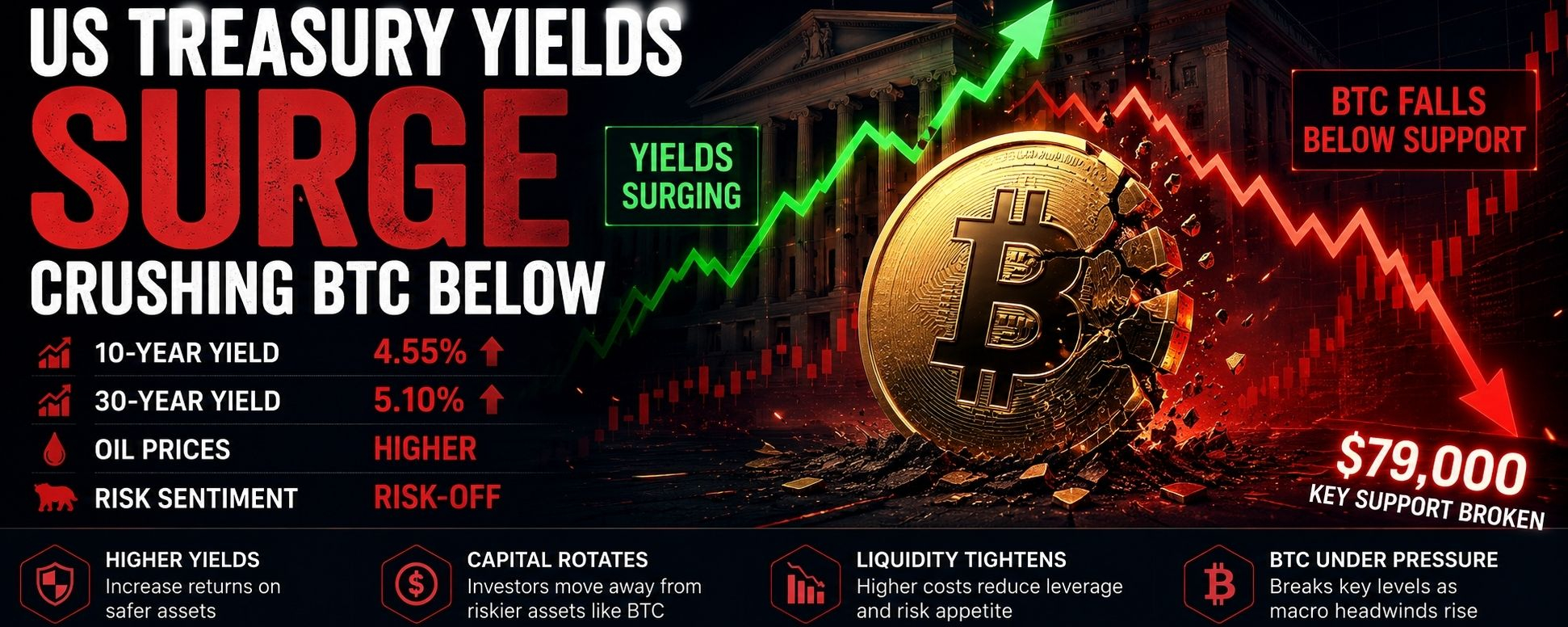


Bitcoin didn’t fall because crypto suddenly broke.
It fell because the bond market reminded everyone who still controls liquidity.
As U.S. Treasury yields exploded higher, BTC lost momentum fast, slipping below major support and dragging trader sentiment with it. The move looked brutal on the chart, but underneath it was something even bigger: macro pressure tightening its grip on crypto again.
For weeks, Bitcoin had been moving with confidence. ETF demand stayed alive. Dips were getting bought. Every pullback looked temporary. The market started acting like momentum alone could carry BTC higher regardless of what happened outside crypto.
Then yields surged.
And suddenly the entire mood changed.
This is the part of the cycle many traders hate talking about. Bitcoin may be decentralized, borderless, and independent by design — but price still reacts to the same liquidity system that moves stocks, bonds, and global markets.
When the cost of money rises, everything changes.
Including crypto.
The Bond Market Just Hit the Brakes
Most retail traders barely watch Treasury yields.
Institutions do.
Because yields decide where capital flows.
When U.S. government bonds start offering stronger returns, investors begin rotating away from speculative assets. Risk becomes harder to justify. Cash suddenly competes again. Safer returns become attractive. The appetite for aggressive positioning starts fading.
That pressure spreads quickly.
Tech stocks weaken. Growth assets cool off. Leverage becomes uncomfortable. And Bitcoin — being one of the most volatile large assets on earth — usually feels the shock harder than most.
That’s exactly what happened here.
BTC didn’t just randomly lose support. It got repriced by macro conditions.
The market went from chasing upside to protecting capital almost overnight.
Bitcoin Still Trades on Liquidity
Crypto loves to pretend it moves independently.
Reality says otherwise.
The strongest Bitcoin rallies almost always happen when liquidity is flowing freely. Cheap money, lower yields, easing financial conditions — that’s when BTC becomes explosive. Risk appetite expands. Speculation accelerates. Traders stop caring about downside.
But when yields rise aggressively, the environment flips.
Money becomes more expensive.
Leverage becomes dangerous.
Investors become selective.
And suddenly the same traders buying every dip start asking whether they should even be exposed at all.
That’s why these moves feel so violent. The market structure changes emotionally before it changes technically.
Fear returns first.
Then price follows.
The Psychological Damage Matters
Breaking below a key level in crypto is never just technical.
It’s emotional.
Bitcoin holding above a major support zone creates confidence. Traders feel safe adding exposure. Momentum traders stay aggressive. Bulls control the narrative.
Once that level breaks, the psychology flips.
Now every bounce gets questioned.
Every rally gets sold faster.
Every green candle feels temporary.
That’s where BTC sits right now.
Not in panic.
But in uncertainty.
And uncertainty is dangerous in leveraged markets.
This Wasn’t a Crypto-Native Selloff
That’s the important distinction.
Nothing inside Bitcoin fundamentally changed overnight.
The network didn’t fail.
ETFs didn’t disappear.
Adoption didn’t reverse.
The selloff came from outside crypto.
That matters because it tells you where the pressure is really coming from.
This is macro stress leaking into digital assets.
And macro stress is harder to fight because it affects everything at once.
When bond yields spike, traders don’t just reduce crypto exposure. They reduce overall risk exposure. Funds rebalance. Institutions hedge. Portfolio managers move defensively. Liquidity gets thinner across the board.
Bitcoin becomes collateral damage in a much larger repricing event.
The “Digital Gold” Narrative Gets Tested Again
Bitcoin supporters love calling BTC an inflation hedge.
But inflation creates two completely different market reactions.
If inflation rises while liquidity stays loose, Bitcoin usually benefits. Investors start searching for scarce assets. The “hard money” narrative gains traction.
But if inflation pushes yields higher and forces tighter financial conditions, Bitcoin trades more like a high-risk tech asset than digital gold.
That contradiction keeps appearing every cycle.
And this time is no different.
Right now the market isn’t rewarding scarcity.
It’s rewarding safety.
That’s a completely different environment.
Institutions Are Now the Real Battlefield
This is where Bitcoin’s evolution becomes interesting.
Years ago, BTC was mostly retail-driven chaos. Now institutions matter heavily. ETFs changed access completely. Traditional capital can move in and out of Bitcoin far faster than before.
That’s bullish long term.
But short term, it creates new pressure.
Institutions don’t trade emotionally like crypto Twitter.
They compare returns.
They compare risk.
They compare exposure.
And when Treasury yields climb aggressively, Bitcoin suddenly has real competition for capital allocation.
That forces BTC to prove itself continuously.
The question becomes simple:
Why hold a volatile asset through uncertainty when safer yields are rising?
That’s the battle happening right now beneath the surface.
The Market Feels Heavy Again
You can feel it in the price action.
Every bounce lacks conviction.
Momentum fades faster.
Traders take profits quicker.
Risk appetite shrinks.
The market starts behaving defensively before headlines fully catch up.
That heaviness matters because crypto is heavily narrative-driven. Once confidence weakens, volatility expands rapidly. Momentum traders disappear. Late longs get trapped. Funding shifts. Liquidations accelerate downside pressure.
And suddenly what looked like a healthy correction starts feeling much bigger emotionally.
Even if structurally it isn’t.
This Is the Side of Bitcoin Most People Ignore
Everyone loves Bitcoin during easy liquidity cycles.
That’s the simple phase.
The difficult phase is when BTC has to survive against tightening conditions, rising yields, stronger dollar pressure, and reduced speculation.
That’s when conviction actually gets tested.
Because Bitcoin’s long-term story may remain intact while short-term conditions still turn ugly.
Both things can exist simultaneously.
That’s what makes this market difficult.
What Happens Next?
Everything now depends on whether yields calm down.
If the bond market stabilizes, Bitcoin can recover quickly. Crypto moves fast once liquidity pressure eases. Confidence returns aggressively when macro fear fades.
But if Treasury yields continue ripping higher, BTC may stay trapped in a difficult environment where rallies struggle to sustain themselves.
That doesn’t automatically mean the bull market is over.
It just means liquidity is no longer helping.
And Bitcoin without supportive liquidity becomes a much harder trade.
Let's go
This selloff wasn’t about Bitcoin suddenly becoming weak.
It was about the market remembering that macro still runs the game.
Crypto traders often focus only on charts, narratives, and hype cycles. But behind every major Bitcoin move sits a much larger machine controlling liquidity, rates, risk appetite, and capital flow.
Right now that machine is tightening.
And BTC is feeling every part of it.
The scary part for bulls isn’t the drop itself.
It’s the realization that Treasury yields — not crypto news — are currently driving the market.
That changes the entire mood.
Because when the bond market takes control, even Bitcoin has to listen.