


I've been watching this setup build all week. The enthusiasm after the CLARITY Act passed through the US Senate on Thursday felt real BTC pushed to $82,000, altcoins caught a bid, and for about 48 hours it looked like the market had found its next leg up. Then Friday happened. And now it's the weekend, and Bitcoin is sitting at $77,800, down over 3% on the day, and the crypto market just shed $110 billion in a single session.
The sell-the-news trade played out exactly the way it always does. Someone buys the rumor, everyone else buys the headline, and then the last buyer becomes the exit liquidity. The CLARITY Act was the rumor. $82,000 was the headline. $77,800 is where we are now.
Trading volume dropped 18% to $37 billion alongside the price, which tells me this isn't panic selling. It's distribution. Patient sellers, not scared ones. That distinction matters when you're trying to figure out where the floor is.
Altcoins got hit harder, as they always do when BTC stumbles. Ethereum is down 3.4% to $2,176. BNB, Solana, and Dogecoin are all off more than 4%. Hyperliquid's HYPE, which had been the standout performer in the top 20 for most of this week, dropped 10% to $41. When the previous leader gives up the most ground, it usually means the rotation has already reversed.
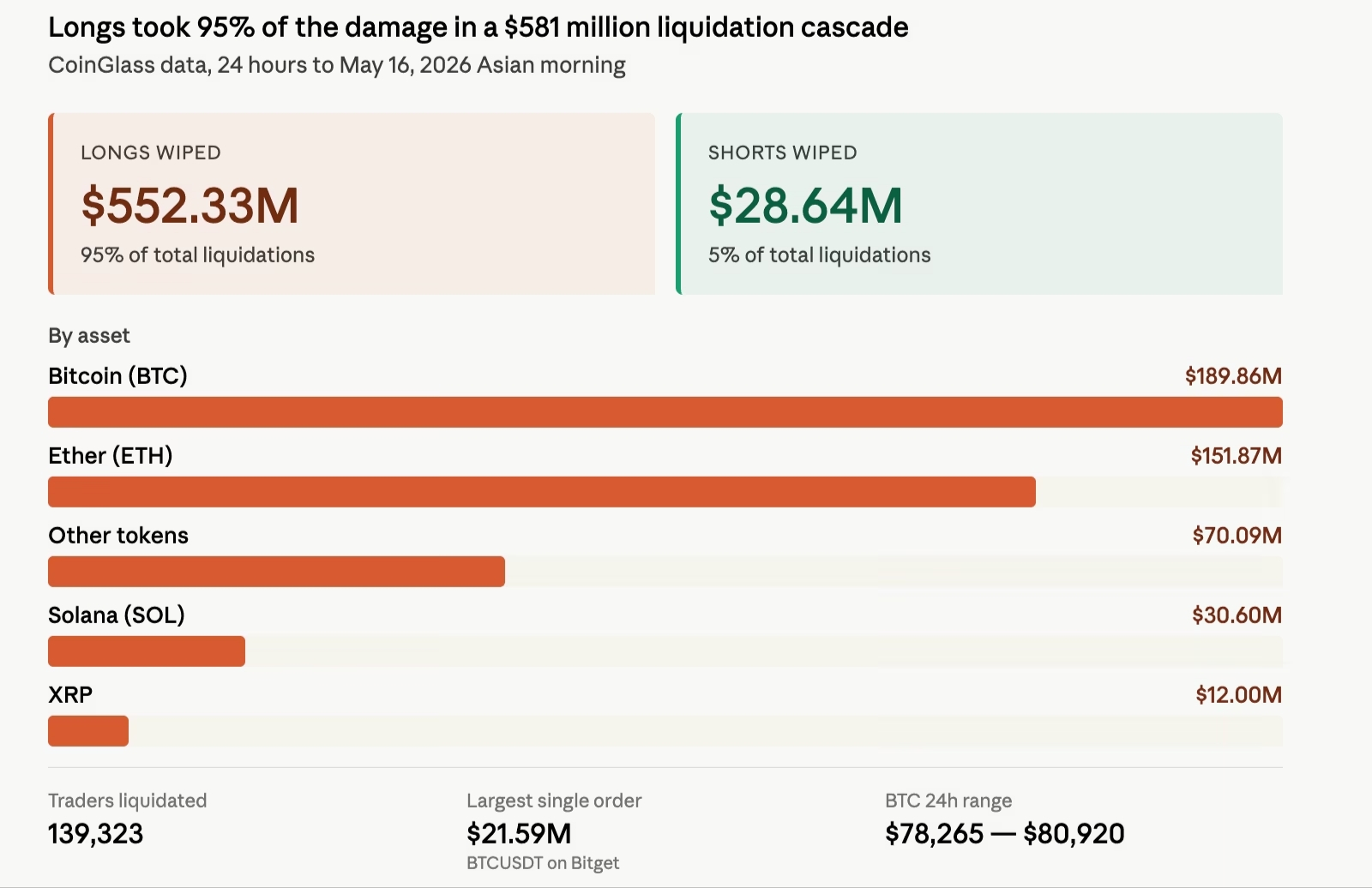
The derivatives market made this selloff ugly fast. Over $580 million in liquidations hit in the past 24 hours and 95% of that damage landed on longs. $552 million in long positions wiped. Bitcoin accounted for $189 million of that, Ethereum followed with $151 million, and Solana added another $30 million. 139,323 traders liquidated in a single session. The largest single order was a $21.59 million BTCUSDT position on Bitget.
That's not a correction. That's a cleaning.
When longs take 95% of the damage, it tells you the market was leaning heavily in one direction. Everyone was positioned for continuation after the CLARITY Act rally. The positioning itself became the vulnerability. This is how crowded trades unwind not through fundamental deterioration, but through the mechanical violence of stops and forced sells stacking on top of each other.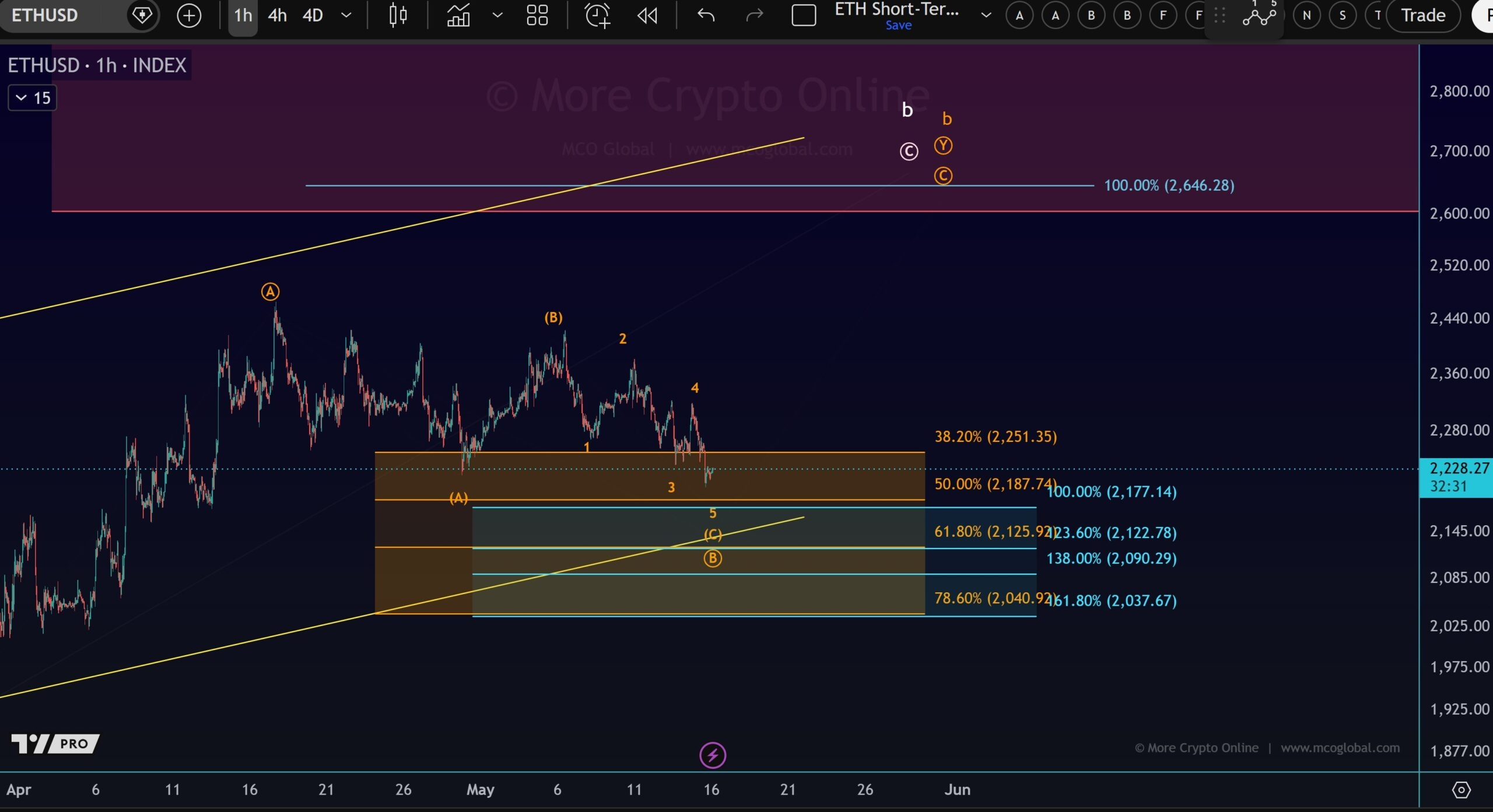
On Ethereum specifically, one analyst is calling this move corrective rather than impulsive and the chart structure makes that argument worth taking seriously. The Elliott Wave count suggests ETH is working through a (C) leg within a larger corrective structure, not initiating a fresh downtrend. The current support zone sits between $2,122 and $2,177. As long as ETH holds that band, the upside case targets $2,318 first, then a potential run toward $2,646. Breach the support, and the next meaningful floor comes in around $2,040.
I'm not positioning around that thesis yet. But I'm watching it. Because if Ethereum holds this zone through the weekend, it reframes the entire narrative from breakdown to shakeout.
Now for the part that actually concerns me.
Bitcoin ETFs lost $1 billion this past week. That's the largest weekly net outflow since January, and it snaps a six-week streak that had seen Wall Street funnel $3.4 billion into the market. BlackRock alone saw clients pull over $317 million. The firm still holds 816,148 BTC worth roughly $63.65 billion, but the direction of flow changed. On Friday, all 12 ETFs recorded outflows simultaneously $290 million in a single day.
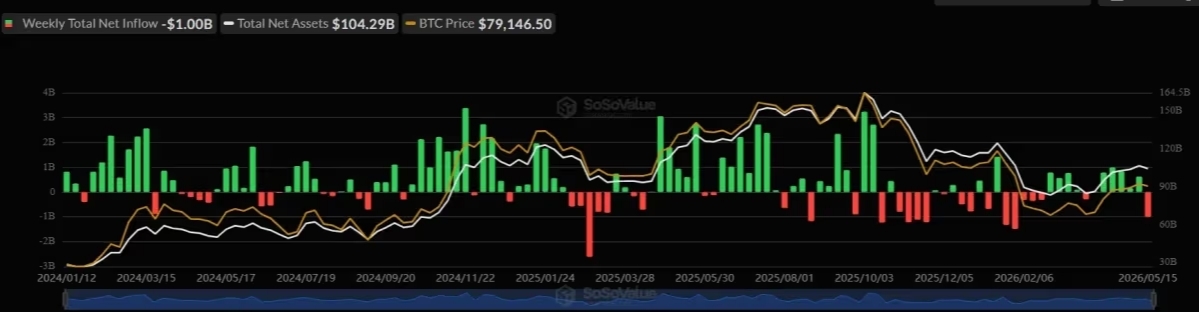
Look at that chart and you can see exactly what happened. Six weeks of green. Institutional money flowing in steadily, absorbing retail sells, propping the bid. Then the week ending May 16 drops into deep red the sharpest single-week outflow bar in months. The total net assets across all Bitcoin ETFs now sit at $104.29 billion, with BTC at $79,146 at the time of that data snapshot.
This matters because the institutional bid is what made the 2025-2026 cycle feel structurally different. Retail used to set the marginal price. Now it's BlackRock clients, pension allocators, and family offices. When those flows reverse even temporarily the support layer underneath the market becomes a lot thinner. And a thin market is a volatile market.
The Trump-Xi summit in China provided no catalyst. The macro backdrop didn't offer any relief either. What we're left with is a market that rallied on a legislative headline, got overcrowded on the long side, and is now flushing the excess positioning over a weekend when liquidity is structurally lower.
I don't think this is the end of the bull case. The CLARITY Act actually matters for the long-term regulatory picture. Institutional adoption hasn't structurally reversed one week of ETF outflows doesn't undo six weeks of inflows. And the on-chain data I've been watching suggests retail has been taking profit for weeks, which means the selling pressure from that cohort may already be largely exhausted.
But I'm not going to pretend I know where the floor is. $77,800 could hold. It could also be a pit stop on the way to the $74,000–$75,000 range that some technicians have been flagging. The macro is murky, the positioning just got washed, and weekend price action has a way of surprising everyone.
Right now I'm watching two things: whether ETH holds that $2,122–$2,177 support band, and whether next week's ETF flow data shows any sign of reinstitutional accumulation. Those two data points will tell me more about the next 30 days than any price chart will.
The honeymoon phase after the CLARITY Act rally is over. What comes next is the real test.