


You know that feeling when you have money just sitting there?
Not your rent. Not your safety net. That other piIe. The one you keep promising yourself you'll do something with. Could be $500. Could be $5,000. Could be more. Just sitting. Watching infIation do its quiet thing.
So you think: I'Il trade it. But trading is a whole lifestyle you didn't sign up for. Charts at midnight. Alerts buzzing while you're at dinner. You try it once, the market humbles you immediately, and the money goes right back where it was.
So it sits. Again.
And here's what nobody says clearly enough: sitting isn't safe. It just feels safe. Money that isn't moving is money that's slowly losing its place in the world.
So DeFi finds you. Or you find it. And at first it genuinely feels like a discovery. Protocols everywhere. 60%, 80%, 200% APY. Someone finally cracked it.
Except they didn't.
Most of that yield is a protocol printing its own token and handing it to you with a bow on it. It's not earnings , it's inflation cosplaying as DeFi. The moment they slow the printing - and they always slow the printing - the number collapses, the token dumps, and the people who came in believing the math are left holding something that used to have value.
You weren't investing. You were just positioned well enough to leave before it fell apart.
So I started looking at HAEDAL. And my first reaction, honestly?
Sounds like every other staking protocol.
You deposit SUI. You get haSUI. You earn staking rewards. Cool. Fine. But if that was all there was, Haedal would just be another name in a long list of names.
Then l looked closer. And I realized the staking is just the door. What's inside is something else entirely.
🦦 Haedal has a market maker built into the protocol. HMM. And before you skip past that — here's what it actually means for you.
Every trade that happens on SUI generates a fee. Every swap, every movement, every transaction. Tiny amounts , but SUI is active, and tiny amounts across billions in volume stop being tiny very fast. Haedal captures those fees through HMM (real revenue from real on-chain activity) - and routes them back to stakers.
So your yield isn't just coming from staking anymore. It's coming from the market moving. From people trading. From the ecosystem simply being alive.
That's already different from everything else. But here's where I stopped and actually sat with it for a minute. Because market makers exist elsewhere. Liquid staking exists everywhere. If it stopped there, Haedal is interesting, but still not extraordinary.
Then it hit me.
Where does the liquidity inside HMM actually come from? Not from thin air. Not from some external provider who can pull out whenever things get uncomfortable. It comes from the stakers themselves.
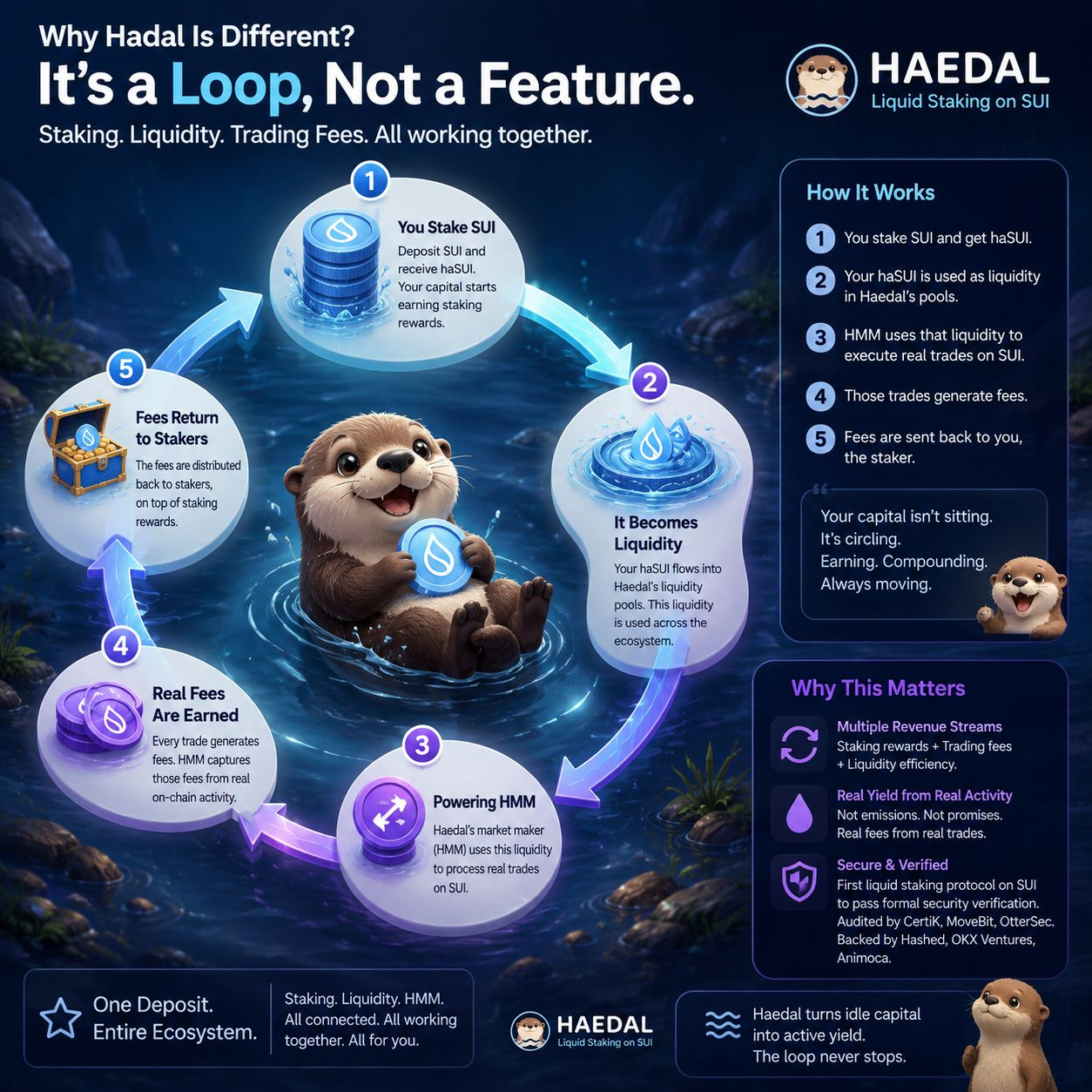
When you deposit SUI and receive haSUI - that capital doesn't just sit tagged as "staked" and forgotten. It flows into Haedal's liquidity pools. Those pools are what power HMM. HMM uses that liquidity to process real trades on SUI, collect real fees, and then - this is the part that closes the loop - routes those fees back to the stakers who provided the liquidity in the first place.
You stake → your capital becomes liquidity → that liquidity earns trading fees → those fees come back to you → on top of your staking rewards → while your haSUI stays liquid and usable across DeFi the entire time.
Staking. Liquidity. Trading fees. All three feeding each other. Continuously. From a single deposit. Not three separate protocols you have to manage, bridge between, and pray work together. One ecosystem where every layer was built to strengthen the others.
The yield isn't one stream. It's a loop. And you're inside it from the moment you deposit.
Is it risk free? No. Show me something in DeFi that is and I'll show you something that hasn't failed yet. But Haedal was the first liquid staking protocol on SUI to pass formal security verification. Audited by CertiK, MoveBit, OtterSec. Backed by Hashed, OKX Ventures, Animoca, people who've watched enough protocols collapse to know what real infrastructure actually looks like. This isn't a protocol hoping you don't look too closely. It's one that hoIds up when you do.
So when you ask what makes Haedal different — the honest answer isn't one feature. It's that they took three things that exist separately everywhere else in DeFi and built them into a single engine where each one makes the others stronger.
Staking alone? Fine. HMM alone? Interesting. Liquidity pools alone? They're everywhere.
But together - with your capital flowing through all three simultaneously - your money stops sitting. It stops being one passive thing waiting for a number to appear. It becomes part of something that's always moving, always earning, always finding the next source of return from real activity happening on a real chain.
Once you see how the loop works, you can't unsee it.
