Everyone talks about oracles when prices move, but very few people talk about what actually happens after that price hits the chain.
Liquidations, lending security, collateral health, RWA settlements, and risk management all depend on one thing, reliable data.
This is where RedStone stands out.
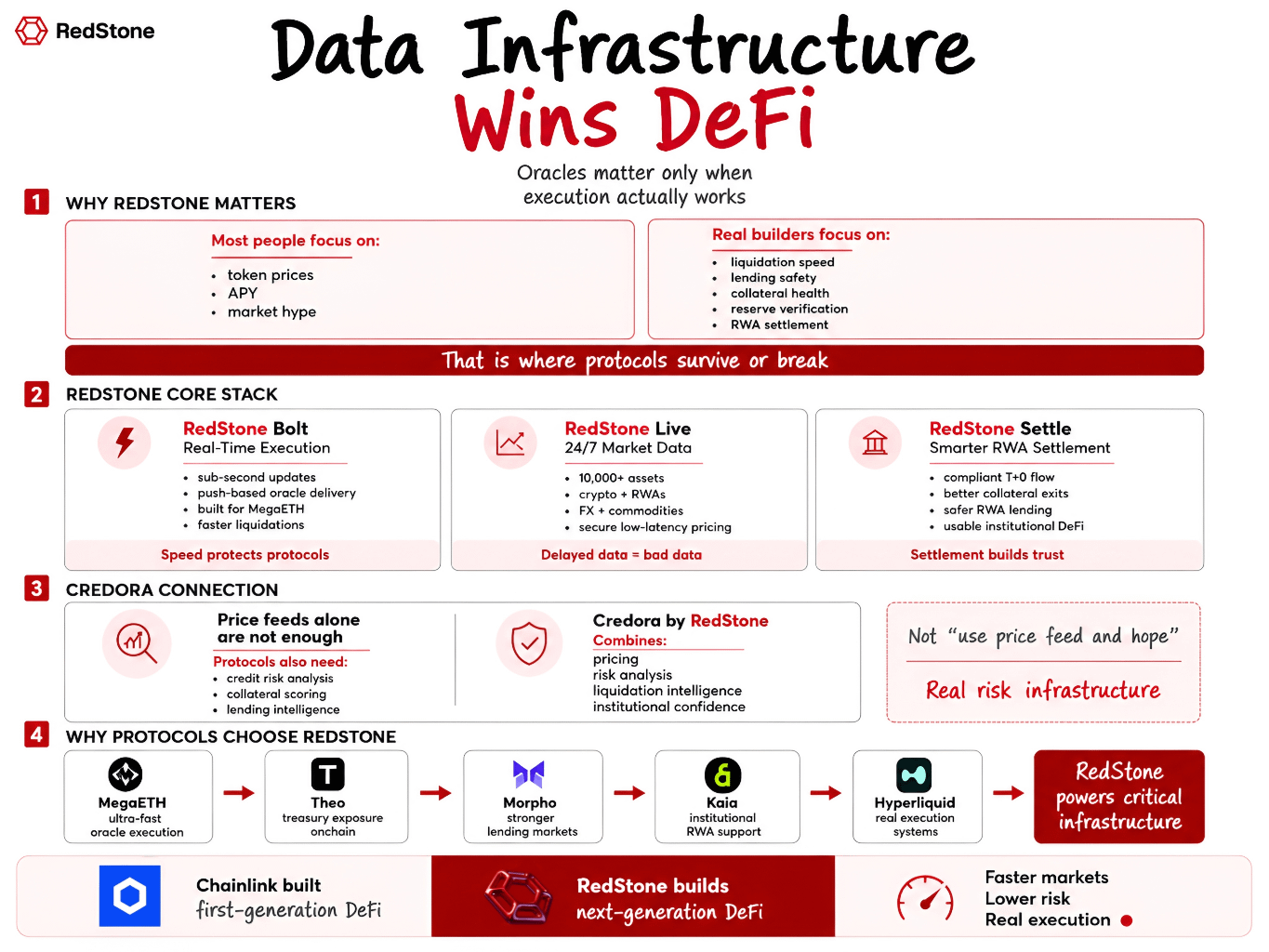
Most traditional oracle systems were built for a slower DeFi era. They work well for simple price feeds, but modern DeFi needs more than just “what is the price right now?”
It needs speed. It needs flexibility. It needs infrastructure built for real execution.
RedStone is not just pushing data, it is building the full data layer for DeFi.
Take RedStone Bolt for example.
Bolt is designed for ultra-fast execution environments like MegaETH, where even milliseconds matter. Instead of slow update cycles, protocols get sub-second latency and real-time market responsiveness.
That means faster liquidations, safer lending, and stronger capital efficiency.
Now compare that with older oracle models where delayed updates can create bad debt before the system reacts.
That difference is not small. That difference is protocol survival.
Then there is RedStone Live.
10,000+ assets available 24/7 with secure and low-latency access. This is huge for RWAs because traditional assets need consistent pricing across markets, not occasional updates.
Many oracle providers focus mainly on crypto-native assets.
RedStone is clearly building for both crypto and real-world assets.
And RedStone Settle solves something most people ignore, compliant T+0 settlement for RWAs used as collateral.
Tokenizing assets is easy. Making them usable inside DeFi is the hard part.
That is where most projects fail.
RedStone is solving that infrastructure gap.
Even Credora integration shows this clearly. Price feeds alone are not enough. Protocols need credit risk analysis too.
RedStone Stack combines pricing, liquidation intelligence, and risk infrastructure together instead of treating them separately.
That is a smarter model than the old “just use a price feed and hope for the best” approach.
Even Chainlink, which is a strong and respected competitor, often gets compared with RedStone.
But the difference is simple:
Chainlink became the standard for the first generation of DeFi.
RedStone is building for the next generation.
Faster markets. RWA lending. Institutional-grade collateral. Low-risk DeFi.
That is a different battlefield.
And the best part is, RedStone keeps proving it with real integrations, Theo, MegaETH, Felix, Kaia, Morpho, Tydro, Hyperliquid.
Not just marketing. Actual execution.
That is why I pay attention to RedStone.
Because the future winners in DeFi will not be the loudest projects.
They will be the ones building infrastructure nobody can operate without.