
Bitcoin is no longer just a digital coin people argue about on the internet.
It has become a global financial phenomenon.
Some see Bitcoin as the future of money. Others see it as digital gold. Some still believe it is too volatile to trust. But regardless of opinions, one thing is undeniable:
Bitcoin changed finance forever.
Back in 2008, during one of the biggest financial crises in modern history, an anonymous person — or group — under the name Satoshi Nakamoto introduced an idea that sounded impossible at the time:
“What if money could exist online without banks controlling it?”
That idea became Bitcoin.
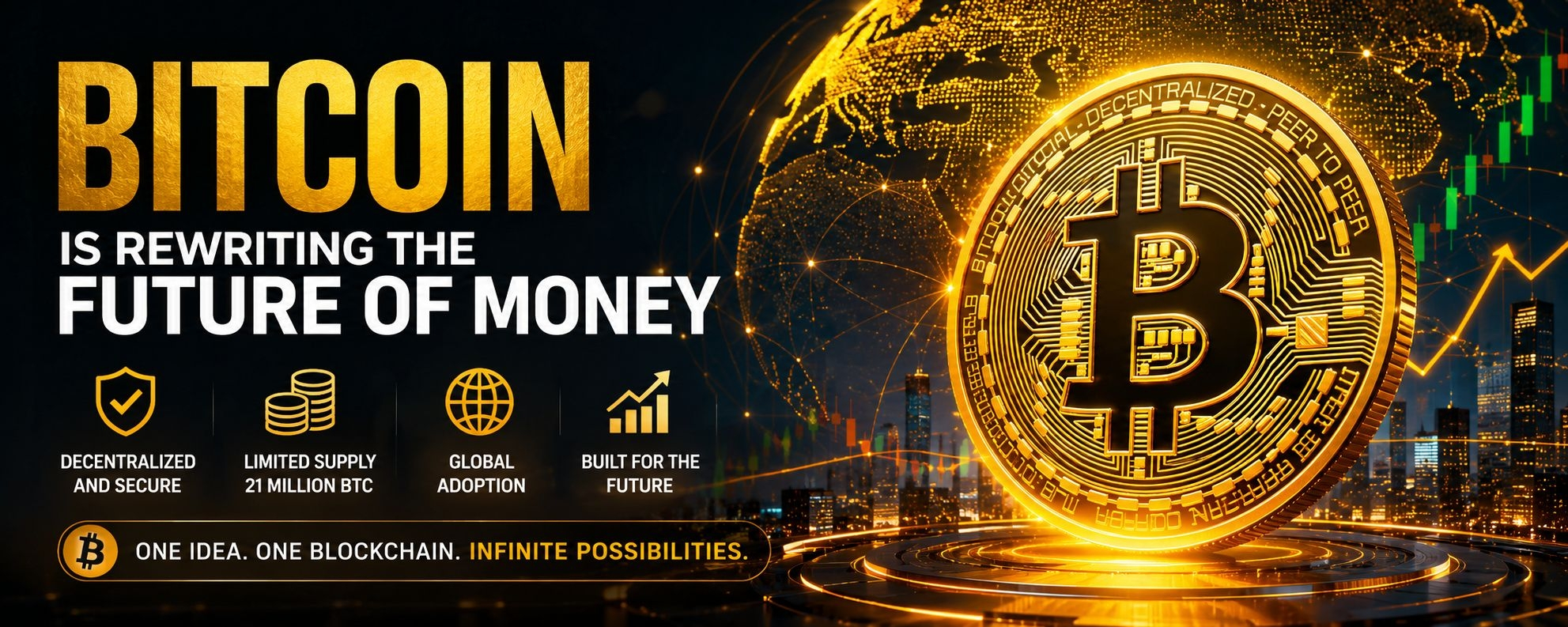
Unlike traditional currencies printed by governments, Bitcoin runs on a decentralized network powered by people all around the world. No central authority controls it. No single company owns it. The network survives because thousands of computers continuously verify transactions and secure the blockchain every second.
That alone made Bitcoin revolutionary.
But what truly gave Bitcoin value was scarcity.
Only 21 million BTC will ever exist.
No matter how much demand increases, nobody can suddenly print more Bitcoin. In a world where inflation keeps reducing purchasing power, that fixed supply became one of Bitcoin’s strongest narratives.
Many investors now compare Bitcoin to gold.
Not because it is physically similar — but because both are limited assets people use to preserve value over time.
Over the years, Bitcoin evolved far beyond a simple internet experiment.
At first, it was mostly used by developers, tech enthusiasts, and small online communities. Today, billion-dollar institutions, hedge funds, public companies, and even governments monitor Bitcoin closely.
Major financial firms now offer Bitcoin investment products. Large corporations hold BTC on their balance sheets. Millions of retail traders buy and sell it daily across global exchanges.
And despite every crash, fear cycle, and media criticism, Bitcoin continues to survive.
That resilience is one of the biggest reasons why people remain bullish long term.
Still, Bitcoin is far from perfect.
The market is extremely volatile.
BTC can rise thousands of dollars in days — and also crash violently when fear enters the market. Emotional traders often panic during corrections, while experienced investors usually focus on long-term trends instead of short-term noise.
Another major debate surrounding Bitcoin is energy consumption.
Mining Bitcoin requires massive computing power, and critics argue the network consumes too much electricity. Supporters respond by saying Bitcoin’s energy usage is the price of maintaining a secure, decentralized monetary system that nobody can manipulate.
That debate will likely continue for years.
But regardless of criticism, adoption keeps growing.
In countries facing inflation or weak banking systems, many people see Bitcoin as financial freedom. For others, it represents an alternative investment outside traditional finance.
And perhaps the most important part of Bitcoin’s story is this:
It introduced the world to blockchain technology.
Without Bitcoin, the entire cryptocurrency industry probably would not exist in the form we know today.
Every major crypto project, every blockchain innovation, and every digital asset market that exists now was influenced in some way by Bitcoin’s creation.
Today, BTC remains the king of crypto.
When Bitcoin moves, the entire market reacts.
Altcoins follow its momentum. Traders watch its charts constantly. Institutions track its dominance. Retail investors wait for breakouts and corrections.
Whether people love it or hate it, Bitcoin remains the center of the crypto universe.
And after more than a decade, it is still here.
Still growing.
Still evolving.
Still proving that one idea released during a financial crisis became one of the most important technological and financial experiments of the modern era.
#Bitcoin #Blockchain #BTCUSD $BTC comment below here to talk about BTC💌 👇
