
Executive Summary
The global shipping industry has long operated under a gentlemen’s agreement anchored by Western financial institutions. For centuries, if you wanted to move goods across the high seas, your vessels required protection certificates from a tight-knit cartel of protection and indemnity clubs, primarily based in London, Tokyo, and Europe. But when geopolitical friction leads to sweeping economic sanctions, the traditional safety nets of maritime commerce begin to tear.
In a radical departure from conventional statecraft, Iran has initiated a framework to offer Bitcoin-backed shipping insurance specifically tailored for transit through the Strait of Hormuz—the world's most critical maritime chokepoint. This is not merely a technical workaround for a nation starved of foreign capital; it represents a fundamental paradigm shift in how sovereign risk is managed, how sanctions are bypassed, and how decentralized digital assets are being weaponized or weapon-proofed at the intersection of global trade and geography.
By substituting sovereign fiat guarantees and Western-vetted insurance policies with hard-coded, multi-signature cryptographic collateral, this initiative attempts to rewrite the rules of maritime law. This deep dive uncovers the structural mechanics of this insurance framework, explores the profound systemic vulnerabilities it aims to exploit, maps the second- and third-order implications for global energy security, and analyzes whether a volatile, decentralized digital asset can truly underwrite the catastrophic risks of one of the most volatile waterways on Earth.
The Geography of Risk: History and Origins
To understand why a state would resort to underwriting maritime insurance with a decentralized cryptocurrency, one must first look at the jagged geography of the Persian Gulf. The Strait of Hormuz is a narrow, hook-shaped waterway separating Iran from Oman and the United Arab Emirates. At its narrowest point, the shipping lanes are a mere two miles wide in either direction, bordered by treacherous shallows and highly militarized coastlines. Through this tight geopolitical throat passes roughly one-fifth of the world’s petroleum liquids and a massive share of liquefied natural gas.
For decades, the Strait has been a chessboard of asymmetric warfare and economic leverage. During the "Tanker War" phase of the Iran-Iraq conflict in the 1980s, over 500 merchant vessels were attacked or damaged, demonstrating how quickly local kinetic conflict can spiral into a global energy crisis. When commercial vessels sail through these waters today, they do not just worry about engine failure or rogue waves; they operate under the shadow of state-sponsored seizures, limpet mines, drone strikes, and electronic GPS spoofing.
Historically, when a region becomes a hot zone, the International Underwriting Association and the Lloyd’s Joint War Committee designate it as a listed area. This instantly triggers a surge in war risk premiums. For nations operating under heavy international sanctions, the problem is compounded. Traditional maritime insurance relies on a multi-layered ecosystem:
Primary Insurers: Local or specialized entities that handle initial claims.
Protection & Indemnity (P&I) Clubs: Mutual insurance associations that provide cover for open-ended third-party liabilities, including oil spills, war risks, and crew fatalities.
Reinsurance Giants: Global institutions like Munich Re or Swiss Re that absorb catastrophic tail-risks.
Because these entities are inextricably linked to the Western banking system, SWIFT networks, and G7 regulatory frameworks, they are legally barred from underwriting vessels carrying Iranian cargo or docking at Iranian ports. For years, Iran attempted to counter this by creating state-backed domestic insurance pools, such as the Kish P&I Club. However, global buyers and shipowners routinely rejected these policies because a state-backed guarantee from a sanctioned nation lacks international liquidity. If a mega-tanker suffers a catastrophic hull breach or causes an environmental disaster in international waters, a policy denominated in heavily depreciated local fiat currency cannot cover a billion-dollar cleanup operation.
This structural dead-end forced a radical reassessment. If the global financial architecture can block the movement of fiat currencies, and if domestic fiat guarantees are deemed worthless abroad, the state required an alternative form of collateral that possesses intrinsic global liquidity, exists outside the jurisdiction of any single central bank, and can be verified transparently on an immutable ledger.
Enter the Bitcoin-backed model.
Core Mechanics: Underwriting War Risk on the Blockchain
At its core, maritime insurance is a game of probability, capitalization, and trust. The Iranian initiative attempts to replace institutional trust with cryptographic certainty. The mechanics of a Bitcoin-backed shipping insurance policy challenge the traditional legal and financial frameworks established by the 1906 Marine Insurance Act.
The Collateral Architecture and Vaulting
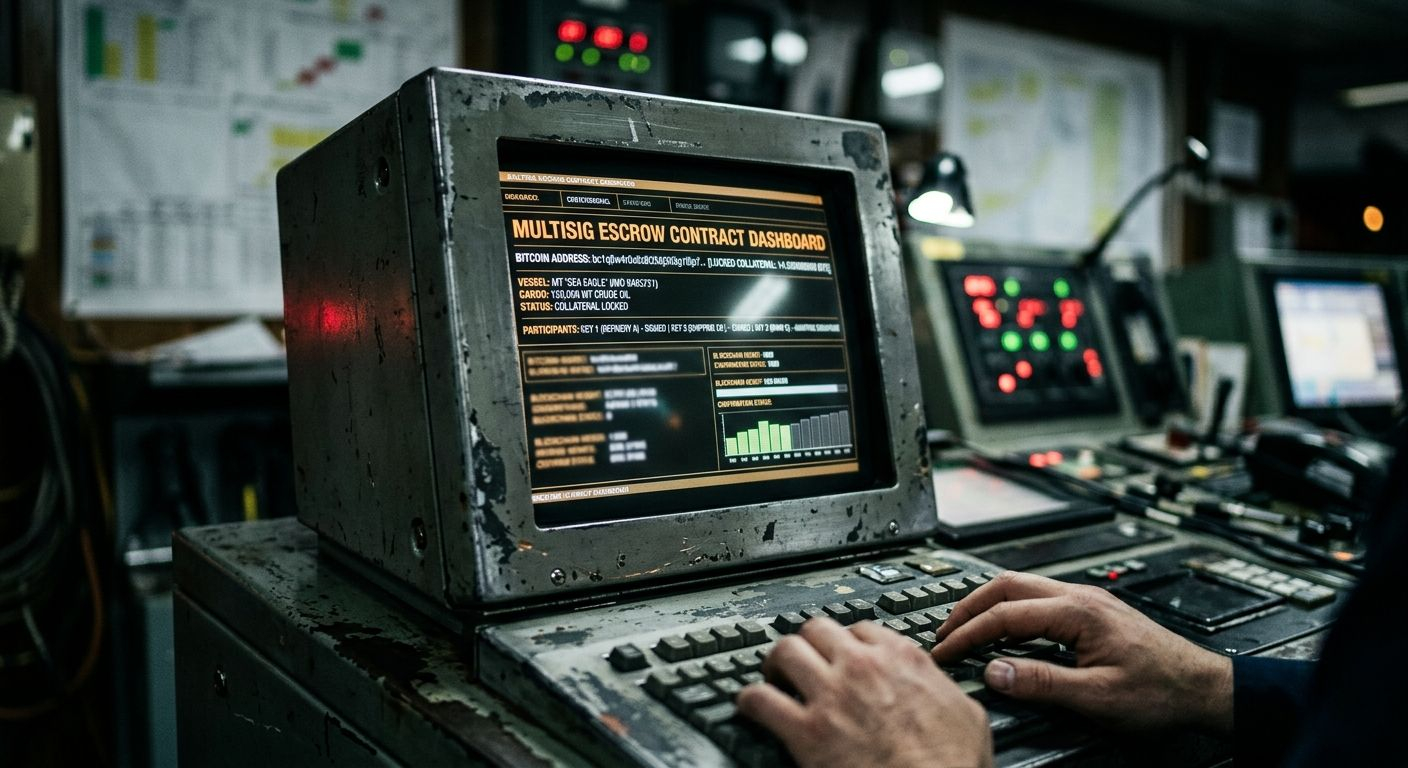
Instead of relying on a bank guarantee or a letter of credit, the state or a consortium of aligned commercial entities establishes a series of dedicated, time-locked, multi-signature Bitcoin addresses. These addresses serve as the capital reserve pool for the insurance fund.
To underwrite a specific voyage through the Strait of Hormuz, the shipowner or cargo operator pays a premium denominated either directly in Bitcoin or in an equivalent asset, which is then converted into the reserve pool. The underwriting entity locks a predetermined amount of Bitcoin into a smart contract or a multisig escrow vault corresponding to the total insured value of the hull, machinery, or liability.
The distribution of keys in this multi-signature setup is strategically designed to mitigate counterparty risk for the shipowner:
Key Holder 1: The domestic underwriting authority or state-backed entity.
Key Holder 2: An independent maritime legal arbiter or a neutral third-party entity operating in a sympathetic or neutral jurisdiction (such as certain free zones in East Asia or the Middle East).
Key Holder 3: The insured party or their designated legal representative.
A payout requires the authorization of two out of the three keys, ensuring that neither the state can unilaterally claw back the collateral without cause, nor can the shipowner fraudulently claim a loss without independent verification.
Oracle Verification and the Problem of "Proof of Loss"
One of the most complex hurdles in decentralized insurance is determining how a digital protocol verifies physical reality. If a tanker is struck by a drone or detained in the Strait of Hormuz, how does the blockchain know?
The system relies on decentralized oracle networks integrated with maritime data feeds. These oracles monitor verifiable, real-world data points, including:
Automated Identification System (AIS): Transponder signals tracking the ship's coordinates, speed, and status.
Satellite Imagery and Remote Sensing: Independent verification of structural damage or unauthorized boarding.
Official Marine Casualty Reports: Filed by independent surveyors and neutral port authorities.
When an incident occurs, the data is pushed to the oracle network. If the parameters of the war-risk policy are met (e.g., the vessel is detained for more than a specified number of days or suffers a kinetic strike within the designated coordinates), the oracle triggers the conditional release of the locked Bitcoin collateral directly to the wallet of the shipowner or the cargo beneficiary.
Navigating Volatility and Liquidity Caps
The most obvious criticism of using Bitcoin as an insurance reserve asset is its price volatility. If the asset value drops by 30% in a week, the insurance fund could suddenly find itself dangerously undercapitalized, leaving vessels exposed.
To buffer against this systemic vulnerability, the framework utilizes an over-collateralization ratio. Rather than matching the insured value dollar-for-dollar, the reserve pool is mandated to maintain a significant buffer, often requiring 150% to 200% of the total liability value locked in asset reserves. Furthermore, the system implements automated rebalancing mechanisms. If the purchasing power of the locked Bitcoin drops below a specific threshold relative to global maritime replacement costs, the underwriter is required to inject additional assets into the vault to maintain the validity of the certificate.
Modern Context: The Weaponization of SWIFT and the Rise of Shadow Fleets
This cryptographic insurance model did not emerge in a vacuum. It is the direct consequence of an increasingly fragmented global order where financial plumbing has become the primary battleground for geopolitical supremacy.
The Breakdown of the Post-WWII Financial Consensus
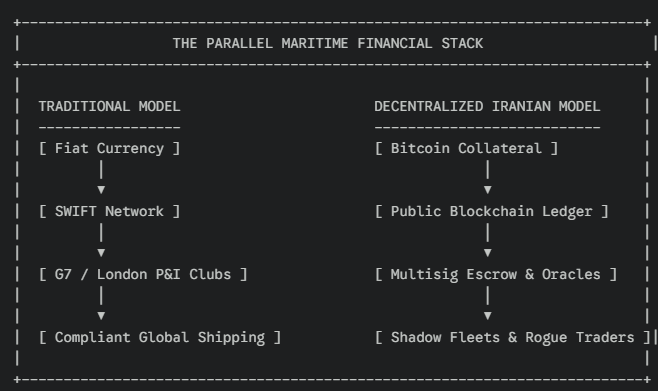
For decades, the United States and its allies have leveraged the dominance of the US dollar and the SWIFT messaging network to enforce foreign policy objectives. By denying targeted nations access to these rails, Western powers can effectively shut down a country’s ability to participate in legal global trade.
However, this strategy has reached a point of diminishing returns, giving rise to what analysts call the "Parallel Global Stack." Deprived of traditional access, sanctioned states have spent years constructing alternative financial and logistical networks. This includes the development of the "Shadow Fleet"—a vast, fluid network of aging oil tankers operating under flags of convenience, frequently changing names, and turning off their AIS transponders to obscure the origin and destination of their cargoes.
Until now, the weakest link in the shadow fleet ecosystem has been insurance. A ship can hide its location, and a buyer can pay using barter or local currencies, but if that ship crashes into another vessel or leaks hundreds of thousands of barrels of crude near a major coastline, the lack of valid, internationally recognized insurance can trigger an immediate international incident and the total seizure of the asset. By introducing a Bitcoin-backed insurance model, Iran is attempting to legitimize its shadow fleet operations, providing an alternative risk-mitigation tool for rogue traders, independent refiners, and non-aligned nations willing to brave Western sanctions.
The Strategic Alliances
This initiative is not just a localized project; it is designed to interface with broader anti-hegemonic economic blocs. We are seeing a convergence of interests between nations looking to de-dollarize their trade networks. For an independent oil refiner in a country that faces perpetual dollar shortages or sanction threats, buying energy insured via an immutable, sovereign-adjacent digital asset removes a massive layer of regulatory friction. It creates a closed-loop trade ecosystem where goods move, risks are managed, and values are settled completely outside the view and reach of Western regulatory authorities.
Key Players, Sovereigns, and Asymmetric Operators
The operationalization of a crypto-backed maritime insurance protocol involves a complex tapestry of state actors, shadowy corporate fronts, and cutting-edge software engineers.
The Sovereign Architect
The Iranian state acts as the ultimate backstop and regulator of this system. Facing intense domestic economic pressures and a restricted capital account, the government has treated Bitcoin mining and asset accumulation not as a hobby, but as a strategic macroeconomic imperative. By utilizing its vast domestic energy reserves to power industrial-scale mining operations, the state has effectively converted stranded natural gas into pristine, un-sanctionable digital capital. This mined Bitcoin forms the bedrock of the insurance reserve pools.
The Intermediary Fronts and "Flags of Convenience"
Because no major international shipping line (such as Maersk or MSC) would risk their global business by accepting an Iranian crypto-backed insurance certificate, the primary users of this system are small, agile, privately held shipping corporations often registered in opaque jurisdictions like Panama, Liberia, or the Marshall Islands.
These operators function as asymmetric actors. They own older, fully depreciated vessels bought on the secondary market specifically for high-risk, high-yield runs through the Strait of Hormuz. For these captains and owners, the traditional insurance market is already closed or prohibitively expensive. The Bitcoin-backed alternative is not a secondary choice; it is the only viable mechanism available to protect their equity against total loss.
Challenges, Failure Modes, and Cryptographic Vulnerabilities
While the concept of decoupling maritime insurance from the Western banking system is structurally fascinating, the practical execution faces monumental hurdles, systemic risks, and potential points of failure.
The Liquidity Disconnect and Tail-Risk Failures
The greatest vulnerability of any insurance pool is a catastrophic, correlated event—what actuaries call a "tail-risk." In the Strait of Hormuz, this would look like a full-scale regional kinetic conflict where dozens of tankers are simultaneously damaged, seized, or sunk.
Traditional reinsurance markets survive such events by spreading the risk across the entire global financial system. A loss in the Persian Gulf is absorbed by capital pools generated from property insurance in Ohio, life insurance in Europe, and catastrophe bonds in Tokyo.
An isolated, Bitcoin-backed insurance fund lacks this global diversification. If a major conflict breaks out and claims flood the system simultaneously, the reserve pool could be completely depleted. If the value of Bitcoin happens to crash during the same period—perhaps triggered by the global instability of the very war occurring in the Middle East—the fund would face a catastrophic insolvency event, leaving shipowners completely uncovered precisely when they need protection most.
The Legal Vacuum and International Port Acceptance
An insurance certificate is only as good as the ports that accept it. When a commercial vessel arrives at a major international port like Singapore, Rotterdam, or Shanghai, maritime authorities demand proof of valid, internationally recognized P&I coverage to ensure that any potential accidents, pollution, or port damage can be financially compensated.
Major global ports are highly integrated into international maritime treaties, such as the International Convention on Civil Liability for Oil Pollution Damage. These frameworks explicitly require insurance from approved financial institutions. A Bitcoin wallet address or a smart contract hash will be flatly rejected by most top-tier port authorities. Consequently, ships utilizing this decentralized insurance are severely restricted in where they can travel, limiting their operations to specific, non-compliant ports or ship-to-ship transfer zones in international waters.
Oracle Exploitation and Cyber-Maritime Warfare
Because the system relies on digital oracles to verify physical damage or detention, the entire infrastructure introduces a novel attack surface: cyber-maritime exploitation.
If a state actor or an advanced hacking group wishes to disrupt this alternative trade network, they do not need to sink a physical ship. Instead, they can target the data feeds supplying the oracles. By spoofing AIS data, compromising satellite communication links, or injecting malicious data into maritime survey reports, an adversary could theoretically trigger a false payout event, draining the insurance fund's Bitcoin reserves without a single shot being fired. Conversely, they could freeze the oracle network during a genuine emergency, preventing a legitimate shipowner from accessing their emergency payout.
Strategic Implications and Scenario Modeling
To fully grasp how this experiment could reshape the global geopolitical landscape, we must analyze its potential evolution through three distinct lenses over the coming decade.
Scenario 1: The Optimistic / Sovereign Autonomy Model (The Baseline)
In this scenario, the Bitcoin-backed insurance model proves resilient for niche, high-risk trade corridors. The protocol successfully handles several minor claims—such as a vessel suffering minor mechanical failure or being temporarily delayed due to localized political standoffs. The automated oracle system payouts execute flawlessly, building baseline credibility among non-aligned trading nations.
Over time, other sanctioned or economically isolated states (such as Venezuela or Russia) adopt similar frameworks, pooling their digital assets to create a broader, multi-state decentralized reinsurance network. The shadow fleet transitions into a formally recognized, parallel maritime ecosystem possessing its own financial rails, its own insurance protocols, and its own dedicated trade routes, significantly eroding the efficacy of Western economic sanctions as a tool of foreign policy.
Scenario 2: The Pessimistic / Systemic Collapse Model (The Tail-Risk)
A major escalation occurs in the Strait of Hormuz. Multiple vessels underwritten by the crypto-fund are targeted and disabled within a 48-hour window. Simultaneously, global markets panic, causing a massive, systemic liquidity crunch that sends the price of Bitcoin tumbling by 40%.
The insurance fund's over-collateralization buffers are instantly wiped out. The state underwriter is unable to inject fresh capital quickly enough due to domestic economic chaos. The smart contracts attempt to execute payouts, but the liquidated value of the digital assets falls far short of the real-world cost required to salvage the vessels and compensate the crews. The system suffers a total loss of confidence. Shipowners abandon the platform, vessels are stranded without recourse, and the experiment collapses under the weight of its own unhedged volatility, reinforcing the dominance of traditional maritime financial institutions.
Scenario 3: The Radical Paradigm Shift (The Integration Model)
Recognizing the efficiency, speed, and un-sanctionable nature of cryptographic escrow, mainstream marine insurers and forward-thinking logistics hubs begin to study the architecture. Rather than operating as a rogue state tool, elements of the decentralized model are co-opted by the global maritime industry.
Top-tier P&I clubs begin offering hybrid policies where standard liabilities are settled in fiat, but high-risk war-zone premiums are managed via transparent, multi-sig smart contracts to allow for instant, friction-free payouts to international crews and shipowners stranded in conflict zones. The technology is stripped of its geopolitical rebellion and integrated into the broader modernization of global supply chain logistics.
The Human Element: The View from the Bridge
Away from the abstract world of geopolitics, macroeconomic models, and cryptographic hashes, there is a very real human cost to this financial engineering. The individuals most directly impacted by this experiment are the merchant mariners who man the decks of these vessels.
Imagine being the captain of an aging, 200,000-ton crude oil tanker navigating the narrow shipping lanes of the Strait of Hormuz at two o'clock in the morning. Your radar is lighting up with naval activity, your GPS coordinates are shifting erratically due to localized electronic interference, and you know that your ship is carrying cargo that makes it a prime target for international seizure or kinetic harassment.
In a traditional setting, a captain derives a certain degree of psychological security from knowing that behind their vessel stands a prestigious insurance institution with deep political connections and an army of lawyers ready to deploy at a moment's notice to secure the crew's release, guarantee medical care, and pay for salvage operations.
On a ship operating under a Bitcoin-backed insurance scheme, that human security network is replaced by code. The crew knows that their safety, their back-pay, and their survival rest on the mathematical execution of an immutable smart contract and the integrity of a digital wallet hidden deep within a decentralized ledger. If things go wrong, there is no corporate headquarters in London to call. There is only a cryptographic balance sheet, a set of private keys, and the hope that the math holds up against the unpredictable, violent realities of global maritime conflict.
Conclusion and Forward Look
Iran’s introduction of a Bitcoin-backed shipping insurance mechanism for the Strait of Hormuz is more than a clever economic workaround; it is an early warning indicator of a world transitioning away from a unipolar financial system toward a fractured, multipolar reality. It exposes the ultimate limitation of traditional economic warfare: when you completely cut an adversary off from the global financial grid, you do not eliminate their need for financial services; you merely eliminate your ability to monitor, regulate, and control how they develop alternatives.
Whether this specific cryptographic experiment succeeds or buckles under the weight of market volatility and regulatory resistance, a critical threshold has been crossed. The lines separating sovereign risk, international maritime law, and decentralized digital networks have blurred permanently. The future of global trade is no longer just being negotiated in diplomatic chambers and boardroom towers; it is being encoded on the blockchain and tested on the volatile waters of the world's most dangerous chokepoints.
By @MrJangKen • ID: 766881381 • 18 May, 2026
#Geopolitics #Bitcoin #MaritimeInsurance #StraitOfHormuz #DeFi