
The conversation around artificial intelligence in crypto is still dominated by surface-level narratives. Most market participants continue chasing whichever AI token trends the fastest, whichever chatbot looks the smartest, or whichever project generates the loudest short-term hype. But beneath all the excitement, a far more important transformation is quietly emerging — the restructuring of how AI itself is owned, coordinated, monetized, and distributed.
That deeper layer is where OpenLedger becomes interesting.
While many AI projects focus primarily on consumer applications or speculative momentum, OpenLedger appears to be positioning itself as foundational infrastructure for the decentralized AI economy. And historically, infrastructure layers are often where the largest long-term value accumulates.
The reason is simple: AI models alone are not enough anymore. Intelligence without transparent data coordination, fair incentive systems, and decentralized ownership eventually becomes centralized power. Today, the global AI industry is increasingly controlled by a handful of major corporations that dominate data pipelines, training infrastructure, cloud resources, and distribution channels. In this environment, developers, data contributors, and smaller innovators frequently generate value without receiving proportional rewards.
This imbalance is becoming one of the most important structural problems in the AI sector.
OpenLedger seems designed around solving exactly that issue.
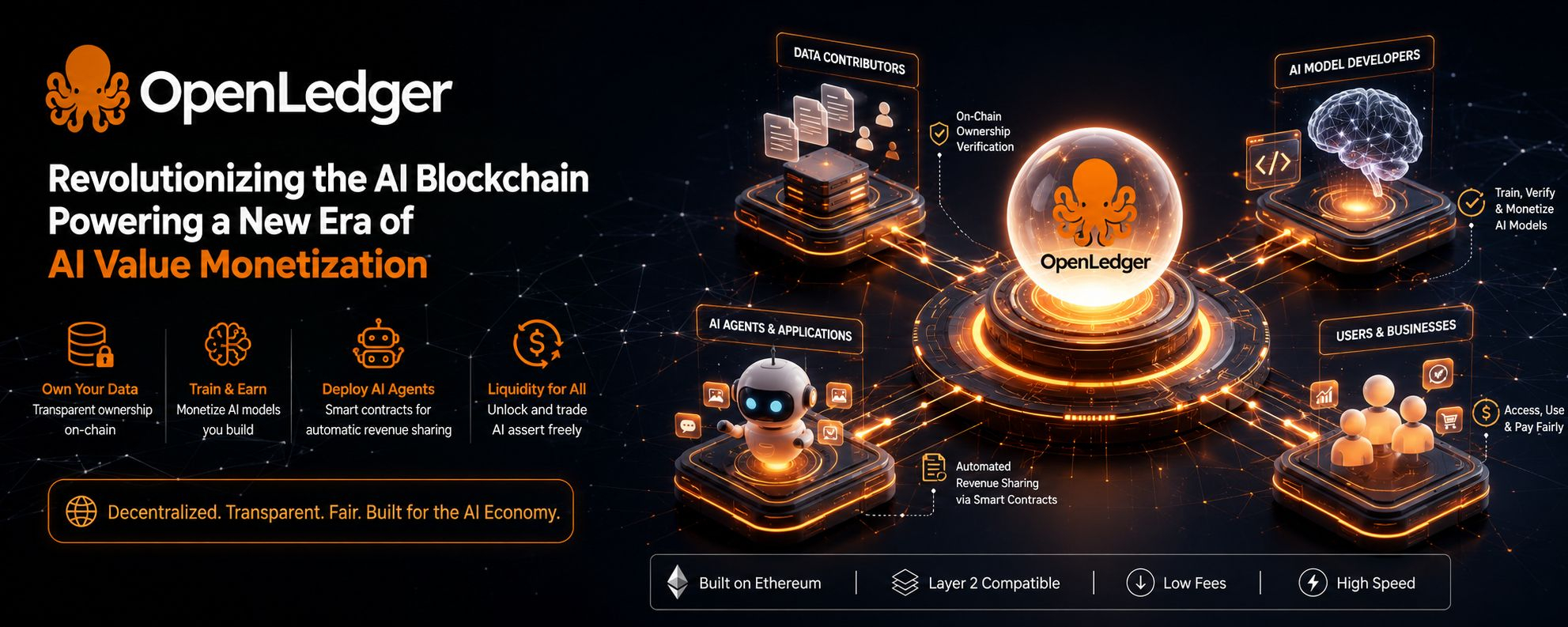
Instead of treating blockchain as a secondary storage layer attached to AI applications, OpenLedger integrates AI operations directly into blockchain architecture itself. Data contribution, model training participation, intelligent agent deployment, and transaction settlement can all become verifiable on-chain activities. Every interaction inside the ecosystem gains traceability, transparency, and programmable ownership.
That changes the economic structure of AI entirely.
In traditional AI systems, valuable datasets are often collected from users with little visibility into how that data is monetized. Model creators frequently depend on centralized platforms for distribution. Smaller developers struggle to compete because infrastructure access is concentrated among large entities with massive computational and financial advantages.
OpenLedger introduces a different direction — one where AI assets themselves become part of a decentralized value network.
Data providers can potentially monetize contributions directly. Developers may gain transparent access to model distribution mechanisms. Intelligent agents can operate with automated on-chain revenue-sharing systems through smart contracts. Instead of value extraction flowing upward toward centralized intermediaries, the ecosystem attempts to distribute value across participants according to contribution and utility.
That idea matters more than many people realize.
Because the future AI economy may not be won solely by the company with the smartest model. It may be won by whoever controls the coordination layer behind intelligence itself.
And coordination layers are historically powerful.
The internet was not dominated only by websites. It was dominated by infrastructure protocols. Financial markets were not transformed only by trading firms, but by settlement networks and liquidity rails. In the same way, decentralized AI may eventually depend less on isolated applications and more on the systems that manage data ownership, access rights, participation incentives, and interoperability between agents, developers, and users.
This is where OpenLedger’s architecture becomes strategically relevant.
Another important aspect is liquidity creation around AI assets.
Most people underestimate how fragmented the AI economy currently is. Millions of users generate valuable behavioral data every day. Independent developers build niche models with real utility. Small communities create datasets tailored to specific industries or languages. Yet most of these assets remain economically illiquid because there is no efficient marketplace structure allowing transparent exchange and monetization.
OpenLedger attempts to unlock that dormant value.
Within such a framework, datasets are not merely passive information. Models are not isolated software products. Intelligent agents are not temporary applications. They become digital economic units capable of being traded, integrated, licensed, or monetized across decentralized ecosystems.
That transition could fundamentally expand the scale of the AI economy.
What makes this especially important is timing.
AI adoption globally is accelerating at an unprecedented pace. Businesses are integrating automation into operations. Consumers increasingly interact with intelligent systems daily. Governments and enterprises are investing heavily into machine learning infrastructure. As AI expands, demand for trustworthy and scalable data coordination systems will likely expand alongside it.
Centralized systems can scale rapidly, but they also create concentration risks.
OpenLedger appears to be exploring an alternative model where participation itself becomes economically aligned. Contributors are not merely users feeding a closed ecosystem. They become active participants inside an open economic network.
That distinction could become increasingly important over time.
Another reason OpenLedger stands out is that it aligns closely with Ethereum ecosystem standards. Compatibility is often underestimated in infrastructure projects, but frictionless integration frequently determines whether ecosystems grow or stagnate. Developers typically avoid systems requiring entirely new tooling, isolated wallet structures, or unfamiliar frameworks.
By remaining compatible with Ethereum infrastructure and Layer 2 environments, OpenLedger lowers adoption barriers significantly. Developers can integrate existing tools. Users can interact through familiar wallet systems. Applications can potentially scale using lower-cost execution layers without sacrificing accessibility.
This creates a smoother path toward ecosystem participation.
And in technology markets, reducing friction is often one of the strongest growth catalysts.
Still, none of this guarantees success.
The decentralized AI sector is becoming extremely crowded. Nearly every new project now claims to be building “AI infrastructure,” “AI coordination,” or “decentralized intelligence.” Most of these narratives will eventually disappear because building sustainable network utility is much harder than generating short-term attention.
Execution remains everything.
OpenLedger still needs to prove long-term adoption, meaningful ecosystem activity, and genuine utility beyond speculative market cycles. Sustainable participation incentives must exist not only during bullish momentum, but during quieter periods when hype fades and only real utility remains.
That challenge is enormous.
Infrastructure projects often develop slower because their value is not immediately visible to retail markets. Consumer-facing applications can create excitement quickly. Backend coordination systems usually require time before their importance becomes obvious. But once infrastructure becomes deeply integrated into an ecosystem, its strategic value can increase dramatically.
Crypto history repeatedly shows this pattern.
The market often underestimates foundational layers during early development phases because architecture is less emotionally exciting than speculation. Yet over longer cycles, protocols enabling coordination, settlement, and liquidity frequently become the systems entire ecosystems rely upon.
OpenLedger may be positioning itself within that category.
The most important shift may ultimately be philosophical rather than technical.
Artificial intelligence is gradually evolving from a standalone software tool into a global economic layer. As that transformation accelerates, questions around ownership, participation, monetization, and governance become unavoidable. Who owns intelligence? Who benefits from the data economy? Who captures the value generated by autonomous systems?
Centralized corporations already have one answer.
Decentralized infrastructure projects like OpenLedger are attempting to build another.
Whether OpenLedger ultimately succeeds or not, the direction it represents feels increasingly aligned with where the broader AI economy may eventually move. The future of AI may not belong only to the smartest models. It may belong to the systems that coordinate intelligence fairly, transparently, and at scale.
And by the time the broader market fully understands where that value capture sits, the infrastructure behind decentralized AI could already be far more important than most people expected.
