
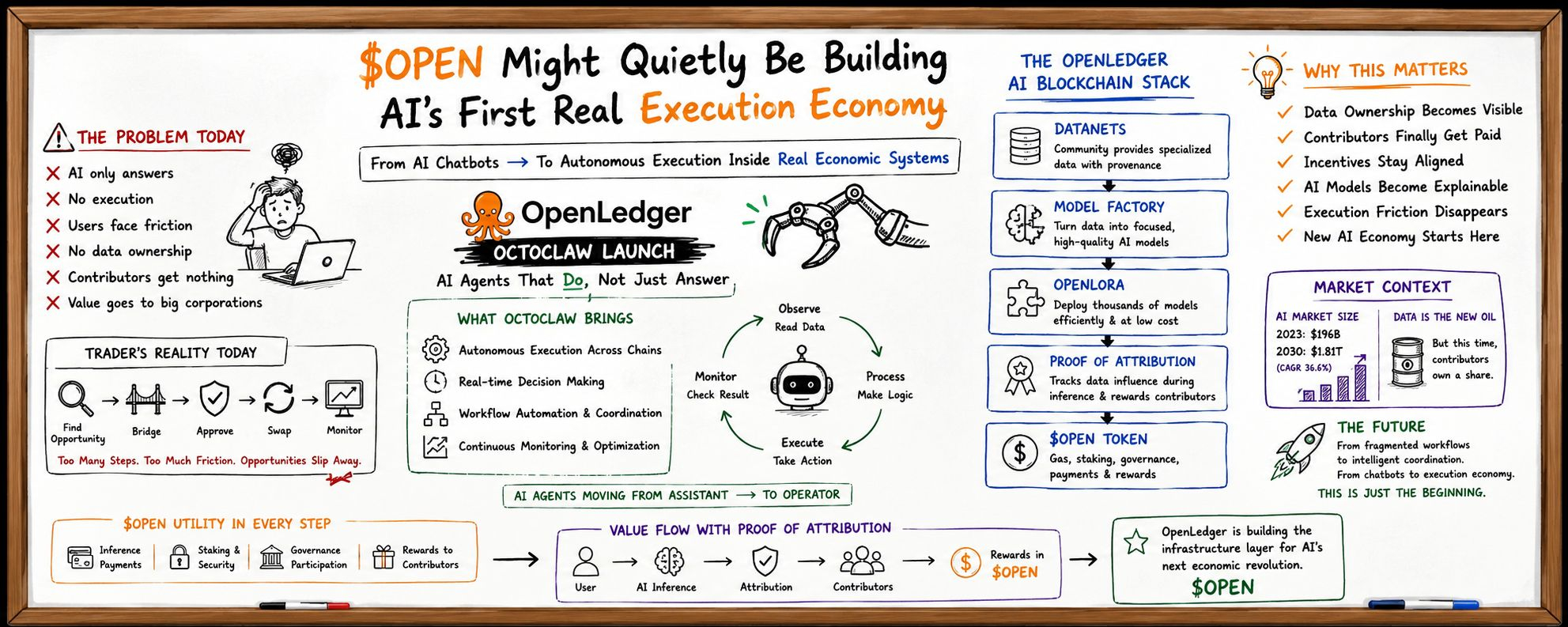
A few months ago I thought most AI crypto projects were basically chasing the same thing.
Better chatbots. Better interfaces. Faster responses. Bigger hype cycles.
But after spending more time looking into OctoClaw and the broader @OpenLedger ecosystem, I started feeling like the real story is happening somewhere deeper than the UI layer people keep focusing on.
What caught my attention was not the chatbot experience.
It was the idea of AI moving from “answering prompts” to actually participating inside economic systems.
That changes the conversation completely.
Most AI tools today still behave like assistants standing outside the system. They give suggestions, summaries, maybe signals. But the user still carries all the friction after that. Open tabs. Bridges. Wallet approvals. Execution timing. Monitoring positions. Switching chains.
The intelligence stops where the workflow actually begins.
OctoClaw feels different because it looks designed around execution flow instead of pure conversation flow.
And honestly, crypto desperately needs that.
Right now markets move too fast for fragmented workflows.One delay during bridging or routing and the opportunity disappears. Most traders already understand this pain without even realizing it’s an infrastructure problem.
That’s why I think $OPEN approaching AI through coordination instead of only intelligence could become important later.
The deeper I read the whitepaper, the more the whole system started making sense together.
Datanets collect specialized community data.
Model Factory turns that data into focused AI systems.
OpenLoRA reduces deployment friction for thousands of models.
Proof of Attribution tracks which data actually influenced inference.
Then Open becomes the settlement layer connecting usage, incentives, governance, and contributor rewards together.
That structure feels much more complete than most AI narratives in crypto right now.
A lot of projects talk about AI replacing humans.
OpenLedger feels more focused on making contribution visible instead.
And I think people are underestimating how important that becomes once AI economies scale.
The internet created massive platforms from user-generated content.
AI might create massive economies from user-generated intelligence.
Those are not the same thing.
The interesting part is that OpenLedger is not trying to force decentralization just for marketing.The system design actually needs transparent attribution because AI contribution without ownership eventually breaks incentive alignment.
If contributors never receive value, specialized data quality eventually declines.
That’s probably why Proof of Attribution feels like the real core product to me, not only OctoClaw itself.
Of course there are still risks.
Autonomous agents operating onchain introduce security pressure, verification costs, and execution complexity. One bad workflow can create cascading problems very quickly.
But at least OpenLedger seems aware of that problem already through attribution tracking, verifiable execution, and onchain registries.
That gives me more confidence than projects pretending AI agents are magically risk-free.
What I keep coming back to though is timing.
The market still mostly treats AI tokens like temporary narratives.
Meanwhile OpenLedger is quietly building infrastructure around ownership, coordination, and AI value distribution while most people are distracted chasing short-term volatility.
Sometimes the biggest shifts start exactly like that.